Winning an Award – news


EbcDOx7XgAAXf_t

I am delighted to share with you the wonderful news: I am one of five poets who have received a Northern Writers Award 2020 from New Writing North. The poetry entries were judged by Vahni Capildeo. They were said to be ‘highly impressed’.

New Writing North is a development agency that supports reading and writing in the North of England. It was established in 1996 to commission new work, create development opportunities, nurture talent, and make connections. Since 2000 NWN has also run the annual Northern Writers Awards. Funding for these awards comes from different sources, such as the Arts Council, TV’s Channel 4.

This year more than £45,000 was given to 26 winners from a record-breaking 1,800 entrants. I sent off my submission of 29 pages at the end of December. With everything that happened this year I had completely forgotten about it. I am going to spend the award money on getting a mentor as this current project is well outside my comfort zone.

The short poem below is the current title poem.


Remembering

Remembering is like hay-fever:
there before you know it.
Other people unaffected and smiling.

Remembering is a disease
with a double-barreled name
like Schadenfreude-Unheimlich,
and the GP whom you’ve waited

to see for at least a week
looks through you and says
she’s never heard of it.

It’s being back in a classroom,
you can’t read the blackboard sums
and the teacher is pointing at you.

Father’s Day


40th Wedding Anniversary
The picture shows me and my parents at a dinner to celebrate their 40th wedding anniversary in 1984. At Christmas 1988 I became the scapegoat for the difficult circumstances around my sister leaving her husband. My father, my brother and that husband were all called Theo. My sister was living with someone else by then.

So, one Theo told me off for keeping in touch with that Theo and the third Theo collected me from my parents’ flat and took me to the airport. My father and I became estranged. Late September 1990 my father was taken to hospital after a suspected heart attack. He was doing okay, my brother told me, no need to rush and book a flight. Two days later my father died in hospital, instantly, after a large heart attack.


Almuerzo con mi padre

My father’s eyes behind the spectacles sparkle.
There’s wisdom in his moustache,
and dreams of fino sherry, chilled in a thin glass.

There would be time to wait and wander,
criss-cross a square, look at people,
the statue of a famous general on his horse.

The dead will be around us on the hills that hold the city.
My father claps his hands, decides where we will eat.

He’s learned his Spanish from reel-to-reel Linguaphone.
I’m online with Duolingo: Vino tinto, pan, conejo.

My father would have found it hard to choose
between the crema catalana and helada.
His moustache would have selected ice cream.

The Old Olive Press


rear view

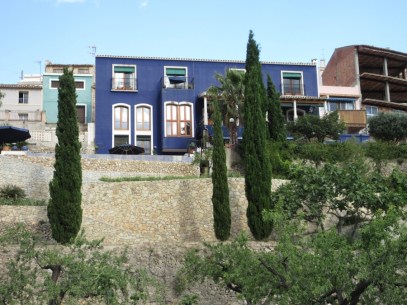
The Old Olive Press, view from the terraces at the rear

June was when I would visit the wonderful Almassera Vella (Old Olive Press) in Relleu, Spain. I have been on several one-week workshops with the incomparable Ann Sansom of the Poetry Business. Other poets from whom I learned a great deal were Mimi Khalvati and the late Matthew Sweeney.

Christopher North, himself a published poet, and his wife Marisa took two years to convert the old olive press into a stunning home. As you can see, they kept the actual press. Relleu is a one-hour drive from Alicante airport and about half an hour from Villajoyosa on the coast.


olive press 2

The olive press


Nowadays, Christopher and Marisa organise cookery workshops. You can also book B&B accommodation and the flat over the road is still available as retreat accommodation for writers.

The poem June rain is from my first collection Another life  published by Oversteps Books Ltd (2016).
June rain
for Cristopher and Marisa

It’s June and the rain is falling.
It is cooler and darker now.
It’s the rain we prayed for last night,
though we’d not meant to do such a thing.

The old women, eight or nine, spread
across benches outside the church.
Us along the tables, a line of snails,
sloping down towards the blue house.

It was speaking of Sundays now filled
with shopping and the silence
that binds Quakers together.

And it’s in silence we, snails,
all of us with our whorled shells
of stories, sit at the breakfast table.

The cheep-cheep-cheep of birds
after the rain is flowing into the room
and a fresh breeze that tells of new stories.

Strawberries – poem


strawberries-1452717_1280

Photo credit: congerdesign on Pixabay

The first June weekend here in Holland is wet and windy: a perfect time to remember strawberries. My local supermarket has them on special offer this week, along with discounts on raspberries and watermelon.

During my childhood I lived in a small town further north, a couple of miles from the beach, and also close to the chimneys of the steelworks. Walking home from school my friend Nellie I and would take the long route, along the small harbour. We would pass the rear entrance to the covered market. I have a vivid image of a line of small horse-drawn carts, loaded with punnets, punnets full of strawberries …

The poem is from my second collection Nothing serious, nothing dangerous (Indigo Dreams Publishing Ltd, 2019).

 
Strawberries

The strawberries of my childhood
were like my favourite grandmother,
soft, a rosy smell, a taste that stayed
with you on the way to school.
Those strawberries were red,
not like the winter swedes
which are a red stone,
are purple with anger.

Strawberries entered our home
first in paper bags, then as June grew
in oblong wicker punnets. Then we ate
them for breakfast and for lunch, pressing
them with a fork on sliced white bread.
You could stroke the strawberries
of my childhood. They were company,
like cats, purring gently even when asleep.
Small green stalks their whiskers, and warm.

Missing Manchester …

Manchester_Art_Gallery_-_geograph.org.uk_-_1748756

I am settled in my caravan in Holland, enjoying the warm weather and making the most of the peaceful environment before the camp site opens 1 July when it will be the high season.

 
But I am missing Manchester and, in particular, the monthly writing workshops with Peter Sansom of the Poetry Business These have been held at Manchester Art Gallery. It consists of three connected buildings, two of which were designed by Sir Charles Barry. The main building is Grade 1 listed, while the Atheneum is Grade II. A modern extension was added in the beginning of this century.

 
During the writing workshops we have the opportunity to be inspired by the permanent collection – works of international significance and Victorian art. The painting Albert Square (1910) by the French impressionist painter Adolphe Valette hangs in a central foyer. Valette lived in Manchester for a period and really caught the damp and wet conditions. My poem is included in the pamphlet A Stolen Hour (Grey Hen Press, 2020,


Albert_Square_Manchester_1910,_Valette


Albert Square

I am not that cellar man pushing 

his barrow loaded with crates of wine.
I am not the horse with its head
stuck into a nose bag, nor
the coach driver resting his
right knee on the plate,
nor the men with bowler hats
conversing by the railings.

Up there is the Town Hall
covered in a velvet coat of soot.
I am the greyness of the oil paint,
the rippled rain reflecting
the cellar man’s rounded boots.
I am the smog and the smoke,
half shielding these statues:
politician, mayor, consort.

Palmistry in Karachi – guest poet


Elsa F

Imagine my surprise and delight when, in January this year, I received an email in Dutch from a fellow poet! Elsa Fisher had read and liked some of my poems. We started a correspondence and were going to meet at the end of May. It’s a great pleasure to introduce this month’s poet who has ‘a clear eye and an ironic ear’.

Elsa Fischer was born in The Hague, Holland. She has lived and worked on four continents and, later in life, studied Art History in Canada and at the Sorbonne. Always a lover of poetry, she joined a poetry workshop after her retirement.

She has two published pamphlets: Palmistry in Karachi (Templar Poetry, 2016) and
Hourglass – Poems from the retirement home (Grey Hen Press, 2018). Other poems have been included in a range of magazines and anthologies. She is currently preparing for a third publication.

Elsa lives in Bern, Switzerland, in a lovely retirement home (where some of her poems are set). She likes to point out that she does not belong to the Woopies (well-off older persons) but rather to the Yelpies (youthful energetic elderly persons)….

I hope you enjoy the range of these poems, with their sharp observation, humour, empathy and poignancy.

 
Palmistry in Karachi

“…the old days when we were still young,
naïve, hot-headed, silly, green. A little bit’s
still there…”              Wislawa Szymborska

 
At twenty I danced the tango
in Karachi at the saried begums’
Red Crescent Bazaar with a gay
attaché who had that rhythm in
his blood and where a sketch
of my profile by a local genius
fetched handfuls of rupees.
I shook hands with Ayub Khan
and Fatima Jinnah, ignorant
of who they were and that
he would have her killed.
There was my near-drowning
in the Arabian Sea and a wicked
camel race along its shore.
And I’ll tell you this: I lost
my innocence in Karachi.
To an Italian born without
toenails and his palms
with no lines so that you,
my friend of little faith, claim
he could not have existed
and that I’ve made it all up.


Seedpods

 
I love how your wisteria seedpods exploded in the night,

love to hear drops falling from where someone waters geraniums

early in the morning as I am writing at the wrought-iron table,

its rusty flakes cutting into skin and I remember how, in another life,

they caught my mother’s dress as she sat down to tea under

the glycine, my first French word, and for a startling moment

I hold this image called up by smells of soil and fleshy leaves,

by all this art nouveau abundance.


In the beginning are my hands
after Andy Goldsworthy

 
they are my skin-cut tools
cracked as dried earth.
I trust them, they lead me.

I listen to the passive witness
of stones, their dialogue with trees,
learn how they rely on each other.
I need the energy of peat – the melt of mud
and mineral feed and sheep’s piss on canvas.
Above all I love my icicles – reconstructed,
glued with my spit or draped like lobster
claws and oysters on a plate of river ice.

I square black-rooted bracken stalks
thorn-pin chestnut leaves into floating
snake ribbons until surfaces open up
and nature itself becomes the object found.

I go into its internal spaces, lie spread-eagled,
feeling the pull, feeling the rain.


Safe

Like ducks waiting for the cull
we line up at the doctor’s,
baring arms for the flu jab.

Once you stood like this, in an orderly row,
mouth wide open to receive the sugar lump
that the school nurse had carefully dosed
with the life-saving drops of Dr Salk’s vaccine.

To be protected from the fate of that boy,
fitted with braces, who sat for years reading
as we messed around with bats and balls in PE.

A nurse helps with the sleeves
and we return to our coops.
Safe for another season.


Trespassing

I’m digging out my winter things.
And watch from behind the slats
how he opens a wardrobe, takes out
the bridal gown for her to hold,
then gently crowns her with a garland.

On a small table lie the bric-a-brac
of a long marriage. Masai beadwork,
a glass paperweight from Venice,
the matryoshkas.

He gives her a moment,
then puts the gown carefully back
on the coat hanger, smiles as he lifts
the garland with its faded ribbons
from her hair. A whiff of Chanel.

He makes sure she’s comfortable
on the walker and wheels her away,
switching off the cellar lights.

I stand for a while, getting used
to the dark, arms heavy
with scarves and shoes.

Music – poem

Schimmel sideways


Looking in the Cloud for a picture of a frog I came across a photo of my piano: a white horse (Schimmel). My friend Marianne who left me the old caravan had a digital piano here. I took that across to the UK and started having lessons with John who came to the house.

The next year (2009) I even took the Grade 1 examination. Turned up at the venue to find bemused children staring at me. I passed, just short of a Distinction. As a reward, I got  a proper acoustic piano. Found this lovely Schimmel with a warm European sound.

Horror! One day I lifted the lid to see a moth appear from between two white keys. Yes, a proper infestation. Fortunately, the wonderfully eccentric tuner, also called John, managed to take the piano apart and deal with that. I continued with lessons. But I was too anxious to go for the Grade 2 or Grade 3. When I moved into the flat, so did the piano. On its side, still a mellow sound. I sold it a couple of years ago. It went to a good home …

The poem Music is from my second collection Nothing serious, nothing dangerous, published by Indigo Dreams Publishing (2019).

 
Music

There was always music going on in our house,
live music, piano and song. The organ was
down the road, past the Catholics’ houses.
We were Protestant then, some of us, anyway.

There was always music in our house.
Bach on a black piano and Brahms
Mein Mädel hat einen Rosenmund.
My mother, the diva, practising before
her weekly lesson with the best alto
in Holland, who kept a pet monkey.
My father, with his piano hands,
shaking his vigorous black hair.

In our house there was always music.
More often than not it would be
minor chords, discordance, long
silence above the empty bar lines.

Moment – poem


Clingendael 2

Photo credit: Ted Koehler

The warm, sunny weather this week has helped me to stay more in the present. I’ve been for walks in the nearby estate of Clingendael.

Clingendael estate has a 17th Century manor house which is home to the Dutch Institute for International Relations. Since the 16th Century the gardens have been remodelled, from the original French design, to the popular English landscape style. Now you can find a rose garden, splendid azaleas and rhododendrons, and a walled fruit garden. There are some marked walks, cycling paths, and canoeists and rowers can travel through by water.

However, Clingendael is most famous for its Japanese garden. It is the only Japanese garden from around 1910 and is, therefore, of great historical importance and a state monument. Marguerite M, Baroness van Brienen made several trips to Japan by ship to purchase the lanterns, statues, bridges and the wooden pavilion. Because of its fragility, the Japanese garden is only open eight weeks of the year, from mid-May to early July. Because of the Corona-crisis, it is closed. Here you can view a short video clip that The Hague city council put on their website.

Clingendael 3

Photo credit: Ted Koehler


My poem Moment from my second collection Nothing serious, nothing dangerous was inspired by a poem with the title This Moment by the Irish poet Eavan Boland who died recently, aged 75, after a stroke. Her poem, with its short, choppy lines starts A neighbourhood/At dusk and is an excellent example of how a short poem can give us a snapshot of time, the night and temporality. You can read the original poem here. It is deceptively simple, but Boland uses several poetic techniques to achieve the effect, such as alliteration and repetition.

 
Moment

A suburb at dawn

People are turning back
from dreams
into their own lives

Frost and spiders,
shrubs cradle themselves.

One side of the road is black.
One row of houses a yellow pink.

A cat wakes up
to the footsteps above,
secure in his oval basket.

Frost fades,
spiders stretch,
ferns unfold in the sun.

Illness – poem

flag-1275831_1280

photo credit: Michael de Groot, Pixabay


I was evacuated within hours of being born: an un-exploded bomb from WW2 had just been found in the hospital grounds. My mother and I were despatched to the nearby town of Haarlem. After a bike ride my father found us there in an old people’s home.

May last year I posted about the small memorial on the Waalsdorpervlakte in the nearby dunes, how the sound of the bells reached me, sitting inside the caravan. You can read more here. This year there will only be one person ringing that large Bourdon bell tomorrow evening, and the wreath-laying ceremony by the monument on the Dam, Amsterdam will also be scaled down.

Liberation Day, the 5th of May, is celebrated on a large scale only every five years. This year, 75 years on, would have been a major event and a Public Holiday. Flags will be flown, for sure.


Moensplein


The poem Illness is from my pamphlet A Stolen Hour which was published in March this year by Grey Hen Press. Because my mother’s father owned an electrical shop, we had a small black-and-white television soon after they became available. You can see the house still has that balcony. I like how in the poem the personal and the public are combined.


Illness

I’m sure it’s May 1956. Grandfather still runs the electrical shop,
but his wife is in hospital. Next month German tourists
will park their cars in resorts on the Dutch coast.
I’m sure I can smell the smoke from the butcher’s next door,
but I’m ill in bed, can only see pink trees above the balcony.

I’m curled up, a sniffy nose and my ears blocked,
but I can’t turn my face away from the place in the dunes,
a pile of boots and shoes. There must have been butterflies.
These twenty men marched out of town, the execution.

I can see myself at the ink-stained desk, a grainy photo.
Then the photo starts moving, shakily, away from the light.
I’m ill again, but not in my bed in my bedroom, because my mother’s
mother is there in her best dress, lying still. Downstairs
the front room curtains have been drawn.

Portrait – poem


Exterior-2
In the pre-pandemic life, I would next Tuesday evening have travelled by train to Stalybridge. Now I am in the Netherlands and will probably eat orange-coloured cakes (left over from King Willem Alexander’s birthday celebrations on Monday).

 
The Poetry Society was founded in 1909 to “promote a more general recognition and appreciation of poetry”. It is now a thriving UK arts organisation with over 4,000 members worldwide. Volunteer members run local branches, called Stanzas. These tend to meet monthly to write and critique members’ poems.

 
The East Manchester & Tameside Stanza meets in the buffet bar on Platform 4 of Stalybridge railway station. The building is one of the very few remaining Victorian station buffet bars. It has the original fittings and fire, and it includes the original 1st class ladies’ waiting room with an ornate ceiling. This award-winning pub is like a museum: lots of photos, railway and other memorabilia.


3.-Interior-portrait-Stalybridge-Station-Buffet-by-Michael-Slaughter-LRPS

 
During feedback sessions, the poem is read twice – by the poet and someone else. The reading may well be interrupted by an announcement We’re sorry that the 19.21 to Manchester Piccadilly has been cancelled…

 
Portrait was published in my second collection Nothing serious, nothing dangerous. It benefited from feedback from the EM&T Stanza regulars. I hope they are all keeping safe and well.


Portrait

When I look down
in the water of our harbour,
quiet, resting between barges,
I hope to find a portrait.

White foam is gloves I dropped long ago,
or my grandmother’s starched lace cap,
metal curled at her temples.

*

When I look down in the black water
I hope to see the fish that has
swallowed my wedding ring,
the ring I lost or threw away.

*

When I hold water in my hands
I have it: a portrait of my forgotten
eyebrows, my fingers a gold frame.