For Easter Sunday I have chosen this poem by my friend Kathleen Kummer. The title is intriguing, the details are precise: we sense they are based on the poet’s own experience. Then there is the reference to that well-known Stanley Spencer painting of the Resurrection. You can see it here. Does it work for you as a prompt?
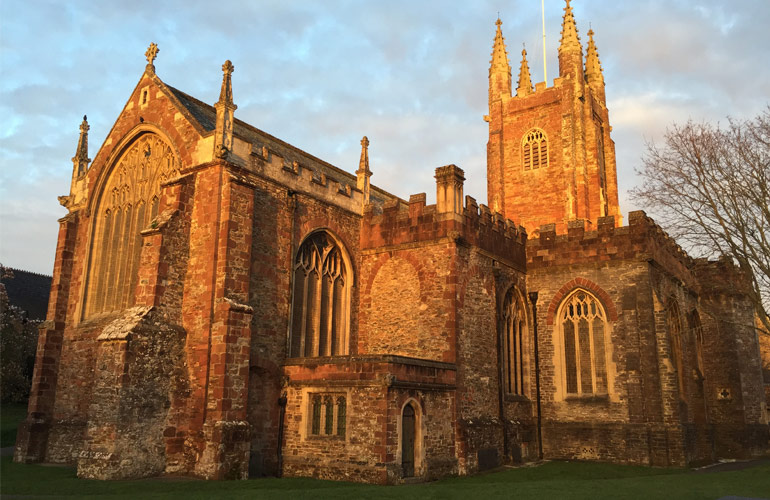
I asked Kathleen about the graveyard. It’s part of St. Mary’s Church, a Grade I listed building in the centre of Totnes, Devon. Perhaps, I could have worked it out for myself: the poem mentions the iconic ‘steep hill’ in Totnes. Kathleen and I have walked up and down it many times, and hope we can do so again soon. Easter Greetings to you all!
Eating a Croissant in a Graveyard
I’m eating a croissant in a graveyard, grassed over. People come here to rest, eat a sandwich. (I wish I’d bought something less flighty, like a scone or an Eccles cake.) The graves are few and not recent. There’s a table-top tomb, ideal for a picnic, but respect is shown: low voices, no chirrup from a mobile phone; people sit on the wall or the grass. I’m expecting that Labrador to cock his leg, but he doesn’t.
Across the street, the bustle of the market just reaches us, and I think of the dead around me, of how this town was theirs, that they walked up the steep hill, stopping to speak to their friends about their simple, complicated lives. When I close my eyes, I see them clambering out of their graves, as in that Resurrection painting by Stanley Spencer, looking dazed, but as if their discomfiture won’t last long, with the green hills they knew around them, the sky blue and summery. And surely the warm-hearted townsfolk will welcome the dead.
It’s as if I’ve banished them by opening my eyes. The place is empty, but for two men in wheelchairs, parked with their backs to the view.
Instructions for painting a bird in six steps
by Fokkina McDonnell
Let your shadow be present. Someone needs to interpret their dreams.
First paint or draw a circle, as many claw prints as your years. Soot is fine. Work clockwise.
Call, chirrup, caw, chirp, chatter – wake your inner aviary.
Black ink is needed and tears. It cannot be rushed.
Use one hand. You may change hands when your fingers are cramped, like a talon.
Hunger. Fatigue. This is their life – hunting on the wing for insects, grub, the odd vole.
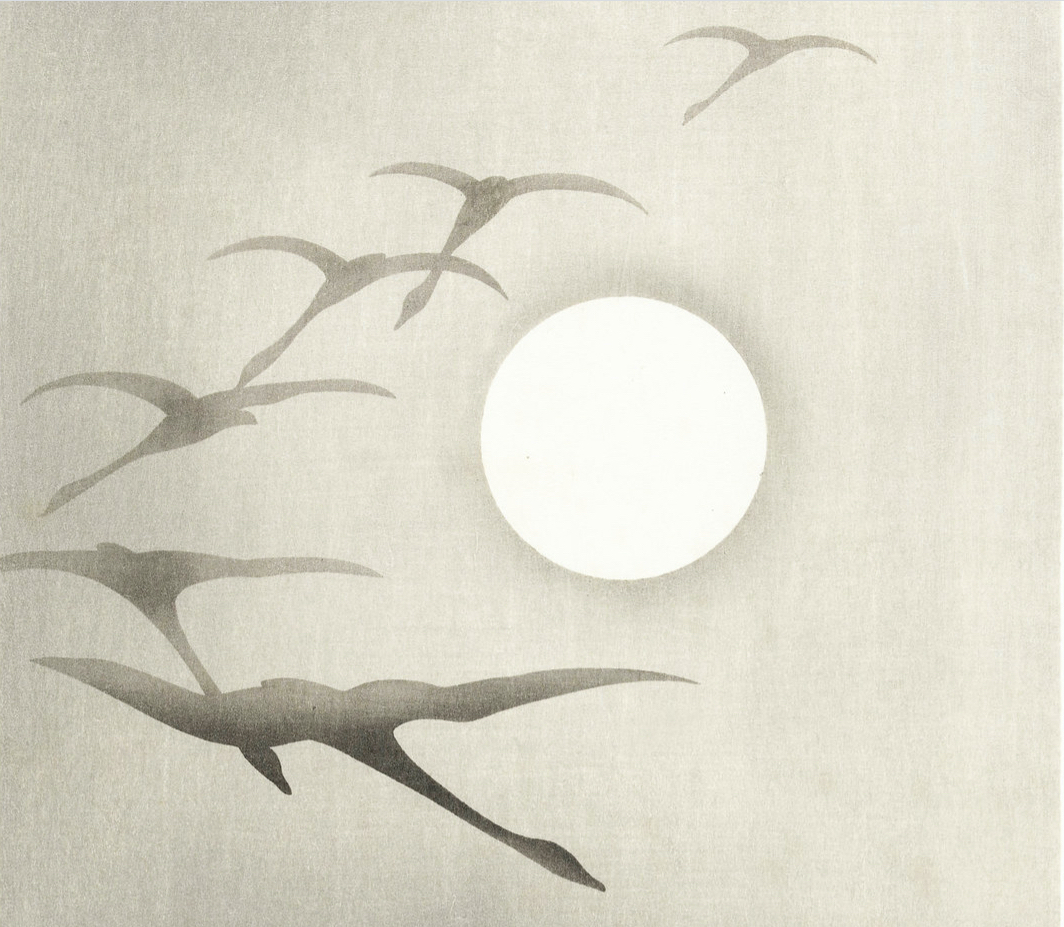
PAINTING:Geese at full moon (detail) by Ohara Koson (1945).
NOTE FROM THE AUTHOR: Doing a writing course The Avian Eye, I’ve become obsessed with birds, researching online: migration, the behaviour of cuckoo, the cleverness of crows.
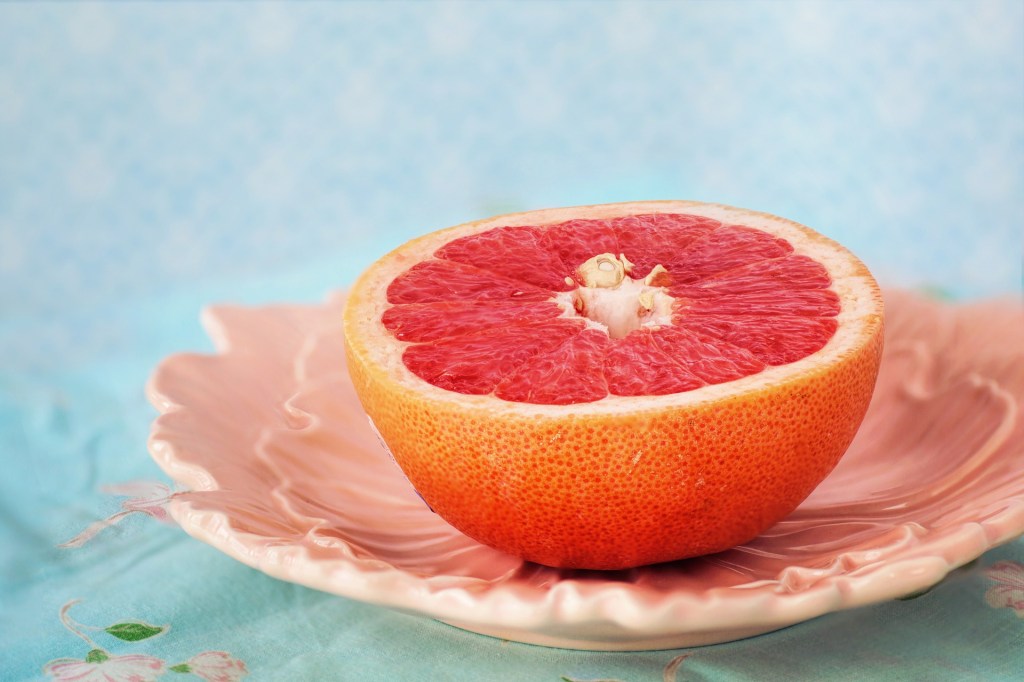
Such a strange fruit: many children don’t like it. I didn’t. Many years later I acquired a curved knife and I found it a tricky and time-consuming job to properly prepare the fruit. Here is Kathleen Kummer’s poem. It doesn’t specify who the people are, but I imagine it’s a mother, watched by children, that “he” is the husband. It’s an understated poem, but those details are precise and poignant.
Preparing grapefruit
Did she peel it – I don’t remember – as though it were an orange? Or cut it in half and make the usual precise incisions, holding back the pith like flaps of skin to extract the pulp?
Our eyes were on her hands as she worked to unravel the strands from each segment of flesh before it tumbled into the bowl. Some fell apart, translucent droplets shaped like tears. How many spoonfuls
would the sick body take of this butterfly food? Would he sleep? I remember the light from the fire, its warmth on our faces, in the drawing room where now the double bed rode at anchor, before the voyage out.
Credit Skitterphoto on Pixabay – Scheveningen Pier
Greetings on World Poetry Day! At the 30th General Conference of UNESCO in Paris, 1999, it was decided to mark 21 March as an annual celebration. Poetry has “the unique ability to capture the creative spirit of the human mind”.
I’ve chosen a poem with international connections, a lot of people, fruit – a festive gathering on a Dutch beach. It’s from my collection Nothing serious, nothing dangerous.
On the beach after My boat by Raymond Carver
Bill’s last words were always Have fun, so I will. He was a very good father, Bill, though he wasn’t my father. Liz will be there too. And Mary and Brian, the Como couple. Seville will be there, all the places I ever fell in love with. We’ll be on a beach, a wide sandy beach with small white shells, large white gulls and far off, in the distance, the red container ships, nothing dangerous, nothing serious.
At the flood line broken razor clams crackle under our feet. There is Dick, almost 80, and Miep, their cycles parked up against the metal wire by the marram grass dotted on the dunes. Esther, Peter, Theo, Ancilla on their e-bikes, they love this beach. Skewered fruit, Water Melon Men and the three Irish men I loved, and the others, the artist with one eye has come back from Hungary. Boats will be there, beached. We’re all beached. My UK friends have come by ship, a ship with starched officers, a ship from Southwold that I specially chartered.
I invited J S Bach, Schubert and anyone else whose names I am forgetting. I have been given dispensation – hey, that sounds medical, nothing dangerous, nothing serious, the friends who are no longer friends, what’s rejection, abandonment among true friends. Apples, oranges, enough grapes to count in the new year, fresh figs, plums, peaches, kiwi fruit for sleep, passion fruit. With all that fruit we are fit to count our blessings, our nine lives. Have fun. The tide’s out, and it is a long time before it’s coming back in.
It’ll be St. Patrick’s Day next Wednesday, so I found you a poem with an Irish theme.
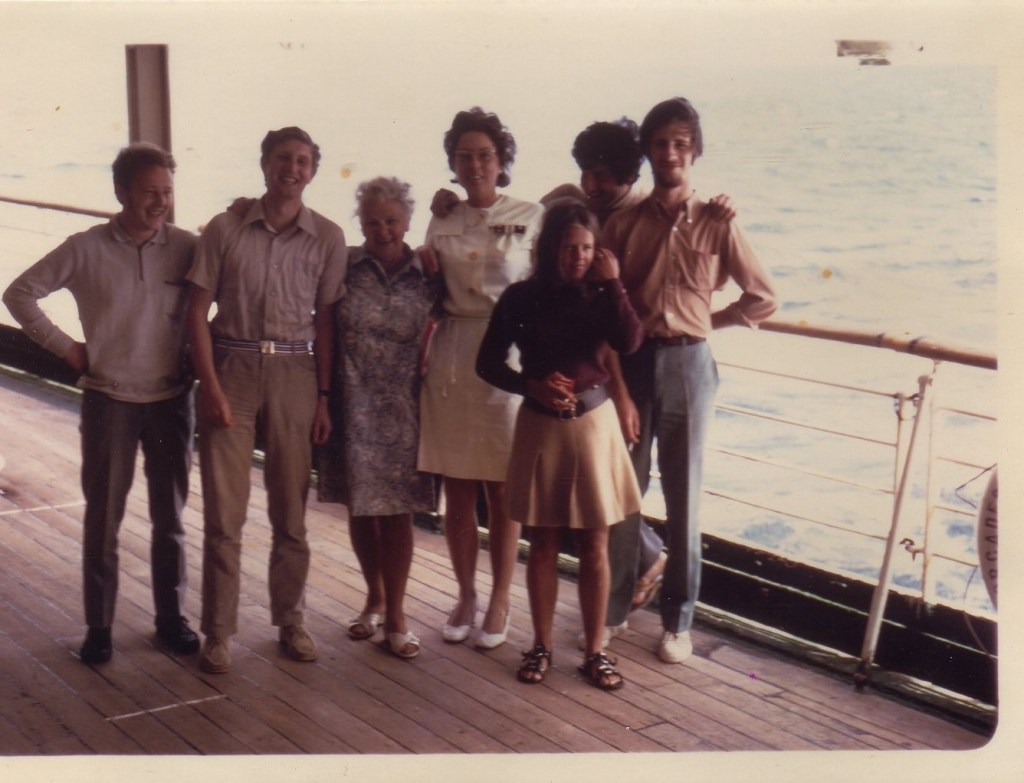
Thousands of Europeans were emigrating to Australia and New Zealand under the ‘Assisted Passage’ scheme. I took my Dutch, English, French and German across the Channel and joined P & O Lines Ltd as a WAP (Woman Assistant Purser) in 1969.
The following year I joined SS Orcades. The ship was due to arrive in Australia in time for older passengers to celebrate Christmas and New Year with family who’d moved there. Because of the large number of Dutch passengers, I held a daily coffee meeting – giving information about ports en route, as well as translating and interpreting.
Each morning, I also met with a small group of German-speaking passengers. On the photo, you can just about see my language badges, attached to my uniform with Velcro!
The poem SS Arcadia, from my second collection Nothing serious, nothing dangerous is about meeting my late husband for the first time. May you be blessed with the luck of the Irish!
Photo Credit: by Taken via PIxabay
SS Arcadia
I was still in my whites, had just rolled down the shutters on shore excursions, orders for birthday cakes, contact lenses lost in the swimming pool.
I was headed down aft, the Tourist Nursery, rehearsals for Hawaiian Night. Oh, I’m going to a hukilau.
It was a moment of whites and early evening sunlight. That Irishman, feet planted wide on shiny boards, who controlled the English bar staff, Goanese stewards.
I already knew that Junior Officers were not supposed to fraternise with Leading Hands.
Can’t you sleep either? After a dark year, many old friends gone, I thought I heard you sing outside the window inches from my ear. Who are you singing for this time of night? Did I dream you?
This is the first stanza of Ruth Padel’s poem Night Singing in a Time of Plague. You can read the full poem on the Poetry Society’s site here. It is a response to John Keats’ poem Ode to a Nightingale. The poem was commissioned as part of the Keats200 bicentenary – a celebration of Keats’ life, works and legacy.
We are close to the first anniversary of the pandemic. The borders of the Netherlands remain closed to visitors from the UK. I have been sleeping less well for weeks now. Here is Kathleen Kummer’s poem, also about the difficulty of finding sleep.
Lying in bed with my life
I am lying in bed with my life. It is one of those sleepless night when I chafe at its bulk alongside me. It will fill the hours with my clan of northerners and sundry others. I shall speak for them all, the living and the dead.
I know the words, which I’m good at repressing when they were my own and unkind. I shout Cut if the scene is unbearable, switch on the lamp to get rid of it, a shame, as I might still have seen my mother’s harebell-blue eyes and the family wearing each other’s hats at a picnic.
The curtain at last turns grey and grainy, and my life rolls up fast with a click inside me. I’m reminded of that when my daughter says I don’t suppose you’ve got a decent tape-measure?
We end the month with a February poem by Kathleen Kummer. I love all the flowers that are included, how the poem touches on that moment of turning. The last two lines carry an extra weight this year.
Another spring
There had been no hint that it was in the air, no question of even imagining a haze of green round the trees. What flowers there were pointed to winter: hellebores, snowdrops, a few crocuses trembling in the grass, and the camellias in bloom, ice-maidens, translucent, quite at home in the cold. It was February. Coming home in the dark, I paused on the step to the garden, held back by the smell of the soil someone had turned in my absence, moist, as if a god were breathing on it to warm the earth. Then I knew for certain that spring was coming, that, deo volente, I’d be there.
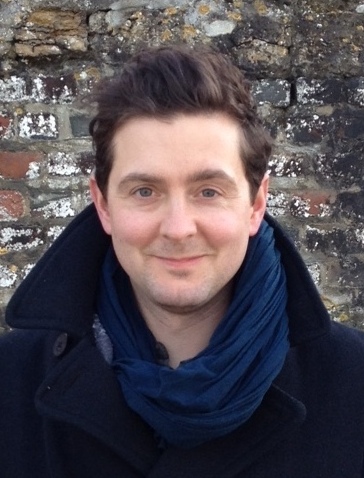
It is a great pleasure introducing this month’s poet. Paul Stephenson and I met eight years ago through the Poetry Business’ Writing School, an eighteen-month programme.
Paul was born and grew up in Cambridge. He studied modern languages and linguistics then European Studies. He spent several years living between London and France, Spain, and the Netherlands. He currently lives between Cambridge and Brussels.
Paul was selected for the Arvon/Jerwood mentoring scheme and the Aldeburgh Eight. He has been co-curator of the Poetry in Aldeburgh poetry festival since 2018.
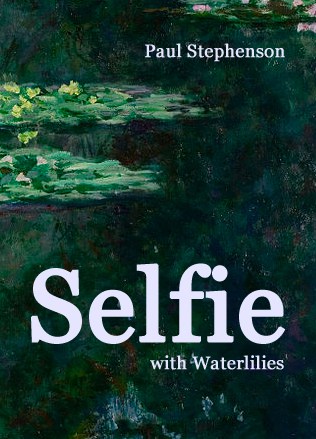
His first pamphlet Those People (Smith/Doorstop, 2015) was a winner in the Poetry Business Book and Pamphlet Competition, judged by Billy Collins. His second pamphlet The Days that Followed Paris (HappenStance, 2016) was written in the wake of the November 2015 terrorist attacks. His book Selfie with Waterlilies was published by Paper Swans Press after winning their 2017 Poetry Pamphlet Prize. Read more at: http://www.paulstep.com
I have selected two poems from Those People. The poems Turkish Delight and The Rub open the pamphlet Selfie with Waterlilies. Here is Paul’s keen eye for the details that matter, his playful language adding an extra dimension to the subject of loss.
Capacity
Seventy litres: in theory more than plenty for three t-shirts, two shorts, the pair of jeans you’re wearing. Then the question of the tent,
saucepan, small canister of gas, map and bible of Thomas Cook timetables – every single train possibility from here to Ankara. One crisp fifty
thousand lira note, a handful of Swiss francs and wad of American Express traveller’s cheques. Foreign currency kept flat, zipped inside a canvas
wallet with Velcro strap, wrapped tight around the waist. Typical Monday. Your father at work. Your mother out somewhere. Your lift here soon.
Passwords
I avoid the house I grew up in, keep away from my mother
and father’s birthdays: calendar opposites, June and January.
I steer clear of my brother’s crash, rule out the hot summer
I left school, graduated, went off. I adopt different characters,
mix upper and lower case. I do my utmost to never
choose when I was born. Mine take years to crack.
Paper Swans Press
Turkish Delight
What you do when you get the call is take it, hear words at dawn before they’re mouthed: You should probably come now.
What you do is shower and dress, skip yoghurt and honey, the baklava breakfast, and walk briskly to the ticket office, hand over your sob story.
Once given a seat today (not tomorrow because tomorrow is too late), what you do is pack, sit on a shell-shocked suitcase poring over a tourist map
mentally-cataloguing Byzantine cathedrals then mosques, till a twelve-seater van for one pulls up to taxi you with stop-starts across the Bosphorous
into Asia. What you do to kill an afternoon on a new continent at the international airport hub is browse briefs and socks, visit the James Joyce Irish pub,
mill about getting sprayed with testers of musk, citrus, bergamot, think nothing of spending sixty three euros and seventy four cents on different nut varieties of
Turkish Delight (which is heavy and must be carried), remember nobody likes Turkish Delight – except him. What you do till they display your gate is stare out
as dusk descends, count the seconds between runway ascents, promise you’ll return one day to be consumed by the vastness of the Hagia Sophia.
The Rub
Menthol my father, menthol his room, menthol his bed.
My out of sight father, my fast relief father, my warming father.
My dual action father, my targeted father, my daily father.
My caution father, my blood flow father, my enclosed father,
Menthol my father, menthol his back, menthol his beard.
My turpentine father, my paraffin father, my eucalyptus father.
My muscular father, my thin layer father, my recommended father.
My wool fat father, my liquid father, my expiry father.
Valentine’s Day: a love poem by my friend Kathleen Kummer. She lived and worked in the Netherlands when married to a Dutchman. Poems from her debut collection Living below sea level featured here on 25 June 2018. To celebrate our 20-year friendship, I will be posting more of Kathleen’s unpublished work over the next few months.
Credit: Leo65, via PIxabay
Hiding Place
Like a holy relic rarely exposed, they lie in a drawer, not handled, let alone read, for half a century, their violet ink on airmail paper, your, my, dried blood on a membrane which is beginning to flake. If touched, it would instantly turn to dust. If read, the dried blood would flow again and burn.
The drawer is hard to close: coarse strands of pain, regret and grief obstruct it. I am able to ease it with the memory of lying with you by the sea, unseen by those who walked through the marram grass, throwing up little showers of sand on us. Nothing has been as soft, as caressing as the sand dunes that summer.
On a writing workshop last weekend, I introduced Vasco Popa’s The Golden Apple: a round of stories, songs, spells, proverbs & riddles. I have been using some of the riddles and proverbs as writing prompts.
Vasco Popa (1922-1991) was Serbia’s greatest modern poet. Ted Hughes was an admirer of his work and wrote the introduction to his Collected Poems. Popa collected folk tales from many sources. He found a rich inspiration for his own poems in this “eternally living wellspring of folk poetry” which he combined with vivid imagery and a touch of the surreal.
Here are two riddles from The Golden Apple. The answers are at the end of the blog.
With an iron key I open a green fortress And drive out the black cattle
A horse with its pack goes into a house and comes out of it, but its tail never goes in.
Vasco Popa
Popa’s Collected Poems inspired my poem Fairy tale. It was first published in erbacce and then in my debut collection Another life (Oversteps Books Ltd, 2016).
Fairy tale
Someone needs to go to a deep cupboard in a dark room the others wait outside
The first one becomes a grandmother with a stoop then someone else steals her white lace cap her smile her soft voice they go to lie still in a deep dark bed in a cold room
Then someone else walks a long way through the wood, across the saddled serpent under a cold sheet of dark clouds
That someone is dressed in crimson already – it will save time the old one will rescue the red girl but they will not have enough bricks to finish the job
after that someone else will get to be hungry and someone will always be eaten



 Instructions for painting a bird in six steps
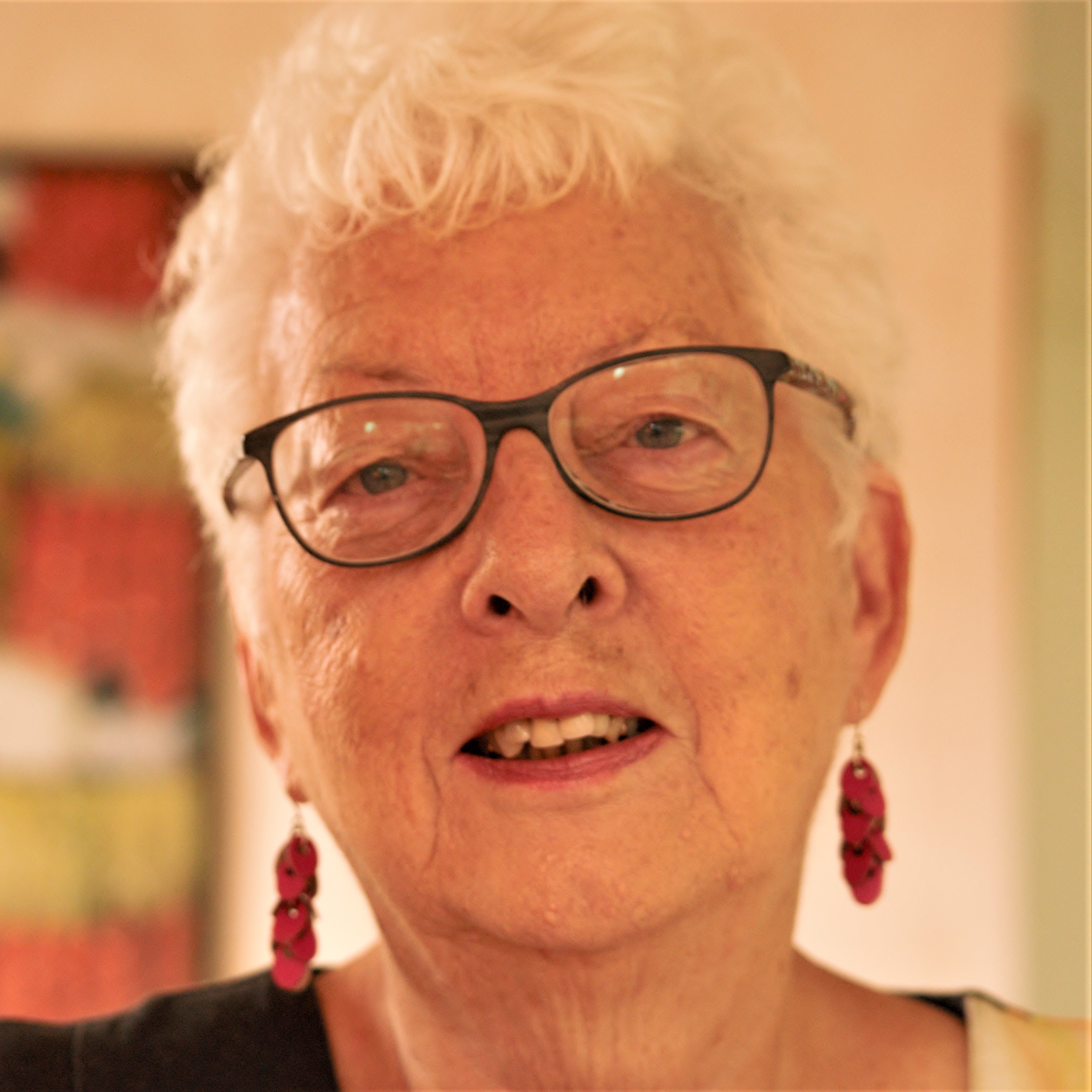 ABOUT THE AUTHOR: Dutch-born Fokkina McDonnell has two poetry collections (