Monthly Archives: June 2023

Photograph with a Very Small Moon

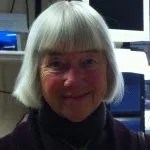
A year ago this month, Gina Wilson died. The two of us met just over a decade ago on the Writing School run by Ann and Peter Sansom of The Poetry Business. We were both psychotherapists, working in private practice.

Gina was published first as a children’s writer – novels (Faber), poetry (Cape), picture books (Walker Books). Her adult poems are ‘complex, though deceptively simple’ and ‘tough and compelling, no verbiage, no sentimentality’ (Kate Clanchy).


Gina’s poems ‘lure you into thinking you’re on safe, possibly domestic territory. Then they catch you unawares, taking off at an unexpected, often surreal tangent.’


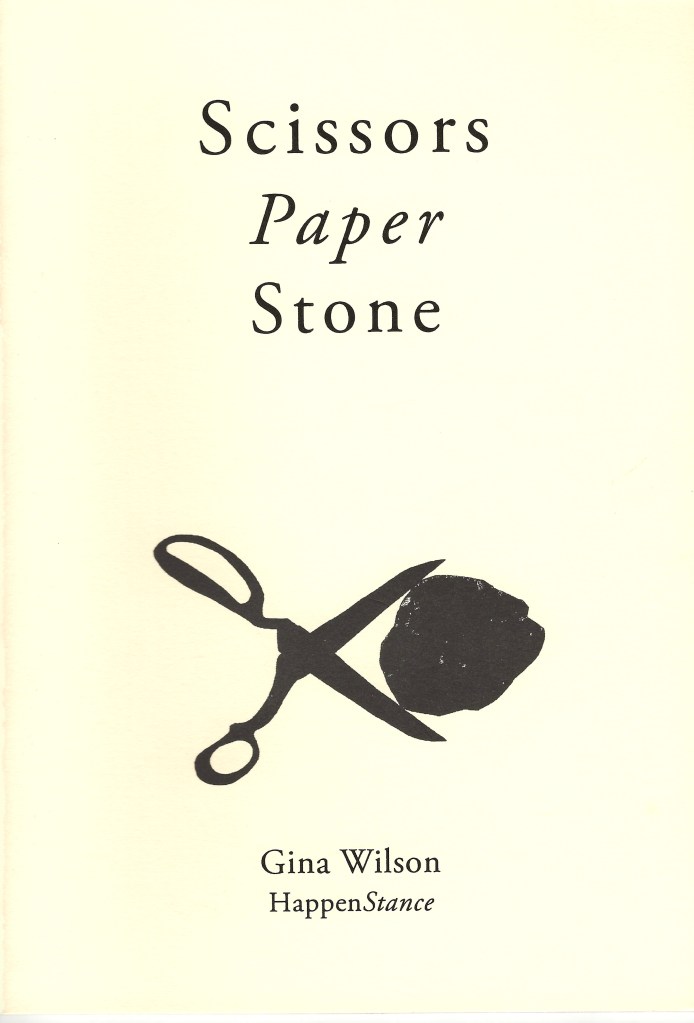
I am grateful to her family for permission to share three poems from Gina’s poetry pamphlets (Scissors Paper Stone, HappenStance, 2010; It Was And It Wasn’t, Mariscat Press, 2017.

First Shoes

I must label, swaddle, cradle them
at just the right temperature.
Their linings are cracking already.

The step of childhood ought to be
weightless, all skipping and dancing
but they look haggard, misshapen

as if old age has worn them.
Polish can’t cover their knocks.

I showed them once at a meeting.
Bring something you’ve kept we were told,
a sign, maybe something you’ve made.

I took the shoes. Nobody spoke.
Because of the way you looked someone said.
As if you were bringing a grief, not a pride.

Photograph with a Very Small Moon

It was still day, the end of a summer one
that people had been happy in;
I wanted its tiny white moon, not quite spherical or certain
to stay.

I wanted to catch it, lacy, fine, almost dissolving
in almond-blossom clouds, so I tilted the camera
upward. Otherwise I might have filmed

little barefoot girls setting up their lantern
with the glass door and tealight,
friends round the warped table, wine;

not the moon, but moths, and slugs
oiling the flagstones. I might have caught
a wind getting up, or the edge in low voices that moment
when darkness plummets.

Still Horses

He said he heard her
one night, about a week
after she died,
her Scots ‘r’
and no-nonsense tone
that carried without being
a shout.

He got out of bed,
found his balance in the dark
and took his time,
checking upstairs first (once a hayloft),
then down stone steps
to where it seemed
there were still horses
and a night-time smell
of straw and soft new dung.

She wasn’t there. Just a shawl
left draped because it was winter.
He opened the door to stars
and mild small moon
in a blur of frost.
Cold held him fast.

When Sunday is not a day of rest

Photo Anton van Daal

A poem that has two fathers in it, with a photo of the actual building.

When Sunday is not a day of rest

Two narrow wooden benches form the arena.
Both gladiators enter through the main left door.
The one with the brown perm has an entourage:
three boys (one with red hair), a girl with braces,
and the eldest son with glasses, the creepy smile
inherited from his father, a businessman with butter
in his mouth who happens to be our uncle.
As church elder, he’ll collect in the interval,
holds out a long wooden pole with black velvet bag.
Both gladiators buy at Stoutebeek,
the town’s upmarket department store.

Our gladiator has better legs, better posture,
a striking hat, which makes up for just three of us.
She is a semi-professional singer.
Our gladiator chose to marry the controller
of church proceedings – the organist.
Outside, afterwards, the light ammunition
of smiles, air kisses and compliments.

a horizon of lilies

It’s a great pleasure to introduce this month’s guest poet Judy Kendall. We met many years ago through our membership of the Yorkshire/Lancashire Haiku group. Judy lived and worked in Japan for nearly seven years. Cinnamon Press published four collections – containing haiku and ‘mainstream’ poems. You can read Judy’s full biography further down. I’ll post a second selection of Judy’s writing next month.

Haiku published in Presence

shades of blue distance in the fells

afternoon off 
red grouse in flight 
almost grazing the heather

moorland air
just after a curlew’s call
liquid fresh—

travelling light
I will my neighbor
to turn the page

(published in Presence and selected for Red Moon Best English Language anthology)

Short poems or ‘vegetable’ haiku published in insatiable carrot (Cinnamon Press, 2015)

[Many of these have featured on Incredible Edible Todmorden’s Edible Poetry site and on or around the town]

tall green mild and meek
not quite the full onion
the gentle leek

hairy bitter cress
going wild
among
the cabbages

snug by the wall
the one the pennine wind forgot
Todmorden’s first apricot

taken apart, the cabbage
becomes all heart
and leaves

chunky, nobbly-eyed
the potato says ‘hi,
will you be my friend?’

Haiku and poems from Joy Change (Cinnamon Press, 2010)
Haiku:

wooden geta
the water quivers with carp
a horizon of lilies

sickle moon, yellow
and black, on my way
back to the heart

(still international haiku competition)

watching the breath come
and go, who am I but
a broken bit of star?

(still international haiku competition)

drifting
mountains shoulder the sky
blotches of pine

(Asahi Shimbun)

Biography

Judy Kendall worked as an English lecturer at Kanazawa University in Japan for nearly seven years. When she first went to Japan she was a practicing playwright but she soon began to focus on poetry and haiku, kickstarted by an invitation to to participate in a collaborative translation of Miyaiki Eiko’s haiku. This became the bilingual publication Suiko /The Water Jar. Since then she has been writing haiku and haibun along with other poetic and prose forms. The haiku mode has informed her four Cinnamon Press poetry collections, particularly Joy Change – composed while she was in Japan. She has won several poetry awards, recently receiving a 2019 Genjuan International Haibun An Cottage prize, and is the essays and bilingual translations editor for Presence haiku journal.

She is Reader in English and Creative Writing at Salford University, and aside from haiku and haibun, works as a poet, poetry translator and visual text exponent. She has published several articles and books on the translation and creative process, including ‘Jo Ha Kyu? and Fu Bi Xing; Reading|Viewing Haiku’ in Juxtapositions, 1 (2). She is currently putting the finishing touches to a monograph for Edinburgh University Press on Where Language Thickens (focusing on the threshold between articulation and inarticulation in language – a threshold in which haiku itself is surely situated).

The best years of our lives

To celebrate my friend Kathleen Kummer’s 94th birthday, here is a poem from her debut collection Living below sea level. Poems from the book have featured on the blog before. The cover image is by Shirley Smith, Society of Wood Engravers.

Kathleen’s father was a coal miner. She went to Cambridge to study Modern Languages. She met and married a Dutchman. For several years Kathleen taught French and German at an International School in The Netherlands.

Happy Birthday, Kathleen: Van harte gefeliciteerd met je verjaardag.

The best years of our lives

Passing under the neo-Gothic
redbrick arch, the original bluestockings?
Not quite, but close enough to be given
the run of the Fellows’ drawing room
to sip our pre-prandial sherry, held
in hands we remembered curled for warmth
round mugs of cocoa. The cold tiles loud
with echoes, we followed the murky passage
to Hall, the swimming-pool’s proximity
still worrying, potent with the imagined
smell of bleach. The dinner was,
as expected, reassuringly bad;
the rooms were bleak, the unfamiliar
duvets thin, cot-sized; resilience
was needed for the nocturnal trek to the bathroom.
But none of this detracted one jot
from the utter, heartfelt certainty
that those had been the best years of our lives.