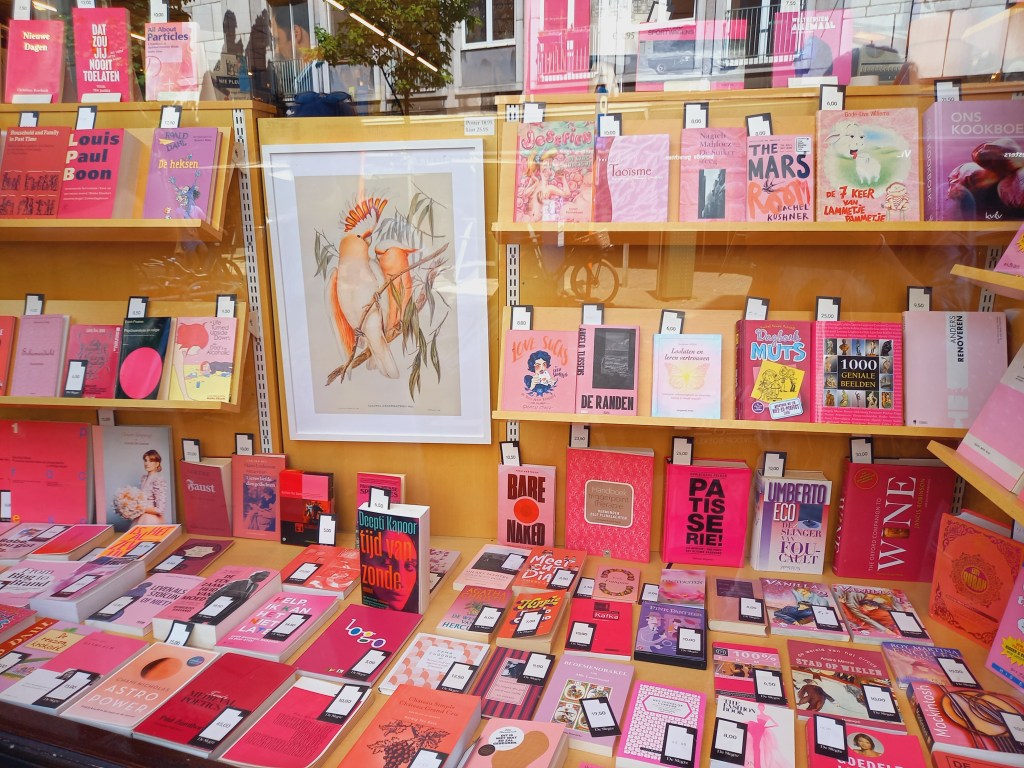
Recently, I had a short reunion with the friend I met 35 years ago during a holiday to China. Our reunion last year was in Ghent, Belgium. I was very pleased to discover a branch of De Slegte, second-hand bookshop, in the same street as our hotel. I’d come by train with a rucksack: spending was modest.
I lent Eleven Kinds of Loneliness by Richard Yates to my friend, so she had reading material for her journey back to the UK. I am a keen reader of short stories, glad to have the paperback returned to me. I enjoyed these: the mundane sadness of domestic life.
As the blurb says: ‘a haunting mosaic of the 1950s, the era when the American dream was finally coming true – and just beginning to ring a little hollow.’ Yes, it’s bleak, like Raymond Carver without the humour. Yates had a difficult childhood and suffered from TB which must have coloured his view of life.
Yates is probably best known for his first novel Revolutionary Road. It was published in 1961 and an instant success. The 2008 film with Kate Winslet and Leonardo DiCaprio was true to the book.
Bookshop De Slegte, Ghent, Belgium
Mary Ruefle’s My Private Property (2016) includes 11 short pieces about Sadness which are spread throughout the book. Here is an extract from Granta’s website: ‘Red sadness never appears sad . . . it appears in flashes of passion, anger, fear, inspiration and courage, in dark unsellable visions; it is an upside-down penny concealed beneath a tea cosy.’
Writing prompt
Go with loneliness or sadness if it appeals. Or choose another emotion/feeling you would like or not like to write about. Choose a few colours which you like and a few you don’t. What comes out of the melting pot? In her prose poems, Ruefle mixes the descriptions of concrete objects with some abstraction, and off-beat imagery: Grey sadness is the sadness of paper clips and rubber bands, of rain and squirrels and chewing gum,….
Yellow sadness is the surprise sadness. It {….} is the confusing sadness of the never-ending and the evanescent…
It is a great privilege to share Paul Stephenson’s poems here. His debut collection was published by Carcanet in June this year. See the end of this post for Paul’s biography and details of his three poetry pamphlets.
When his partner suddenly died, life changed utterly for Paul Stephenson. In Hard Drive a prologue and epilogue hold six parts of almost equal length. These poems take the reader through the journey of grief: Signature, Officialdom, Clearing Shelves, Covered Reservoir, Intentions, Attachment.
‘A noted formalist, with a flair for experiment, pattern and the use of constraints’, Paul also has a talent for intriguing titles: Other people who died at 38; Better Verbs for Scattering; We weren’t married. He was my civil partner.
There is a great variety of form: erasure poems, use of indents and columns, haibun, prose poems, alongside the narrative poems which range in length from three lines to the five-page poem Your Brain. Unfortunately, WordPress can’t do justice to the poems which need formatting.
I have chosen four poems from four parts: What Jean saw, Battleships, On mailing a lock of his hair to America, belatedly, and Putting It Out There. Battleships is a particular favourite – precise and poignant.
What Jean Saw
Through the letterbox the little bald patch of you asleep on the floor
Battleships
I must sort his room, a room as full of ships as any room could be, clear up the battle waging on open seas.
I imagine them, christened one summer afternoon, careering down their slipway ironclad onto polished parquet.
Red and blue ships strewn – mile-long, laden with guided missiles, locked onto my feet, closing in on my knees.
Picking up a ship, I cup it, poor target, slide a knife in the cracks between floorboards to extricate others.
No mayday for these navies in trouble, these heavily manned fleets, their broadsides struck, hulls torn and listing.
For the scuttled and sunk, damaged and wrecked, the ships reported missing, I bag them up and think charity.
No more games here. No more torpedoes in crossfire – hit! His room a tidy horizon, the radar blank.
On mailing a lock of his hair to America, belatedly
Would his hair be worth it? Would his hair provide comfort? Would his hair cause upset? Would his hair be an act of violence? Would his hair destroy their day?
Would his hair survive the journey? Would his hair have to declare itself? Would his hair be seized? Would his hair still shine? Would his hair be hair after all this time?
Putting It Out There
So here I am worrying myself to death about commodifying your death, arranging and sequencing your death, curating the left and right pages of your death, deciding which parts of your death to leave out.
Here I am again, giving a title to your death, choosing an attractive cover for your death, (will your death have French flaps?) writing intelligent-sounding blurb for your death, thinking how we might best promote your death, who might best be willing to endorse it.
Still me, waiting to be sent a proof of your death. I’ll need an eye for detail to check your death for typos. I’ve got to get it right – the finger-feel, the texture of the paper of the pages of your death, ensure a sharp jet black for your death’s ink. (I’m wondering about the numbers in your death’s ISBN).
Before I sign off on your death – your death done, and wait for a box with hard copies of your death and organize things to launch your death – finally, then wait, for reviews of your death (hopefully considered), to be told how well your death has sold.
Biography
Paul Stephenson studied modern languages and linguistics, then European studies. He has published three pamphlets: Those People (Smith/Doorstop, 2015), which won the Poetry Business pamphlet competition; The Days that Followed Paris (HappenStance, 2016), written after the November 2015 terrorist attacks; and Selfie with Waterlilies (Paper Swans Press, 2017). He is a University teacher and researcher living between Cambridge and Brussels.
It’s a great pleasure to introduce my guest poet Judith Wilkinson. Judith and I are both members of the Groningen Stanza. It had been meeting through Zoom for over a year, and in March I went up to meet her and the other members in person.
Judith Wilkinson is a British poet and award-winning translator, living in Groningen, the Netherlands. She has published three collections of her own poetry with Shoestring Press: Tightrope Dancer (2010), Canyon Journey (2016) and In Desert (2021). Some of the poems in Tightrope Dancer have been performed by the London dance-theatre company The Kosh.
Wilkinson is also a translator of Dutch and Flemish poetry, including Toon Tellegen’s Raptors (Carcanet Press 2011), which was awarded the Popescu Prize for European poetry in translation. Other awards include the Brockway Prize and the David Reid Translation Prize.
The poems in this selection are from In Desert, which explores various desert experiences, solitary journeys in which people are thrown back on their own resources. ‘The Risks You Take’ and ‘The Tuareg’s Journey’ form part of a longer sequence inspired by a Dutch expedition through the Sahara.
IMAGINING GEORGIA O’KEEFFE AT HER GHOST RANCH
‘My pleasant disposition likes the world with nobody in it.’ (Georgia O’Keeffe)
I will never tire of the desert, its severe hillsides, punctuated with mesquite, its unsentimental trees, shrouded in dust.
Now that he has left me for another, a few owls and a mourning dove are all that splinter the silence spreading before me like a horizon.
I don’t need more mourning, I want to walk across the bristly desert floor that the ocean turned into, arrange some black stones in my yard into a cordate shape I’ll call My Heart.
I was shipwrecked here a few times in my life and found restoration under a pitiless sky. Having let all the waters pour away, the desert unwrapped me, and my flint faith, bound to the Badlands rolling from my door.
I set my easel in plains of cinnabar and flax so I can explore the palette of solitude, capture mandarin-dusted mountains, staggered against sky, cliffs isolated in space, rising from the plateaux in banana and persimmon and cream, undulating mounds striated with celadon and a lavender mist coating the distance.
Every day I scour the ground for fossil seashells, little definite ghost-houses, air-havens I could live in.
I’m free to gather the bleached bones of the desert: deer horn, horse’s pelvis, ram’s skull, splaying them open like butterflies, dipping them in bouquets of wildflowers, suspending them above the ever-looming Pedernal.
This morning I trekked far into the Black Place because I could, because it was difficult, because fear and pain were expecting me.
When I got back I grabbed the ladder by the shed and leaned it against the evening sky. It needed nothing.
THE RISKS YOU TAKE
‘The true contemplative is he who has risked his mind in the desert.’ (Thomas Merton, Letter to Dom Francis Decroix)
Can I extract myself from you? Someone called you a few degrees short of bipolar, always urgent, pouncing on life, difficult not to love.
When depression settles on you, you travel beyond reach, going far out to some rocky, arid place, peopled by spectres and you stay there, stubbornly studying them, letting them haunt you, before coming back to tell the tale that restores you to your life.
There is so much of you, that you crowd out my patch of wilderness, that space where I too risk my mind for the sake of the inexplicable.
After months of turbulence I’m regaining some composure, breathing in what the desert offers – although I’m not sure I want all my prayers to go to the gods of serenity.
Absorbing this swathe of wilderness, I wonder if this is what I want for myself, the wide, wild courage to leave you, your tempests, your risks
THE TUAREG’S JOURNEY
Lost, not lost, in the ténéré, desert of loneliness, where the Kel Essuf spook us till we’re adrift on the empty side of home, as time sifts, dunes lapse.
Without GPS, without coordinates, we measure grass blades, we focus without a compass. With an infinite politeness to the desert we can tell a reliable groove in the sand from a wind-distorted one, extract logic from a shrub, tell the lie of the land by a bloom’s impermanence, take our direction from sun and moon and all the stars constellated in our heads.
We will never find Gewas, the Lost Oasis, we will always find Gewas in the middle of the trackless ténéré.
Lost and not lost, so lost that we’re at home
Note: Kel Essuf: anthropomorphic spirits; Ténéré: Tuareg word for desert, wilderness; Gewas: the Lost Oasis that figures in many Tuareg legends.
Credit: Ondrej Sponiar via Pixabay
THE WHOLE MOSAIC – A DAY IN THE ATACAMA DESERT
‘Why are there archaeologists and astronomers in one place? Because in the Atacama the past is more accessible than elsewhere.’ Patricio Guzmán, Nostalgia for the Light (film documentary)
At the observatory an astronomer scans the sky for treasure: clusters of stars, nebulas, planets, comets like those that watered the earth, or the death throes of a supernova, hatching our atoms. Here the Chilean sky is so translucent he can almost finger the stars, pull them down to eye-height, unravel the energy prizing them apart, as if the story, from start to finish, was his birthright.
In this salt-steeped land an archaeologist studies strata of sand and rock underpinned by meteorites distorting the direction of his compass. Tenacity got him this far, leading him to rock face carved by pre-Columbian shepherds, whose mummified remains he gathers up, tracing each part to its origin. He finds a petrified lake, fish frozen in time, and an ancient trade route from the high plains to the sea, where caravans of llamas once found their way.
Near the ruins of a concentration camp, women sift through the desert, decade after decade, in search of loved ones. Stumbling on Pinochet’s mass graves, they piece together splinters worlds apart, bleached by the calcinating sun. ‘I found a piece of my brother there and spent a morning with his foot, stroking it, though it smelled of decay, hoping to find the whole mosaic that was my brother.’
I am delighted to introduce this month’s guest poet Sue Kindon. We met on Zoom during lockdown 1, through a mutual poet friend.
Sue Kindon lives and writes in the French Pyrenees. An enthusiastic member of the local slam team, her greatest achievement to date is an award for a poem in French.
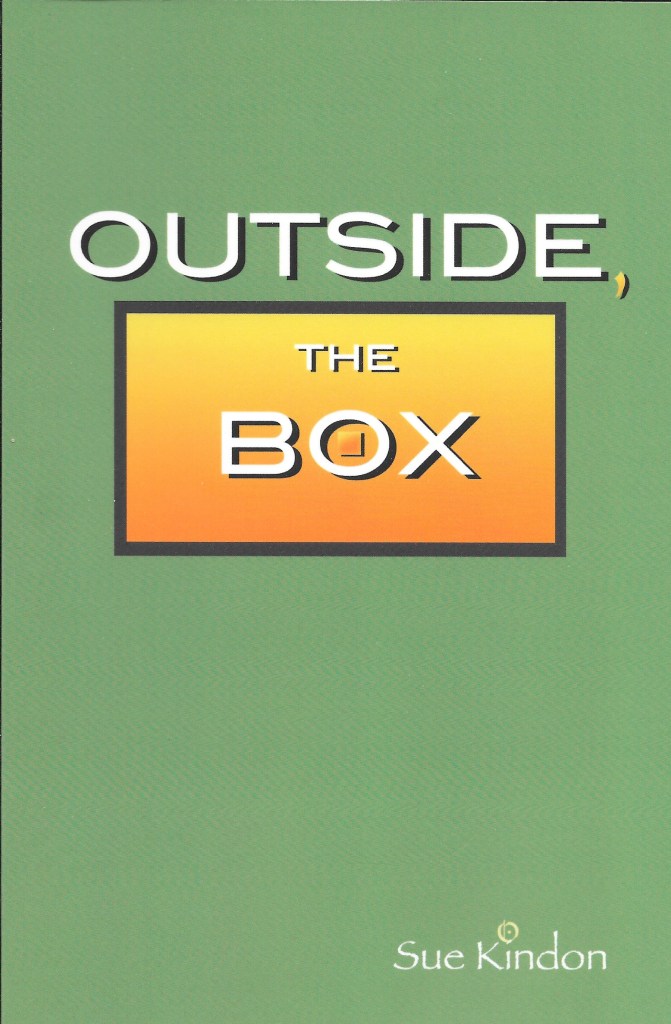
Kindon was Runner Up in the 2021 Ginkgo Prize (for Eco-poetry); and has two pamphlets to her name – She who pays the piper (Three Drops Press, 2017) and Outside, the Box (4Word Press, 2019). The poems in the latter were sparked by the box moth plague that devastated the landscape a few years ago.
I’ve selected five poems from Outside, the Box, to give you a taste of the range and humanity of Sue’s poems.
Box Moth (Cydalima perspectalis)
white moths haunt each hedge all summer their larvae gorge on our ancient ways
The House of Running Water
We’re so far off the mains, I cross myself, or is it my reflection? Our drinking water isn’t purified, sobbing in glugs from a faery underworld just beyond the spring line. Boils, frogs, plagues of grass snakes are there none. The kitchen tap dispenses an incessant stream in spite of some newly-converted saint bottled up in supermarket plastic. Every day an elven-prince strikes rock with his divining rod and sets loose unchlorinated magic: we drink deep, until our inner walls cascade with the stuff.
I could never return, now my mind is clean as the washing on the line. Townsfolk have forgotten how the old world flows. It must be something in the water.
Bernadette
I thought of you as a sister from the start. You were the one who insisted I worked in the shade, you saw that my fair skin reddened in the southern sun trap of the presbytery walls. Your straight larkspur back bent for hours as you laboured to remove chiendent and petty spurge.
You would go missing for a quick smoke outside the tall grey gates of our temporary eden, and I felt the loss, sure as the last petals falling from the climbing rose. Then you’d be back, tending the last geranium and offering a kind word I might not understand.
So much more I wanted to say: and now I’m gaining confidence with the language, it’s already winter, and the gates are shut.
On Safari
Death came to me as a zebra crossing my path. I’m not ready yet, I said, and he stepped aside.
As I passed by, I admired the pull of perfect stripes, the kiss of dark mane
and I was nearly fooled by his op-art trompe-l’oeil invitation to step into his black-and-white-wash skin
and set down my bright sorrow. I was dazzled by the glow of skeletal zebra ribs
until I saw the shadow of famished lion at the tunnel mouth and smelt the jitter of my blood on parted lips.
Jardin de Curé – Damage Limitation
Our prayers have kept the moth at bay – and careful spraying – chemicals have underplayed their part.
The volunteers have withered up or died. A few stalwarts welcome late summer visitors but when it comes to weeding, they pull the flax and leave the nipplewort.
Nettles flourish by the chapel wall. Self-seeded marjoram annexes the cabbage plot.
At least the box hedge is intact. Our prayers have kept the moth at bay.