Tag Archives: Poetry

Exploring the Orinoco

It’s a pleasure and a privilege to introduce Alan Payne, the poet featured this month. We met during the 2012-13 Poetry Business Writing School.

Alan Payne

Alan was born in Trinidad and lives in Sheffield. His pamphlet Exploring the Orinoco was a winner in the 2009 – 10 Poetry Business competition. He has had poems published in Smiths Knoll, the North and Scintilla, and in various anthologies including The Sheffield Anthology: Poems from the City Imagined, and Cast: The Poetry Business Book of New Contemporary Poets. He worked for many years as a teacher of young children.

His poems visit themes of loss, grief and migration. Alan writes with great economy, sometimes even sparseness. Poignancy is created by his selection of accurate and telling details. Alan always writes with empathy for the people in his poems. His poems taught me that it is fine to revisit the themes that continue to haunt us.

The poems Colombie and Exploring the Orinoco are from the 2009 pamphlet. Menu and Silence are published in The North, issue 60, August 2018.

Colombie

Sudden stars pulled us through
the Dragon’s Mouth.
Port of Spain extinguished.
Home and homeliness
already a legend.

Next day, briefly ashore
in Guadeloupe –
the patois a distorted version
of a beloved tongue,
its lilt curled in my ear.

Crossing the Atlantic –
a band’s orchestrated goodbyes
lost in the wind,
the thundery embrace
of the Northern Range
an echo in the swell,
my stuffed alligator
a talisman.

Fabled Plymouth.
And the journey north, by train,
to Apperley Bridge.
There, in that no-man’s-land,
I tasted pickled onions.
Assumed a stranger’s skin.
A worsted suit.

 
Exploring the Orinoco

With the Thames in their hearts,
and childhood fevers in common,
my father and his dead brother
explored the Orinoco.

The boat of my father’s faith
carried them upstream
to the port of Encaramada,
past the granite domes
of Punta Curiquima.

There, on a deserted island,
they camped for the night,
sitting on the scattered husks
of turtle shells,
reading in the moonlight,
and dining. A faint stink
of rotting crocodiles
corroded the air

During the night, a jaguar
added discord to the howling
of their dogs,
and cataracts answered
the rumbles overhead.

Once, a small black monkey,
like a widow in mourning,
returned the sweet, sceptical smile
of my father’s brother
as he glanced up
from his beloved Darwin.
With a pencil, he underlined
a few words; then disappeared
into the forest
of my father’s mind,
where their mother’s grief
(one boy saved, one boy lost)
left him bereft.

 
Menu

Stereotypical, I know, this woman
carrying an urn on her head, smiling,
as if it’s nothing to have walked
to the market in Tunapuna,
and this man who, good-naturedly,
holds out his cup, and this donkey,
waiting patiently by the man’s side,
still, with well-behaved ears.

My father framed it, hung it on the wall,
a reminder of S.S. Colombie,
au revoir, the French waiter
with one blue eye, one green eye,
Trinidad, Martinique, Guadeloupe,
and then the chilly Atlantic.


Silence

There was always silence in our house,
the silence before grace,
the silence following the Lord’s Prayer,
the silence of my father’s work
that seeped out from behind
his polished study door,
the silence of my mother’s brother
who, we were told, died in the war,
but as I later discovered
blew his brains out
in a car-park in Hammersmith
on receiving his call-up papers.

Above a thousand feet of space


D Wilson action


In the Balance

You pause beneath a boss of ice
above a thousand feet of space.
The picks of your axes barely bite:
it’s bullet hard, black with rock dust.
You’ve run out forty feet of rope,
placed only an ice-screw and screamer.
You’ve dreamed of this route for half your life.
Your calves ache. You can’t wait long.

Decision time. Weigh the following:-
an abseil retreat to blankets, pasta, beer;
the taste in your mouth if you bottle out;
November at work without a fix;
glimpses of where the pitch might ease;
a face at a window, Dad come home,
and you not knowing where you’ve been
or how to get back from it.

 
David Wilson turned to writing poetry a few years ago after being inspired by reading Derek Walcott’s poem ‘Midsummer, Tobago’ on the wall of a hospital waiting room in Leeds. He then discovered the Writing Days run by the Poetry Business in Sheffield and started writing poems of his own. His pamphlet Slope was published by Smith/Doorstop in 2016 and he has a collection coming out with them in 2019.

David was born and brought up in North London and studied at the London School of Economics, followed by a Master’s degree at Leeds University, which at the time had the only indoor climbing wall in the country and was close to excellent outcrop climbing. He has climbed extensively in the UK, Alps and further afield, at a standard best described as erratic.  In mid-life he got hooked on windsurfing, but writing about climbing has led him back into it.

After living in Leeds, David settled with his family in Harrogate. He has worked freelance for many years as an organisation development consultant. He now works part-time, exclusively in the area of academic leadership, helping people like Heads of Department to tackle the many challenges they face. He mainly works 1:1 with people and the diversity of their subject areas is a delight: from Medieval Welsh Poetry to Theoretical Physics to Cancer Research to Arabic, and that’s just in the past few weeks!  Favourite poets include Jane Kenyon, Les Murray, Jane McKie, Norman McCaig and Seamus Heaney.

Slope cover

David and I met on the 2012/13 Writing School and I’m delighted to share his work. Below are more poems from the pamphlet Slope. Everest was awarded 1st prize in the 2015 Poets & Players poetry competition, judged by Paul Muldoon. For a few technical terms: a cam is a device fitted into cracks to protect a lead climber. It has spring-loaded metal cams which grip the rock. A Micro-traxion gadget is a pulley that locks the rope, capturing what’s gained as a climber is hauled from a crevasse. A screamer is a sling which has stitches designed to rip and thereby absorb the energy of a fall. Typically used with doubtful ice-screws.

Stanage Edge

Summer’s returned for one day only,
blue sky, no wind, mist in the valleys,
bracken bronzing every hill,
the Edge’s gritstone silver in the sun.
Rock warm to touch. But holds won’t sweat.

I check my harness, knots and rack,
lay away, step high and up again to poise
off-balance, wriggle a cam into place,
then smear a slab, heels low, until
a crack grips my outstretched hand.

We linger on the edge. Smoke rises
straight up from the chimney at Hope.
It’s not a day to hurl ourselves against
but for dancing with, to feel alive
on Black Slab, Inverted V, Goliath’s Groove.

And it will light the long edge in our minds,
where name after name spells a life,
Flying Buttress and Left Unconquerable,
holds we could trust to be always there,
winds which threw every word away.


Everest

Once it was Chomolungma,
Mother Goddess of the Earth,
a face whose veil rarely lifted,
its whiteness the White Whale’s.

Now it’s like Elvis near the end,
a giant in a soiled jumpsuit,
blank, useful for percentages,
a sheet from which the music’s fled.


Alpine Partner

I was thinking of glaciers as metaphors,
you knew the car park’s exit code.
And you’d practised techniques
for rescue from a crevasse.

to dig a T slot, bury your ice-axe,
attach our micro-traxion gadget,
then fix the rope as a Z-haul
across the sweating surface, so that inch

by inch you heaved me up when I fell,
up from that cold place – its white walls
and longing, fins of green ice, pale blue caves,
darker blue depth beyond saying.

Illness poems

Emma Press have recently put out a call for submissions of poems on Illness. The closing date for your submission (maximum of three poems and up to 65 lines each) is 31 August. To be able to submit you must have bought one printed book or e-book in this calendar year. Emma Press is an active small publisher with a range of anthologies, individual pamphlets and collections. So that one book could pay for several submissions. I will be submitting and have ordered Postcard stories, mini-stories about Belfast.

The editors are looking to “express the experience of illness right across the spectrum” and are “keen to uncover invisible symptoms, as well as unravel the stigma of mental illness”.

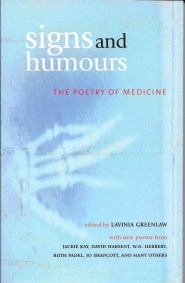
Signs and humours cover0001

I have Signs and humours: the poetry of medicine on the shelf. This anthology holds 100 poems written over the last 2,000 years and it includes subjects such as autism, infertility, pancreatitis. It was edited by Lavinia Greenlaw who commissioned 20 poets to write on a topic of their choice. The poets were then introduced to medical specialists on that subject (for example, PTSD, glaucoma, malaria, psoriasis). Since 1982 I have had tinnitus in my right ear, so David Harsent’s poem Tinnitus spoke to me; a short extract:

A single note drawn out
beyond imagining,
pitched for a dog or a rat
by a man with a single string
on a busted violin.

There are also poems about how we respond  when faced with a diagnosis. The first few lines from Raymond Carver’s What the Doctor Said:

He said it doesn’t’ look good
he said it looks bad in fact real bad
he said I counted thirty-two of them on one lung before
I quit counting them

There is Sharon Olds who accompanies her father to a meeting with the doctor who says that nothing more can be done: My father said /‘Thank you.’ And he sat motionless, alone,/with the dignity of a foreign leader.

Around AD 842, when he was paralysed, Po Chü-I wrote a short poem that ends:

All that matters is an active mind, what is the use of feet?
By land one can ride in a carrying chair, by water be rowed in a boat.

The anthology Signs and humours was published in 2007. It will be interesting to see the similarities and differences between this and the Emma Press Anthology. Will there be poems about eating disorders, body dysmorphia, internet addiction?

DRYING HER PRAYERS

Kasane

DRYING HER PRAYERS

As the rains of spring
Fall, day after day, so I
Fare on through time
While by the fence the grasses grow
And green spreads everywhere.

                           Izumi Shikibu (late 10th C)

Mother, you are hanging out prayers on the willow
but the ink hasn’t dried;
little flies scenting sweet gum embellish
your latest calligraphy.

I breathe on my hands, it is March,
My fingers are white as bamboo.
On the bridge, I hear the sisterly
slop of our sandals, still wait

for the god, hiding behind our gate,
to give chase, tap me on the shoulder,
offer a pale green scroll
with your name written there, words

golden, scattered like pollen.


This is a poem from Parting the Ghosts of Salt, a sequence of 15 poems. They are a series of letters exchanged between a mother, Tamiko, and daughter, Kasane, both of whom are married to sumo wrestlers. Each poem starts with a striking quote, from medieval and modern Japanese poetry. All the poems are entirely imagined, but they ring true. And it’s an interesting form.

Pam Thompson

Pam Thompson, this month’s featured poet, has published several pamphlets and her second collection Strange Fashion was published by Pindrop Press last year. Pam and I met on the Poetry Business Writing School in 2012. Pam has recently completed her PhD in Creative Writing. She is a free-lance writer, lecturer, writing tutor and reviewer. Her poems travel widely. There may be humour, but this is always combined with a clear eye for the telling detail and with compassion. Pam blogs at https://pamthompsonpoetry.com

Near Heaven – a journalist encountering Virginia Woolf is at once surreal, humorous and poignant. In the Abecedarian for Liam Pam uses the form – which can be tricky – in a natural way to tell a family story rich with detail.

 
Near Heaven

The lift doors open
on the wrong floor but she’s perfectly cheery.
Ms Woolf, I begin,
and she gives me that haughty, beady-eyed stare
like an intelligent red setter,
What is it you’re reading?
She pats a huge leather holdall,
her voice trails, … Of course … in my day we …
and sunsets … Eliot, with his green-powdered face
smiled like a girl
She’s drifted off my point.

To bring her back I say
that what the reader wants is
your favourite pen, coffee or red wine.
Your top ten diary writing tips,
what to do when the novel gets stuck.

At this rate we’ll never make the launch
The Wings? Waving at the Lighthouse?
These days I never even read the press release,
just take along fizz, their favourite fags
or something stronger; usually they’ll give
me all I want, sometimes a little extra.

So, Ms Woolf, the most dangerous place you’ve ever …?

I’m thinking she’s not heard the question
when our lift bell dings –
This must be your party, dear, she says, in the voice of my mother
and there they are, uncles, aunts, my father, all my cats,
two hamsters,
and I’m about to greet them, waving fizz, posh ciggies.

A hiss of words …a Schaeffercoffee … then fainter,
write before breakfast, garden, then write again,
take a little float down the river

the river

then she presses the button, the doors close, she ascends.

 
Abecedarian for Liam

All those years you had blonde hair –
back in Hong Kong they considered it lucky.
Cake in a posh hotel, you were six, born in the Year of the
Dragon, old people touched your hair, no inhibitions,
even when we were at your side, you were golden, a charm
for locals. Remember how you wondered if the Sikh doorman was
God? The photo shows him laughing, me
helping you blow out your candles,
I hope I made you wish, then you and the other kids
jumped all over the beds and the settee in our room,
Kowloon was a day or so away, and getting
lost, both of you so little – Derry only three – to be
meandering along the wrong road, away from the lights, with
Nanna too, Derry tired and crying, I was crying inside but kept
on pretending, and I’ve blanked it, but Henry
probably got us out of it, then the day we
queued for the tram to Victoria Peak and I’ve just
remembered Stanley, the shanty town we all mentally
stepped over, physically routed ourselves around,
the tee-shirts painted with your name in kanji,
up late eating Pringles, on a speedboat with Derry, Rosie and Lisa,
visiting a Shinto temple, posing outside with Nanna,
with Tom and Fauna, your favourite smoked salmon, scrambled eggs,
Xmas breakfast with champagne, and I could lie to
you when I’m telling you twenty-one years later, that the
zoo trip was on Boxing Day when I think that was the speedboat.

Seven ways of dealing with rejection

This year I have been sending far more poems out and so it follows logically that more will be rejected. Of course, more will be accepted by magazines and successful in competitions. That’s all about “hit rates”. So far this year, ten poems have been published or accepted for publication – anthologies, magazines, competition anthologies.

But the rejections sting. The other day there was a terse two-line email from a magazine: Not what we’re looking for at the moment. Contrast that with the editors of Strix. The magazine was nominated for the prestigious Saboteur award: more sales, more submissions. They went to the trouble of sending separate emails to the people whose work had been shortlisted for issue 4. From 926 pieces submitted, 44 were shortlisted. I had made it that far and it was good to know.

Reframe

Before I retrained as a psychotherapist, I worked in various consultancies. A rejection was always reframed as getting closer to an acceptance. We needed reminding that a day of paid work typically went with two or three days of unpaid work: marketing, PR, admin, training and development, travelling, etc.

My poems are “tied up” when they are out with editors and competition judges and “free” when they’ve not been chosen.

Keep things moving and don’t fret

I have a simple Word table with poems in alphabetical order, a To Do list with details of magazines and their submission windows, and a list of magazines that are new to me. I also have an A4 folder that holds competition leaflets in plastic wallets, organised according to deadlines.

As soon as I know that a poem is “free”, I make the decision as to where it will go next. I aim to send it out within one or two days. Many submissions now are by email or the Submittable portal, so it’s easy.

Yes, I allow myself a bit of a moan in my diary, but that’s in a separate room from where I write.

Persistence

All the research on what makes for successful Sales people quote the P-word. Zen and the Art of Motorcycle Maintenance clocked up 121 rejections and Chicken Soup for the Soul was rejected 144 times. The American poet William Stafford wrote a poem a day for many years. Apparently, he had a hit rate of 1 : 7, so that’s a poem a week.

Compare yourself with yourself, not with others

Many years ago I read some very interesting NLP (Neuro-Linguistic Programming) research. Modelling has always been at the heart of NLP. What is that successful people do? What are their attitudes, values, beliefs? What do they say to themselves?

This research looked at sportspeople who had been seriously injured (during practice, performance, or outside of their sport, e.g. traffic accident). The group examined were those who after their operations, stay in hospital, rehabilitation, etc. were stronger and fitter than before the accident. They did two things: they took it a day at a time and they compared themselves with themselves, not with others.

Keep your successes within reach, within sight.

Especially for those of us who’re the “responsible workaholic” type with a perfectionist streak, it’s natural to focus on what’s missing, what’s not right. Successful poems used to get deleted from that Word table to make sure they weren’t accidentally sent out again. Now I have them on top of the table, in bold print. A great reminder.

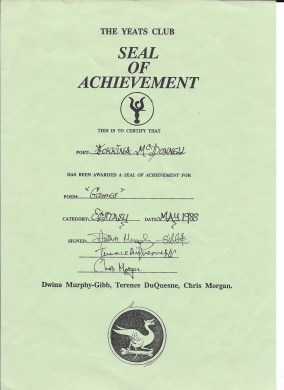
I also have an A4 folder with letters and emails from editors and competition organisers, certificates. My own work is on a shelf in a bookcase in the room where I write. The picture is of a competition certificate. It was one of my earliest successes (1988) and I was thrilled to receive it. I framed it and put it on the hall wall, at the bottom of the stairs.

Games Certificate

Eggs in baskets

I’ve started writing and sending out flash fiction and I greatly enjoy blogging. Since closing my practice I have more time for and energy for writing and for sending the work out in the world, but I was becoming too attached to the outcome. It’s good for me to not have all the eggs in one basket.

Zen and the Art of Submitting Poetry

Rejection does not make you a bad poet.
Acceptance does not make you a good one.
Therefore, neither should trouble you.

Chase after fame, however, and you put your life
into the hands of others:
They will tip you between hope and despair.

Aim, then, to be aimless.
Seek neither publication, nor acclaim:
Submit without submitting.

The poem is by Cameron Self and it’s on the Literary Norfolk site.

What a waste!

hardys-well-2-e1529961469867.jpeg

Hardy’s Well is a pub at the end of Manchester’s famous Curry Mile. The building is 200 years old. As a bet with the landlord in 1994 Lemm Sissay wrote the poem that is on the side wall: a rebellious shout. The pub closed in 2016 and is at risk of being demolished. A planning application has been submitted for a block of 26 flats with shops. The wall with the poem will be retained inside the new building. Below is my reply to Lemm Sissay.

What a waste!

What a waste of wise, witty words, wholly wild, worldwide; wicked, wanton, willful, witless wickedness.
When the watering hole Hardy’s Well is without water, wine, whiskey, whisky,
without Wienerwurst, Wi-Fi, whitebait, wontons, wedges, waffles;
without waiters, white witches, widows, widowers in wellingtons,
women, wheeler dealers, wastrels, wino’s, woodworkers in winklepickers,
white wicket keepers, weightlifter with whippets whining at the window;
Welsh welders in woollen woven wetsuits.

Wretched, wretched, wretched! Wrong, wrong, wrong!

We who wave at weddings, whisper at wakes, we wish to wave wands,
write wry words as ways to wound those wealthy windbags with their weasel words.
When we wander away towards Withington, walk against whipping wind
we weep, watching weeds, wear and tear on wooden wheelbarrows
in a wasteland, we who wage war against wrongs, let’s have a whip round.

Poet Lemm Sissay is philosophical about the development: Things change, and new poems emerge. It’s all part of the march of time. (Manchester Evening News).


Refrigerator, 1957

To help me get back into writing, I got out 52. Write a poem a week. Start now. Keep going. The book originated in the 52 Project by Jo Bell and guest poets. I opened it at random and got to Prompt No. 15 titled Bell, Book and Candle. This is a prompt on writing about the unnoticed object.

The second sample poem Refrigerator, 1957 is by the American poet Thomas Lux. As synchronicity would have it, today is the first anniversary of his death. He was born in 1946 on the dairy farm his father owned. On poets.org, the website of the Academy of American Poets, I watched a short video In Memoriam 2017 which had a picture and a short quote by each of the US poets who died last year.

Adding that date to an ordinary object already makes it less ordinary. It tells us the perspective is that of an eleven-year old boy. More like a vaultyou pull the handle out it starts. There is humour: not a place to go in hope or hunger. Then the poem zooms in, heart red, sexual red, neon red, on that jar of Maraschino cherries. The same jar there through a childhood of dull dinners… Then we go down the timeline to grandparents, pig farm in Bohemia. The poem ends and because you do not eat/ that which rips your heart with joy.


Joan

To honour International Women’s Day I’m posting this poem about a woman.  It was first published in The Best of Manchester Poets, vol. 2, published by Puppywolf (2011).  I aimed to give the reader enough clues (the Gauloises cigarettes, the stubborn streak) for them to be able to guess the identity of this woman before they read the final lines.

It’s a good prompt: with which historical figure (famous or infamous) could you have gone to school, college, university with?  Did you even sit next to them in the classroom?  What were they like then?

Joan

One of the girls I went to college with

was Joan who’d left home early.

She smoked Gauloises, had a stubborn

streak, wanted to study philosophy.

We thought she was depressed; she cut

herself and once put out a cigarette on her arm.

I wish I’d asked her why.  I can see her now

with that hair cropped short, staring straight ahead.

People shouting, the smoke, the crackling fire.

Too hot, I need to step back.


Paterson

During the Christmas holidays I went to see Paterson, the delightful film about a bus driver who writes poems.  The poems in the film are by the New York poet Ron Padgett.  Back home I found his work in the New York Poets II Anthology, including the Love Poem that Paterson writes in the film.  The first line is: We have plenty of matches in our house. 

Paterson is also the title of a long poem by William Carlos Williams, so I re-read him.  Seeing Paterson sit in his bus scribbling away each morning before he drives off for the day reminded me of another American poet, William Stafford.  He wrote a poem each day, starting with a brief description of the weather, then a short aphorism, then a poem.  I believe his “hit rate” for acceptances was 1 : 7, or 1: 8.  I’ll settle for that!

May you have a healthy, happy and creative year.  If you’re short on inspiration, you can always write about the matches in your house.  Over Christmas I used up a couple of boxes of good old “Svalan” from Sweden.  Now I’ m on “Flix” from the Netherlands.  The packaging is modern, but the tips are brown…