Tag Archives: Poetry

Is it a competition?


11

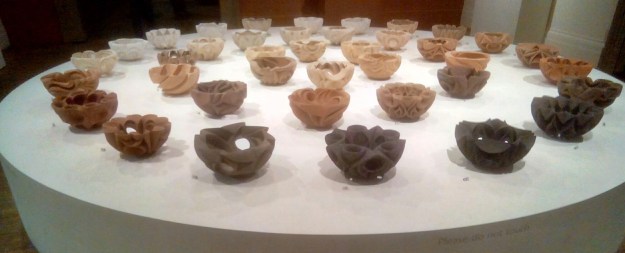
Virtues of Unity, by Halima Cassell

Is it a competition? the woman with dark hair and glasses asked. I stood writing in a small notebook.  On the contrary, I said. I told her this installation is a major and ongoing project. The artist Halima Cassell was born in Kashmir, then raised in the UK. In England she is called a “foreigner” or “second generation migrant”, so she has always been aware of issues of identity. However, when she visited Pakistan as an adult in 2009, she was called “British Asian” or more frequently “a foreigner from England”.

This sense of double dislocation was the trigger for Virtues of Unity. Different countries produce different colours and textures of clay. Each sculpture has its own design. Superficially, we seem dissimilar, but we share DNA. We all come from the clay of the earth and will return to that same elemental clay. The shape of the sculpture resembles the earth, the holes remind us of the womb and the birth canal. Halima was pregnant with her first child when she conceived the project.

So far, Halima has made 39 vessels. Her aim is to make 195, one for each of the countries in the world today. It will be a life-long journey. Each of the sculptures has been made from the clay of that country. The designs of each vessel and the titles represents a positive quality of that country, eg the Netherlands is called Harmony.

I was on a writing workshop at Manchester Art Gallery and we were to imagine a public superhero with a piece of art in the Gallery. I have been pleased to read that the under 35’s are streaming the composer J S Bach. He has been one of my superheroes for many years.

2 (2)


Virtues of Unity

He seemed invisible to visitors,
though he was dressed in a costume
of the period, and his wig resembled
curved waves of a waterfall.

In truth, I thought he was part
of the installation: thirty-nine spheres,
each one representing a country and
made from the clay of this country.

He moved slowly anticlockwise,
stopped at the small ceramic vessel,
a creamy white called Faith.
The positive quality of Germany.

A slow smile grew on his face
when he saw there were no openings,
that the vessel seemed restful,
flowering into a solid cathedral.

Russet, tan, black, brown, beige, taupe,
grey, creamy-white, white. Eyes fixed
on his native country, he started humming
Jesu, joy of man’s desiring, and I was glad.


Glad not to be the corpse

NWA_ScottishBookTrust_HIGHRES_January_18_2018_KatGollock_-73_Lydia_Harris-200x300
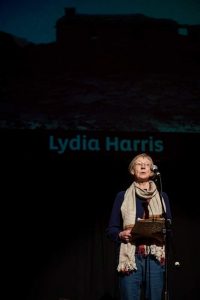
A knock-out title for a poetry book, I should say. Lydia Harris and I met on the Poetry Business Writing School in 2012, the year Smiths Knoll published her pamphlet.
The others are glad not to be the corpse is the first line of a poem with the title
We make a video  on All Saints, North Street for English Heritage.

Many of Lydia’s poems have this filmic quality. They’re typically condensed narratives, with arresting first lines, and slivers of telling monologue or dialogue. They are also a masterclass in choosing titles. Could you resist I couldn’t ask if he was glad he’d married me; Widow to step-son; Lice-infested sea trout; Oxygen mask? The next poem is a delicious example:

The rolls arrive at the Inchnadamph Hotel

She doesn’t say ‘I never should have married you’,
instead tries I’ve cleaned our tennis shoes.
He spots the van through his binoculars,
the rattle on the cattle grid alerts the lad who helps.

The rolls brim with themselves,
two each, in baskets on the tables,
they smell of steam and Morag’s overall,
the early morning shuffle in the bakery.

A twist of butter opens out, floats on cloud.
Perhaps I’ll find a horseshoe charm, a wind-up bird.
She reaches for the marmalade.

I’d like a Harvey’s Bristol Cream, he says.
Tonight, she laughs, at five.

The day’s a swing-boat,
red plush seats, a fringe of gold.
He’s helped her in,
pulled the rope to make it rise.

 
Shortly after we met, Lydia moved to Scotland. She has made her home on one of the northern Orkney islands, a small but vibrant community. Recently, her pamphlet of Westray poems An unbolted door was published. I’m very pleased I can share a few poems from the book here. Lydia’s website is homeabout.co.uk


Lydia


How to Approach the Pier

With a bowline tied to your monkey-fist,
with your heaving-rope coiled sun-wise,
bow to Faray, engine in reverse.

With your stern door lined up to the ramp,
to starboard, the quarry, slumped
where the stones for the pier were hacked free.

With outlines of Wideford and Keelylang
papered on the skyline. The tide running high
and the wind southerly.

With trails of foam in your wake,
Geldibust to port. With the stanchions easy,
hung with tyres.

With a route pressed to your palm,
in your pouch, the honed spoon
and that knapped flint from Howar.


Jeemo Services My Van in January

He keeps spare bulbs in a fridge,
cattle in the byre next door,

spreads shafts and flanges
round the anvil
like the gaming pieces
and spindle whorls from Scar,

the woman who bore them
so long dead
she’s in the sky
over Ouseness at night,
unravelling her skins.

 
From the Box Bed

Our sheets are sails on the sweet hay sack
and we sail to the moon with an ebb and a flow.

Your hands smooth my throat in the starlit room,
there’s nothing to say but the brush of flesh.

My lips drink your breath and the tide is in,
the clock on the wall makes the only sound

but for the air as it leaves your lungs,
sweeter than scallops from the pan,

for where has it been,
inside your skin and I take you in.

Brahms’ Alto Rhapsody

Rotterdam 015

Marianne Carolan, Rotterdam, 2008.

This week my friend Marianne would have celebrated her birthday.  One of my best memories is the trip I made with Marianne and other sponsors to Lalibela, Ethiopia in January 2007, during the Timket celebrations. Marianne had set up the Lalibela Educational Trust in 2006, to ensure there would be enough funding for sponsored children when they moved into secondary and tertiary education – university, nursing college.

With her 2007 Christmas card she sent a change of address: she’d bought a flat in Rotterdam, to be close to her new partner.  She was going to join an accordion orchestra and find a violin teacher.  I booked my flights in November 2007, the month Marianne’s GP mis-diagnosed, telling her symptoms were just Irritable Bowel Syndrome (IBS).  After the photo was taken Spring 2008, Marianne donated her accordion to the woman director of the orchestra.


Brahms’ Alto Rhapsody

The March visit had been planned
as a celebration of your retirement.
We walked on Calshot beach
summing up our lives, loves,
gifts and regrets.

Later, in your study upstairs,
we listened, connected
to your white MP3.
I couldn’t stop myself
from humming along.

Your ex-colleague (younger,
glasses, a little overweight)
started to speak in the silence –
when the men have stopped singing.
At your cremation they let
that alto voice fade away

An angel chooses a chocolate by Fokkina McDonnell

Abegail's avatarAbegail Morley

An angel chooses a chocolate

The chalky terracotta wall with mildew patches
has bled into her long, shapeless dress.
This woman mothered too many sons,
this would-be Saint of Obesity.
The single chocolate rests in her right hand,
shielded from the sun by the other hand.

Her neighbour in the blue dress offers
the square box to the angel, sitting
to her left on a wooden stool.
This woman has short hair, stocky feet,
late-afternoon ginger shadows on her chin.
She is the Madonna of Reassignment.

Stiff wings point forward like sails,
the angel’s nose is the beak of a hawk.
His wings and gown have turned
blue-grey. A long dusty road,
but he carries these shadows lightly
and points politely, with a bent finger.

(Note: after the painting by Karolina Larusdottir)

View original post

Rain, rain, rain …


rain


This poem by Lemm Sissay is a great example of “concrete” poetry: the physical shape of the poem fits with the subject matter. Rain is on a wall on Oxford Road, Manchester, between the Whitworth and Manchester University. It’s the partner of Hardy’s Well, the poem by Lemm Sissay that is on the wall of a pub. I blogged about that in July last year. The title of the piece is What a Waste!

The last few days it has been raining here in Manchester, though the sun comes out now and then. It made me think of the famous poem Rain by Don Paterson. You can find it on http://www.poetry.org the site of the Academy of American Poets. It’s mostly in four-line stanzas and has end-rhymes, and starts:

I love all films that start with rain:
rain, braiding a windowpane
or darkening a hung-out dress
or streaming down her upturned face;

The poem ends with a one-line stanza which is a very striking “turn”. Many poems have turns, most famously, of course, the sonnet form with its volta. Paterson has:

and none of this, none of this matters.

 
My rain poem is in my collection Another life. There are several turns in the poem, including in the final stanza.

The Lido, Clifton

It is dry this Monday morning.
I wonder what it’s like swimming here
when it rains. Just then the drizzle starts,
a gently pulsating rhythm.

Bristol had the oldest open-air lido
in the country. Refurbished Grade II
it sits between the backs of offices.

The water is warm, kept at this
steady temperature. Floating on my back
I see the movement of clouds.

The following year my friend
would abandon me once I became ill,
but here we are drawing small ripples
in the water, each of us in our own lane.

Please Hear What I’m Not Saying

cover MIND


With 200 poems, this is a substantial anthology of mental health issues. It was compiled and edited by Isabelle Kenyon of Fly on the Wall Press. Profits from the publication go to MIND, the UK mental health charity and a small charity based in Scotland. So far almost £600 has been raised.

Isabelle organised a micro-competition to celebrate the first anniversary of the anthology’s publication. I just received my copy of the anthology, as she declared Voice the winner.

 
Voice

I’m scared of the voice that tells me to let go of the wheel.
It’s an old man’s, harsh, gritty, cold, pushing me.
That time: Monday, sunny, A487, heading for Portmadog …

throat, sweaty fingers, heat


Black figures carry bags home. Whatever home might mean.
Silence, only sirens calling. The dog-end of the year.


Falling is kind of doing something.
You can fall sideways, head first, backwards.
I have worked all these years to stay upright.
Running like a rabbit on a metal track.

John and Mary meet …


2 romance

A romantic display at the 2018 Keukenhof, the Netherlands

A poem for Valentine’s Day:


John and Mary meet

John and Mary meet.
John and Mary greet.

The Film and Reels.
The Cog and Wheels.

John falls first.
Therefore, he kneels.

Mary thinks she knows
what John feels.

So, Mary falls as well,
as far as John can tell.

The sorcerer, a spell.
The Bell and Peals.

John and Mary greet.
John and Mary eat,

more sour than sweet.
Their eyes no longer meet.

The Boy Who Found Fear


janie

Jane McKie’s collections of poetry are Morocco Rococo (Cinnamon Press, 2007), When the Sun Turns Green (Polygon, 2009), and Kitsune (Cinnamon Press, 2015). In 2011 she won the Edwin Morgan poetry prize and published a pamphlet, Garden of Bedsteads, with Mariscat Press, a PBS Choice. Her most recent pamphlet is From the Wonder Book of Would You Believe It? (Mariscat Press, 2016). She is a Lecturer in Creative Writing at the University of Edinburgh and an Advisor to the Edwin Morgan Trust.

Jane’s poems have been described as “magnificently precise” and “spare and visceral, strange and accessible”. Jane is another poet from the 2012-13 Writing School and it’s a great pleasure to introduce her with three poems from Kitsune. The poem Leper Window was awarded first prize in the 2011 Edwin Morgan International Poetry Competition.

 
The Boy Who Found Fear

Boy made of sand
carries a black swan underarm
to jimmy windows, lift
all those little rubies
that wink in the small hours like digital clocks.
And as he crosses thresholds, lintels,
the grains of him unpick steadily
through the night,
ticking minutes, seconds
till he’s caught.

The man and his wife
get home. There he is –
black feathers on the floor,
pile of sand so powder-white
it makes them recall their Gold
Coast honeymoon and weep.
The thieving boy! They sweep him up
into a pan, chuck him out.
He can’t speak to tell them: Stop,
I’m sorry. A real boy at last.


Leper Window, St Mary the Virgin

The contagion of lepers
has lifted.

The low glass, where they crouched
even lower,

remains, but their breath,
their rash, their lack,

has passed into the lace
of shadows in the yard.

Where God looked
but did not touch,

the lip of sandstone
is purled with fissures.


Viking Horse-bone Ice Skates

The horse won’t know how its metatarsal
can be whittled by friction with the lake,
how the act of skating is part halting
glide, part planer blade; or how thick ice melts
back to health, its grooves, its scuffed ‘v’s, softening
to fill their own wounds. And the horse won’t know
how the skating boy, who opens his mouth
as he flies, will lose three blunt teeth, two milk,
one new; how these teeth, also, will be found.

Let’s abolish January

xmas baubles 2018

Winter passed.  The Christmas lights came down / together with the shabby stars / strung across the various shopping streets.   (Louise Glück, The White Series, from her collection Faithful and Virtuous Night.)

Today is Epiphany, day for putting those baubles away.  None have broken this Christmas. I read Lincoln in the Bardo over Christmas.  That reminded me of my January poem.


Let’s abolish January

Delete these damp and dreary days.
Disperse this suite of thirty-one.
The country ravaged by storms and floods.
Baubles broken, fir trees bare, marriages
cracking behind steamed-up windows.
January is the uninvited guest. Sea-sickness
feels eternal to the retching sailor.
Blue-black ink seeps from the ballot boxes.

By missing out January we would save lives,
livers, light bulbs, pointless resolutions;
but lose snowdrops and Epiphany.
And what of those destined to die
in that cold, dark cave of the year?
They would be doomed to wander,
blocking our chimneys, spooking children.
Singers without a voice, sailors without a boat.

Anxiety and Dogs

I was thrilled to get the news: Indigo Dream Publishing will publish my second poetry collection in early Autumn 2019. IDP are well-established, have won awards, and they publish about two-three poetry books a month. They’re organised and business-like: I’ve already signed the contract and had the template, with a production timetable.

When my debut collection got accepted in Spring 2016, I was prepared for a dip, or even worse: a few poet friends had told me they couldn’t write for six months. But I managed to keep writing, sending work out and it was summer…

This time I’ve plummeted: we’re heading for Winter; a lot of poems have been accepted elsewhere, and another 40+ have now been spoken for. When I get anxious, I try to deal with it by tidying up, clearing and de-cluttering. That was the worst thing I could have done! I deleted a lot of old so-so poems from my pc; then put dozens more so-so poems in a single file. I felt bereft and at a loss.

A good friend, a qualified proof reader, will go through the manuscript. I’ve checked, getting confused about punctuation: a comma, a colon, a semi-colon?? I’ve put them in and taken them out. Time to email it to my friend!

During the clearing and sorting, I came across a photo album. Here is a picture of one of the dogs in a poem that’ll be in the new book.

Pablo

Dogs

I would love to buy a recording
of the dogs we had, but not for long.

The grey poodle called Pablo
with a disease of the stomach.

The two grown hunting dogs
that howled through the nights

of a week, tore a door to shreds,
were returned to the owner.

Our red Irish setter Alexander,
re-homed when my father

gave up the battle and our whole
family moved into that small flat.