Tag Archives: Pindrop Press

Fieldfare, blown off course, early spring

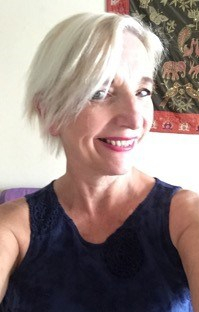
A lively and intriguing title for a poem sequence by our guest poet Lydia Harris. Her work has featured here before (March 2019). This sequence is from her new collection Objects for Private Devotion, beautifully produced by Pindrop Press, published last year. Lydia lives in the Orkney island of Westray. Many of the poem sequences in her new book focus on local culture, people, nature, objects – such as the prayer nut which provides the cover image.

The sequence about the fieldfare is inspired by the great Serbian poet Vasco Popa. The Blackbird’s Field is also a sequence, from Popa’s Collected Poems, close on 400 pages – drawing on folk tale, surrealist fable, personal anecdote, and tribal myth.

Fieldfare, blown off course, early spring

After Vasco Popa 

My Fieldfare

He’s made of bone pins.
He’s a book inside a box
with a beak-shaped lid.
A snapped-shut lock.

He Makes Landfall

at Hagock where the Scollays
ploughed in patches,
wore tracks with their boots,
gulped spring water,
built their house.

Body

His muscles hurtle
from rump to neb.

First Song

The sky is my eye,
earth my egg.
From Noup to the Ness
in the turn of my head.

How I know him

His underwing flashes,
he wheels before settling
on plough or pasture.

His Manners

When the tide is asleep
he swallows it.
His wings are granite
with a hundred eyes.

Second Song

Bone grinds skin,
stone splits grain.

His Passion

Flames again.
He thinks he is clay.
The sea wrought him
like a mace head,
speckled, banded,
half-way done.
Bird before he was bird.

Third Song

Snapped flint,
water-worn
sea pebble.

His Dress Code

He squints through an eye mask,
lifts his mottled back through west winds,
across north winds.

A Flagstone in the Wall Speaks to Him

Grapple with my grain.
My night surfaces.
Tap the lichen from my face.
Draw silver from my base.

Lament

I’ve lost my folk,
my night ships,
my dear blood,
thick then thin,
night bird, stray bird.

Tongue

A whip of liver-coloured flesh
sheathed in the coffin of his beak.

His Heart

Its flicker forms ice,
his own padlocked air.
His map of the wind
stiff with frost
in the skirts of an old storm.

He Takes His Leave

Fooled by the moon.
He’s lost his bearings,
like the night boat.
We need to talk
on the edge of sight.

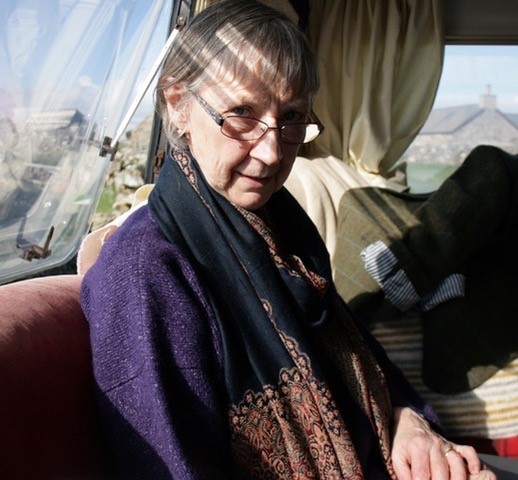
Biography: Lydia Harris lives in the Orkney island of Westray. Her first pamphlet Glad not to be the corpse was published by Smiths Knoll in 2012. In 2017 she held a Scottish Book Trust New Writers’ Award. Her pamphlet A Small Space was placed first in the Paper Swans competition 2020.
A Word in Your Ear – guest poet

Alex Josephy

It is a great pleasure to introduce this month’s poet. Alex Josephy and I met last November. We both read at the ‘virtual’ Poetry in Aldeburgh festival, along with poets Sharon Black and Christopher North – all of us with a connection to Europe.

Alex lives in London and Italy. Her collection Naked Since Faversham was published by Pindrop Press in 2020. Other work includes White Roads, poems set in Italy, Paekakariki Press, 2018, and Other Blackbirds, Cinnamon Press, 2016. Her poems have won the McLellan and Battered Moons prizes, and have appeared in magazines and anthologies in the UK and Italy.

As part of the Poetry School Mixed Borders scheme, she has been poet-in-residence at Rainham Hall, Essex, and in Markham Square, London. Alex is a poetry mentor and writes reviews for publications such as Envoi and London Grip. Find out more on her website: http://www.alexjosephy.eu

I have chosen four poems from Naked Since Faversham which show the range of her work. I hope they speak to you, as they did to me.

Grasshopper, Castelvecchio

Stalled between diagonal slats,
you’re a dry hull, ridge-backed

as if whittled from a vine stem,
forelegs splayed to grip the ledge

you’ve chosen for shelter.
Hail made me close the shutters;

that’s when I noticed you, remote
in winter torpor. When I woke

you were still here, a cold wedge
interrupting the light.

Each time I pass I look for you,
imagine how the frost

deepens, fills your hollows;
hear no rasp of song, no longing

for green. Cavalletta, little horse,
I hope we’ll see the spring.

A Word in Your Ear

Cielo, the heaven
of unimportant things:
half an hour together

in the usual bar.
It’s a light still on
when the morning sky

starts to remember blue.
Cielo, just look
at the shape of it:

five strokes, a hasty dot,
slight enough
to skim a canvas

on a brush-tip, watery
peaks and arcs.
That fluent curve –

a sudden smile,
stand-offish verticals,
and then a hug.

A little bite of something
sweet and quick –
cielo, cielo, ce l’ho!

warbles the pastry cook.
His cielo is yeast
that swells the heart

of a brioche, opens
rooms of warm air
in a bread roll.

Going Up

At the door I pause to salute
the white plastic vessel. Press

the panel, cupping a palm
beneath. The blessing flows;

I wring my hands, fold them,
gather a fearful breath, hope

for the best. Together we can fight
infection. Shed what I’ve carried,

invisible on the wheezy bus. This is
a clean hand zone. Trace finger bone

to knuckle, heart line to life line.
Catch a whiff of spirit,

hurry through Reception,
head for the silver lift.

Therapy

Take thistledown, hold it in the bowl
of your palms. Feel it tingle
like Spumante.

No, it can’t mend your heart,
but it will float you to the surface
of your skin.

Each time you long for your child
across the ocean,
find a river

or a canal., worn stone steps
down to the towpath.
Accept

a kingfisher’s quick shot of blue,
a moorhen’s buoyancy;
how easily

they dive, come up somewhere
unexpected, sleeved
in a twist of air.

DRYING HER PRAYERS

Kasane

DRYING HER PRAYERS

As the rains of spring
Fall, day after day, so I
Fare on through time
While by the fence the grasses grow
And green spreads everywhere.

                           Izumi Shikibu (late 10th C)

Mother, you are hanging out prayers on the willow
but the ink hasn’t dried;
little flies scenting sweet gum embellish
your latest calligraphy.

I breathe on my hands, it is March,
My fingers are white as bamboo.
On the bridge, I hear the sisterly
slop of our sandals, still wait

for the god, hiding behind our gate,
to give chase, tap me on the shoulder,
offer a pale green scroll
with your name written there, words

golden, scattered like pollen.


This is a poem from Parting the Ghosts of Salt, a sequence of 15 poems. They are a series of letters exchanged between a mother, Tamiko, and daughter, Kasane, both of whom are married to sumo wrestlers. Each poem starts with a striking quote, from medieval and modern Japanese poetry. All the poems are entirely imagined, but they ring true. And it’s an interesting form.

Pam Thompson

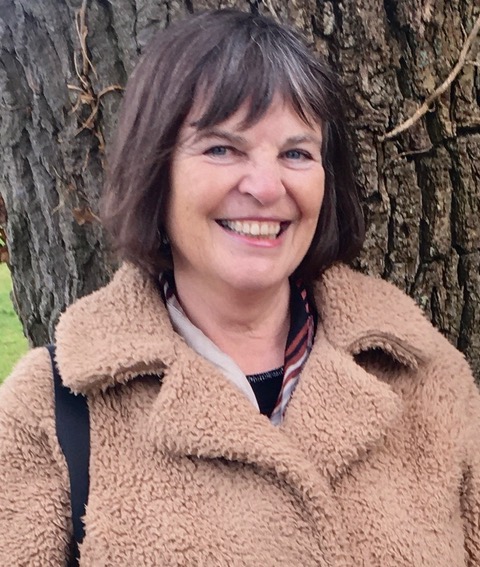
Pam Thompson, this month’s featured poet, has published several pamphlets and her second collection Strange Fashion was published by Pindrop Press last year. Pam and I met on the Poetry Business Writing School in 2012. Pam has recently completed her PhD in Creative Writing. She is a free-lance writer, lecturer, writing tutor and reviewer. Her poems travel widely. There may be humour, but this is always combined with a clear eye for the telling detail and with compassion. Pam blogs at https://pamthompsonpoetry.com

Near Heaven – a journalist encountering Virginia Woolf is at once surreal, humorous and poignant. In the Abecedarian for Liam Pam uses the form – which can be tricky – in a natural way to tell a family story rich with detail.

 
Near Heaven

The lift doors open
on the wrong floor but she’s perfectly cheery.
Ms Woolf, I begin,
and she gives me that haughty, beady-eyed stare
like an intelligent red setter,
What is it you’re reading?
She pats a huge leather holdall,
her voice trails, … Of course … in my day we …
and sunsets … Eliot, with his green-powdered face
smiled like a girl
She’s drifted off my point.

To bring her back I say
that what the reader wants is
your favourite pen, coffee or red wine.
Your top ten diary writing tips,
what to do when the novel gets stuck.

At this rate we’ll never make the launch
The Wings? Waving at the Lighthouse?
These days I never even read the press release,
just take along fizz, their favourite fags
or something stronger; usually they’ll give
me all I want, sometimes a little extra.

So, Ms Woolf, the most dangerous place you’ve ever …?

I’m thinking she’s not heard the question
when our lift bell dings –
This must be your party, dear, she says, in the voice of my mother
and there they are, uncles, aunts, my father, all my cats,
two hamsters,
and I’m about to greet them, waving fizz, posh ciggies.

A hiss of words …a Schaeffercoffee … then fainter,
write before breakfast, garden, then write again,
take a little float down the river

the river

then she presses the button, the doors close, she ascends.

 
Abecedarian for Liam

All those years you had blonde hair –
back in Hong Kong they considered it lucky.
Cake in a posh hotel, you were six, born in the Year of the
Dragon, old people touched your hair, no inhibitions,
even when we were at your side, you were golden, a charm
for locals. Remember how you wondered if the Sikh doorman was
God? The photo shows him laughing, me
helping you blow out your candles,
I hope I made you wish, then you and the other kids
jumped all over the beds and the settee in our room,
Kowloon was a day or so away, and getting
lost, both of you so little – Derry only three – to be
meandering along the wrong road, away from the lights, with
Nanna too, Derry tired and crying, I was crying inside but kept
on pretending, and I’ve blanked it, but Henry
probably got us out of it, then the day we
queued for the tram to Victoria Peak and I’ve just
remembered Stanley, the shanty town we all mentally
stepped over, physically routed ourselves around,
the tee-shirts painted with your name in kanji,
up late eating Pringles, on a speedboat with Derry, Rosie and Lisa,
visiting a Shinto temple, posing outside with Nanna,
with Tom and Fauna, your favourite smoked salmon, scrambled eggs,
Xmas breakfast with champagne, and I could lie to
you when I’m telling you twenty-one years later, that the
zoo trip was on Boxing Day when I think that was the speedboat.