Category Archives: Writing Prompt

Boxes – writing prompt

It’s good to get an acceptance and even better when it’s prompt! Thanks to Paul Brookes for accepting this poem and two others for his online poetry journal The Starbeck Orion. You’ll find it here: the 880.substack.com. Issue 4 is themed. Current contributions are open themed.


You will be asked what your favourite constellation is. I bought the domain name acaciapublications in the early 90s, so you won’t be surprised that Camelopardalis is mine. It is a large but faint constellation of the northern sky representing a giraffe.


The poem was written from a prompt on the Boxes workshop with Graham Mort. WordPress wanted to make it a list, which messed up the numbers the lines had. We like a non-sequitur…

Boxes

I declined it. The man in black nodded, walked back to the horse.

Boy, am I glad I can feel my legs.

There must always be doors for the pleasure of opening them. Cats know this.

Boardroom brown, expensive pens, hand-rolled cigars, promises on parchment.

On display in the glass case: the motorbike, black-and-white photos, three bullets.

Groundswell – so little land, so much water.

Was I not meant to see the deep scarlet lining?

Writing prompt

Which kind of box could you write about – jewellery, the one your cat prefers? A musical one with a ballerina? Pandora’s box?

Past Tense Future Imperfect – guest poet

It’s a pleasure to introduce this month’s guest poet Jon Miller. We met some years ago on a poetry workshop. His biography is at the end of the post.

Jon was winner of The Poetry Business International Book and Pamphlet Award 2022 and his latest pamphlet Past Tense Future Imperfect (2023) is published by Smith|Doorstop from which these three poems are taken.

They Made A Crime Series Here

We are miles off Hringvegur, American satnav garbling
‘Fjardarheidi’: a high pass, a blizzard shreds the windscreen,

then down to Seydisfjordur, where the road stubs itself out
against the fjord; like us, it has given up fighting the inevitable.

Past the fish factory, its yellow flag cracking the wind.
Corrugated sheds, oil tanks. Houses stare into themselves.

This town has let out all its breath, waits to take another
next century. For the lonely, binoculars stand on windowsills.

A thought bubble: Stay low. The world is not your lobster.
Tie everything down. Run for port. A beard hides a lot of guilt.

Picnic benches crouch like crabs at car parks and supermarkets;
husbands keep engines running in case wives make a break for it.

A camper van – rented – drifts by, turns down the wrong road,
bikes shrouded in grey, a child’s face at the window.

Beside the filling station three farmers lean into a trailer,
debate the efficacy of bladed implements. One looks up.

Nothing connects until everything does. We have tickets,
drive into the ferry, its belly, its deep machine hum, extras no longer.

Lost Child

Not the brazen trumpeters
or the flittering sailboats
or in the minds of mariners
with their white-washed eyes
is there a button of hope.

Neither in the small boys roaming
the fogged avenues
called home for tea
returning with birds’ nests
and the ruins of puberty.

You become a twitch
in the fingertips of newscasters
or out here where it happened
the midnight click of the latch
the song in the five-barred gate.

This Way to the Observation Lounge

Out through the placid archipelagos they go
at ease in their daylit aquarium
moving over water at the pace of a slow car.

The sea is flat on its back. The flag barely mutters
at the mast. All are hypnotised by empty sea and sky,
by the line where nothing meets.

They have left the world to turn without them.
and sit with hands clasped in laps
as if listening to a sermon on vacancy.

Asleep, they twitch to escape their clothes.
They know themselves the way the blind
feel what they cannot see.

I could tuck in chins, settle a head on its neck,
retrieve dropped novels, while their eyes read dreams
the way an unborn child pushes against its mother’s belly.

They are at rest. Someone is on the bridge.
Over the horizon is harbour. Weather is busy somewhere else.
Who they are has fallen away like rain over islands.

Biography

Jon Miller lives near Ullapool in the Scottish Highlands and has had poetry published in a wide range of literary magazines as well as being a contributor of book and exhibition reviews and literary journalism. He formerly editor of Northwords Now, a magazine featuring writing from the north of Scotland. He was short-listed for the Wigtown Poetry Prize in 2021 and awarded joint First Place in the Neil Gunn Poetry Competition 2022.

A Coalition of Cheetahs – guest poet

It’s a great pleasure to introduce our April guest poet Doreen Gurrey. We met on a writing workshop some years ago and belong to a group that meets regularly online. You can find Doreen’s biography at the end of the post. I have chosen three poems from her new pamphlet A Coalition of Cheetahs, just out with smith/doorstop. It was a winner of the 2023 Poetry Business International Book & Pamphlet Prize.

Zoo

From the lit hall, I slide back the hardboard panel
to find you under the stairs, crouched like an Indian street seller
in front of the toy animals you’ve fumbled into a ring.

Hands and knees on chipped linoleum, I crawl in,
smell the turps and boot polish, the must of apples
separated until next year.

You’re listening to the slow clicks of the electric meter,
your heart monitor, sharing the sound with the broom
which shoulders the corner like your guardian angel.

I haul you out, pick up the polar bear, giraffe,
the big elephant and the little elephant, then soothe
the smouldering print, reddening on your thigh.

Yarn

I was learning to knit when you left me,
decoding the language; stocking stitch, moss,
knit2tog., twist; the wool a filigree

snaking through my fingers across
the floor. The note was cold: In Italy
don’t write or ring. Needles knit up my loss,

a pink anaconda down to my knees.
I learned to pick up stitches I’d dropped,
then all my friends said pink suited me,

asked would I carry on or had I stopped?
I said I’d started another in green,
that casting off was easier than casting on.

Guest

You came with all you needed,
your car a metal suitcase,

the boot full of booze
the back seat housing a portable grill.

Temporary you said, but I forgot
how little you need to live.

You kept mostly to the garage,
the beer stacked next to the tool box,

the radio tuned in to the French news;
you smoked your roll ups and grilled

your côtes de porc.
My washing took on a Gallic smell.

Now you’re gone, I’ve got the garage back,
but sometimes mistake

the growl of the tumble drier
for your phlegmy cough,

the washing machine’s whine
for your whistling.

Biography

Doreen Gurrey trained as an English and drama teacher and for several years ran her own Youth Theatre Company. She went on to become an Adult Literacy Tutor writing and delivering Family Learning courses for the local council. Latterly she has worked as a Creative Writing tutor at York University. Her work has appeared in Poetry Salzburg Review, The North and The Yorkshire Anthology. She has won prizes in The McClellan, Bridport and Troubadour poetry competitions. Doreen lives in York and has five grown up children.

Wendsday – guest poet

It’s a great pleasure to introduce this month’s guest poet Matthew Stewart, with three poems from his collection Whatever you do, just don’t. It was published by HappenStance Press to their usual high standards in 2023. The background of the jacket is an old map of Extremadura, Spain. The poem Gostrey Meadow was published in Stand. See below the poems for Matthew’s biography. I admire the attention to detail, precision, and economy of his poems: so much between the lines…

Banana

Come to think of it, she didn’t tell us
who’d got hold of the banana, or how,
and we forgot to ask, stunned by the news
that at ten years old she’d never seen one.

She was still proud her class had raffled it
for the war effort, still slightly mournful
at it turning black on her teacher’s desk
long before they drew the winning ticket.

She wouldn’t talk about gas masks, the Blitz,
the doodlebugs (how they changed to V2s) —
but she always recalled her fury
at the waste of bloody good food.

Wendsday

Halfway through the word and the week,
my pen used to pause and stumble,
tripped up by my eight-year-old tongue

and even now I still delight
in having learned at last to swap
the n and d and add the e.

I stumbled, too, after coming
to Spain. Shook off routines and rules.
Let a new language soak through me.

Two more hassle-packed, tensed-up days
till vino tinto y queso
instead of cod and chips.

Gostrey Meadow

Showing my son round, I notice
a father taking a picture
of his wife and son who’s melted
half an ice cream on his fingers
and the other half on his face.

It’s a copy of a photo
in our album. Same river.
Same heat-laden sky. Same roles.
Same spot on the bank. Same pose.
Our trees were ten feet shorter.

Biography

Matthew Stewart lives between Extremadura in Spain and West Sussex in the South of England. He works in the Spanish wine trade as a blender and exporter. His blog site ‘Rogue Strands’ is a respected source for poetry lovers, and he reviews widely for a range of publications. His first full collection was The Knives of Villalejo (Eyewear, 2017). Before that, there were two pamphlets from HappenStance:
Tasting Notes (2012) and Inventing Truth (2011).

To Live Here – haiku

This month’s guest slot is for poems from To Live Here, an anthology of haiku published by The Wee Sparrow Press. The Press was founded by Claire Thom. 100% of the proceeds of their anthologies are given to charity.

The anthology is edited by Giorgia Di Pancrazio & Katherine E Winnick. The lovely cover and illustrations are by Scottish artist Colin Thom.

To Live Here is “A collection of haiku on the theme of home, which explores the many facets of human experience, from the mundane to the sublime. Featuring the work of talented poets from around the world, this anthology invites readers to reflect on the beauty and complexity of the world we inhabit.”

Salford Loaves and Fishes, a charity supporting the homeless, has already received over £600. The anthology is available through Amazon – ISBN 9788409528165. I’m grateful to Francis Attard and Julie Mellor for permission to share their haiku.

sandy beach
turtles lay clutches of eggs
off-shore breeze

Francis Attard, Malta

three cornered field
the generations
who farmed here

Julie Mellor

on the verge a stork stepping out

Fokkina McDonnell

Forgetting My Father – guest poet

Photo credit: Naomi Woddis

It’s a great pleasure to introduce our December guest poet Jill Abram. Jill and I met several years ago on a writing workshop. I have chosen four poems of Jill’s pamphlet Forgetting My Father. The beautiful cover was designed by Aaron Kent and was inspired by rhododendrons in the last of the poems. You’ll find Jill’s biography and links after her poems.

This is the last post of 2023: Season’s Greetings to you; thank you for your support.

How To Belong

At Jewish youth club we all wore
Rock Against Racism badges
and danced to Glad To Be Gay
girls in one ring, boys in another.

They ate ham sandwiches when
their parents weren’t looking yet
scorned me for Smokey Bacon crisps
and going to school on Yom Kippur.

The Evangelicals lured us into their
church hall with ping pong then tried
to keep us with singing and prayers
and Jesus. They wanted all of us.

Words Are Not All We Have

Words are all we have. – Samuel Beckett

Don’t get into debt with anyone but me!
Dad’s sole instruction when he left me
at university. When we did the reckoning
he took the hit on my car’s depreciation.
And because I’d sold it, he drove 300 miles
in his to bring me and all I owned home.

We argued over SI units once. I fetched all
my A-level text books, showed him proof
after proof. He wasn’t having it. He’d grown up
with imperial; I knew metric, and that I was right.
Next day he brought a page he’d found at work,
looked at the floor as he handed it to me: I withdraw.

Now he can’t say anything because of the tube
in his throat and maybe – we’ll know when they
remove it – that blood clot. When I try to leave
his bedside, he grips my finger and won’t let go.

My Sister Is


a gold coin:
She is precious.
Her style is simple and elegant.
I’d like to exchange her
for something of equal value.

an alarm clock:
Controlled by radio from Rugby,
accurate to a fraction of a second.
If she were by my bed, she’d go wrong
and wake me at 5am.

a mid-morning beverage:
Green tea fits her philosophy,
black coffee her personality.

a steamroller:
She’d say that was more appropriate
for me, being heavier than her.
I’d say she has a greater power to crush.

a bear:
Will she be a ferocious, mama grizzly
or cuddly teddy? We never know
until she gets here.

a window:
Round, square or arched?
Hmm, certainly arch

a hand thrown pot:
Finest china drawn out thin, glazed
in lustrous copper and cobalt. In the kiln,
a bubble formed on her rim.

a coffin:
Made to measure, lined with silk,
a velvet cushion, and no shortage
of people to carry it.

Slow Orphaning

Images slide across my lock screen at random:
hot pink rhododendrons at Kew last May,
glasses of rum and ginger on a hotel balcony.
Here’s Mum, pensive and beautiful as she
gazes at the skyline from a Thames boat
when she came to see me. The last time
I tried to visit her, she said she was busy.

Dad teeing up on the ninth at Dunham
in an orange cagoule. Rain never held him back.
A heart attack slowed him. A bypass stopped him
at a stroke. His body survived fifteen years
while his mind died and I grieved for
so long. So long I was surprised
there were still tears for his funeral.

Biography
Poet, producer and presenter, Jill Abram is autistic, has Jewish heritage and lives with fibromyalgia. She grew up in Manchester, travelled the world and now lives in Brixton. She has performed her poems, which have been widely published, across London and beyond, including Ledbury Poetry Festival, StAnza, Paris, USA and online. She was Director of the influential collective Malika’s Poetry Kitchen for twelve years. Jill’s debut pamphlet, Forgetting My Father, was published by Broken Sleep Books in May 2023. Jill has a newsletter. You can sign up via her website or directly via this link and here is the link to Broken Sleep Books, if you want to buy a copy of the pamphlet.

Carnation Lily Lily Rose – guest poet

It’s a great pleasure to feature four poems from our guest poet Jane McKie. Her collection Carnation Lily Lily Rose was published by Blue Diode earlier this year. The title and title poem are after John Singer Sargent’s painting of the same name. Each word is also the heading of the four sections of the book.

The collection includes a range of poetic forms and shapes: prose poems, a concrete poem, long and thin poems. We meet couplets and triplets, striking titles: Cairn to a Dead Biker, X-Ray of a Deer’s Skull. The poems crackle with energy and vitality. The book is ‘a hymn to all the different kinds of connective tissue that lightly, but firmly, weave us into the fabric of our own and others’ lives’. (David Kinloch).

Lord, Make Me an Instrument

Here the clouds outrun land: greyer, fleeter,
casting their shadows on the estuary and making
mud move at their speed, blown rather than
fixed, flexing with light / dark / light / dark,
sea-blite at the edges to catch the odd discarded
fag butt. Sea pea, clover, yellow vetch.

Further out, the flattened eelgrass – a trammelled
thatch without the tide; with it, upstanding,
like proud speech. Into this landscape creeps
a man following redshank, black-tailed godwits;
watch him huddle – glimmer of a struck match.
Winged souls call to the crackle of his breath.

Sand

Tonight, I’m in an arbour designed
by an artist who moonlights as a gardener.

Our host’s aesthetic sixth sense is spot on:
look how the roses jostle the frame,
how the lattice pins them like pretty moths.
A drink in one’s hand is compulsory.

And we guests are laughing, playing up
a hunger that may be on the wane,
but holds us, tonight, as snug as palms
around glasses. It is brilliant, this garden,
and familiar, as if it is not a garden at all
but a gateway, and we are not guests
at a middle-aged party but school-leavers
on a promised, delicious brink.

Tonight, if you sliced me open,
you would find a swirl of glitter:
all the shades of the sand
at Alum bay squeezed
into one miniature glass lighthouse.

Antigravity

They hover along pavements, barelegged,
on Mini Micro scooters, a flock of them –

the best of us. Hovering in shirtsleeves, hearts
and mouths open before guile sets in.

Don’t they feel the cold? Hovering to class
like motes in light.

On this unbearable, ordinary day, we mothers
can’t stop them lifting off the ground,

their small hands to their mouths
as they giggle, spitting out milk teeth,

growing too quickly. Catch onto
their waistbands and don’t let go.

Harness

I think of the invisible harness that hitches us, one to the other,
how it signifies both baggage and provision;

how, in the past, I have slipped the harness
and tested freedom, finding it overrated;

how mood is a harness, like gravity, pitching our orbits
a little off-kilter;

how sometimes the harness pinches and we are inclined
to worry it, fidgeting, even to tear at it;

how we trust the harness to repair itself like skin.

Biography

Jane McKie works as a Senior Lecturer in Creative Writing at the University of Edinburgh. Her first collection, Morocco Rococo (Cinnamon Press) was awarded the 2008 Sundial/Scottish Arts Council prize for best first book of 2007. Recent collections include Quiet Woman Stay (Cinnamon Press, 2020) and Jawbreaker (2021) which won the Wigtown Poetry Festival’s Alastair Reid’s Pamphlet Prize 2021.

Jane, as a member of the Edinburgh-based Shore Poets, facilitates poetry readings and music. She is interested in collaboration across forms, writes with 12, a collective of women writers, and with Edinburgh’s genre spoken word group Writers’ Bloc.

Fieldfare, blown off course, early spring – guest poet

A lively and intriguing title for a poem sequence by our guest poet Lydia Harris. Her work has featured here before (March 2019). This sequence is from her new collection Objects for Private Devotion, beautifully produced by Pindrop Press, published last year. Lydia lives in the Orkney island of Westray. Many of the poem sequences in her new book focus on local culture, people, nature, objects – such as the prayer nut which provides the cover image.

The sequence about the fieldfare is inspired by the great Serbian poet Vasco Popa. The Blackbird’s Field is also a sequence, from Popa’s Collected Poems, close on 400 pages – drawing on folk tale, surrealist fable, personal anecdote, and tribal myth.

Fieldfare, blown off course, early spring

After Vasco Popa 

My Fieldfare

He’s made of bone pins.
He’s a book inside a box
with a beak-shaped lid.
A snapped-shut lock.

He Makes Landfall

at Hagock where the Scollays
ploughed in patches,
wore tracks with their boots,
gulped spring water,
built their house.

Body

His muscles hurtle
from rump to neb.

First Song

The sky is my eye,
earth my egg.
From Noup to the Ness
in the turn of my head.

How I know him

His underwing flashes,
he wheels before settling
on plough or pasture.

His Manners

When the tide is asleep
he swallows it.
His wings are granite
with a hundred eyes.

Second Song

Bone grinds skin,
stone splits grain.

His Passion

Flames again.
He thinks he is clay.
The sea wrought him
like a mace head,
speckled, banded,
half-way done.
Bird before he was bird.

Third Song

Snapped flint,
water-worn
sea pebble.

His Dress Code

He squints through an eye mask,
lifts his mottled back through west winds,
across north winds.

A Flagstone in the Wall Speaks to Him

Grapple with my grain.
My night surfaces.
Tap the lichen from my face.
Draw silver from my base.

Lament

I’ve lost my folk,
my night ships,
my dear blood,
thick then thin,
night bird, stray bird.

Tongue

A whip of liver-coloured flesh
sheathed in the coffin of his beak.

His Heart

Its flicker forms ice,
his own padlocked air.
His map of the wind
stiff with frost
in the skirts of an old storm.

He Takes His Leave

Fooled by the moon.
He’s lost his bearings,
like the night boat.
We need to talk
on the edge of sight.

Biography: Lydia Harris lives in the Orkney island of Westray. Her first pamphlet Glad not to be the corpse was published by Smiths Knoll in 2012. In 2017 she held a Scottish Book Trust New Writers’ Award. Her pamphlet A Small Space was placed first in the Paper Swans competition 2020.

paper crown – guest poet

This is my 300th blog post. Many thanks to all the blog’s followers, also for your likes and lovely comments. They are much appreciated. I’m taking a break from weekly blogging: I need to ‘fill the well’ – take myself out to find poems and art on the streets of The Hague, get inspired and fired up again. I’m celebrating the 300th post in the company of Cecile Bol – our August guest poet.


Cecile is also the organiser of the Poetry Society’s Groningen Stanza. When I moved back to The Netherlands , I was fortunate that their meetings were on Zoom due to the lockdown. It was great to meet Cecile and other members of the Stanza in person earlier this year. The hotel where I stayed is just a few houses down from the literary café De Graanrepubliek where they meet.


I have chosen three poems from Cecile’s chapbook Fold me a Fishtail. Read more about Cecile and the book below her poems.

yet you speak of resilience

there are things that make me sink back into the grave
(red on black, stardust freckles, knee socks, foxy wrists)
inside Plato’s cave, where moving shadows are safe

I saw a flowered brown tie turn into a snake
woke up crying, your shoulder blade stuck to my lip
there are things that make me sink back into the grave

same table, same cheap wine, same talk, another day
you pull me close as if you’re not pushing me in,
inside Plato’s cave, where moving shadows are safe

like the cute demon I asked how I should behave
– he said ‘always choose slyly between loud and still’ –
there are things that make me sink back into the grave

they nibble at my feet, ask if this time I’ll stay
(petrol candy, flawed magic, and plenty to kiss)
inside Plato’s cave, where moving shadows are safe

I seep through layers of earth, call out all their names
yet you speak of resilience as if we can win
there are things that make me sink back into the grave
inside Plato’s cave, where moving shadows are safe

paper crown

a cut-out crown is still a crown
for a girl on a stolen horse
I would have swapped our sanities
to see her hair become lost in
rose horizons, saddlebags filled
with boxes of chocolate sprinkles

I’d been chasing robber children
long before we met – and I will
stick with this selfish travelling
until or well beyond my death
but she – she bore whole galaxies
sprinkled into maps on her skin

in my inside pocket you’ll find
scissors, tape and golden paper
the day I borrowed her reindeer
I thought in time she’d ride my horse
instead I stop at roadside shrines
and eat chocolate sprinkles daily

robber child: arguably the most interesting character in H.C. Andersen’s story The Snow Queen is the unnamed little robber girl

Krasokouloura

I should have made them milk
and bread, while they were still in bed –
instead, I impulsively fired up
the electric oven – as always, procrastinating –
to bake twenty ring-shaped Greek cookies
with things lying around the cupboard.

Flour, sugar, baking powder, cinnamon,
salt, ground cloves, some olive oil
and another glass of white wine.

I should have written them a note,
but I’m that cat; as always, capitulating
to curiosity – I had to taste one, still warm,
curled up on the windowsill – new sun,
please, tell me what skills it would take
to achieve immaculate roundness.

Biography:
Cecile Bol is a Dutch writer with a small family and a big edible garden in the north of the Netherlands. She doesn’t have an MA in Creative Writing, because things like that don’t exist in her country. She does, however, earn her money as a self-employed copywriter. The somewhat well-known poet Helen Ivory describes Cecile’s work as ‘like finding snakes in your strawberry patch’. Cecile enjoys incorporating fairy tales and popular culture in her poetry, and her poems often have a slight erotic edge. Cooking (mostly Greek) food is her means of meditation. Cecile owns 57 different kinds of herbs and spices of which cumin and dill are her favourites.


Cecile’s debut chapbook Fold me a Fishtail was published by UK-based Selcouth Station Press in 2022 (Sadly, Selcouth Station Press ceased to be in 2023). So what’s Fold me a Fishtail about? Cecile: “I sometimes wonder whether Disney’s Ariel misses her mermaid tail, now that she’s the legged wife of prince Eric. Isn’t she way too curious and free-spirited for a conventional family life? Or is that just me? That feeling chained to a husband, toddler and suburban lifestyle was enough to drive me dangerously crazy? Fold me a Fishtail is a collection of mostly confessional poetry about a long journey into, through and out of (?) the dark.”

Favourite objects – writing prompt

Credit: geralt via Pixabay

A prose poem of mine was published in # 185 of orbis magazine. The inspiration may, in part, have come from reading the long prose poem 12 O’Clock News by Elizabeth Bishop.

It refers to eight items in her room, with a gooseneck lamp standing in for the moon. The first section ends ‘Visibility is poor. Nevertheless, we shall try to give you some idea of the lay of the land and the present situation.’

I love the humour in it. Here is the description of a pile of mss: ‘A slight landslide occurred in the northwest about an hour ago. The exposed soil appears to be of poor quality: almost white, calcareous and shaly. There are believed to have been no casualties.’

Bishop’s prose poem changes tone as it continues. With the final object, ashtray, we’re suddenly in a warzone; there are dead bodies, corrupt leaders are mentioned. It’s even more devastating because of the ordinariness of the object.

Animate and inanimate objects relating to J Abraham

The favourite mug

Waisted, Nile green, curved handle, fit for purpose: dishwasher proof; delicate gold lettering The Frog Prince, on both sides: black frog, gold crown. I admit to one shadow side: pangs of jealousy when on Sundays I see him take out the old cup-and-saucer. Mr Abraham is a bachelor, but tells visitors he has been married twice, to the same woman. In fact, he is an inspector of taxes.

The handkerchief

With a yellowing initial I do not get many outings. It was a proud moment last Friday, row H in the stalls, aisle seat. A Bruckner motet. That gentleman called ‘J’ keeps concert programmes in a special box file. Used to sing in a choir, but has given up on Him upstairs.

The ashtray

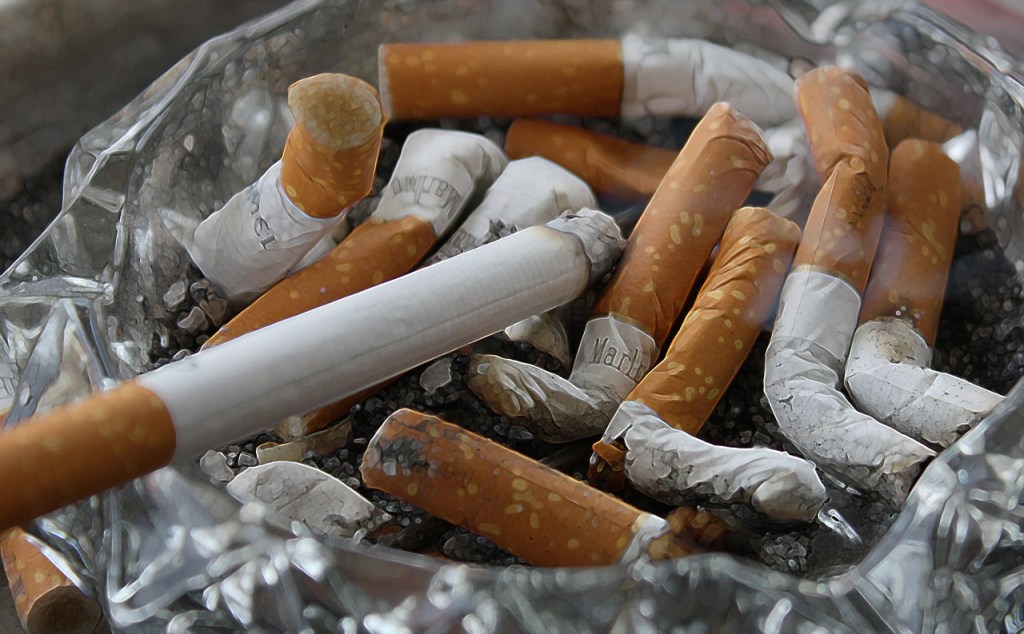
My life as a masochist, the short version. I am clean and I have barely any burn marks. To make matters worse, I was moved to the shed. Technically, it’s a Summer House, but no windows, so no tax is payable. He should be told that non-smokers too can die of lung cancer. I am praying for a relapse.

The moustache

Hegel, Kant, Wittgenstein, Hume, Locke, Rousseau, Voltaire. Cogito, ergo sum. Sum, ergo cogito. A butterfly can remember its life as a chrysalis, and I have full cognisance at cellular level of my previous manifestations. JA grows me specially, once a year, for a charitable purpose. This year I have a Teutonic shape. The flecks of grey soften my appearance. Mug, handkerchief, ashtray – they will end up in a grey bin, or at The Red Cross. I will have the last laugh.

The newspaper cutting

Protected by a plastic wallet, I’m a piece from The Guardian 08.05.12. How we made … Break Down: Artist Michael Landy on how he and his collaborator destroyed all 7,227 of his possessions. Need I say more?