Category Archives: Art

Hacker – guest poet

Keith Lander


It’s a great pleasure to introduce this month’s poet Keith Lander. We first met early autumn 2004 in the Village Hall, Manchester where the poet Linda Chase was running a weekly poetry course, on behalf of the Poetry School. The Poetry School is the UK’s largest provider of poetry education, offering a wide range of courses at all levels.

Keith Lander was born and grew up in Manchester. At school he studied sciences and went on to gain a B.Sc. in mathematics from the University of Wales, Bangor. This led him into the IT industry where he worked as a software engineer and for several years was a consultant for Siemens in Munich.

He has had poems published in a number of anthologies and magazines including The North, Envoi and Obsessed with Pipework and has been long listed three times for the National Poetry Competition. He has an M.A. in Creative Writing from Manchester Metropolitan University.

The three poems feature the mysterious “Milo” character. You can find all three in the pamphlet Pandemonium, published by Yaffle Press in 2019. For more information about Keith Lander go to his writing website.


Hacker

This morning Wu Mian of Guangzhou province,
Zen hacker extraordinaire, Milo’s big buddy,
will smash through Mr C’s firewall
using a password provided by Milo.

He’ll be sitting alone in his garden
surrounded by clematis and acacia blossom
listening to the music of the fountain
while reading Lu Chi’s Wen Fu.

A trojan horse will appear out of cyberspace
and release its hidden hoard of phisher men
who’ll slide into the fountain,
hack their way into his heart
and steal his deepest secrets.


In theatre: Milo’s view

Milo tells me I won’t feel a thing.
He on the other hand will be awake
monitoring the situation.
He’s seen the videos on YouTube,
how they stop the heart, cool the body, pump
the blood through a machine. No way is he

going to get trapped in that infernal thing.
So he stays out of the arteries, surfs
from lymph node to lymph node, watches the surgeon
remove the right saphenous vein through a hole in my groin,
peeps gobsmacked as they graft it in place.
And how he cheers when they remove the valve,

the choked old squeaker. How sweet the bovine
replacement smells—green grass, fresh pastures.
He has to cling to a rib while they staple
the sternum back together, but then passes out
when they shock me back to this world.
Milo was right: I didn’t feel a thing.
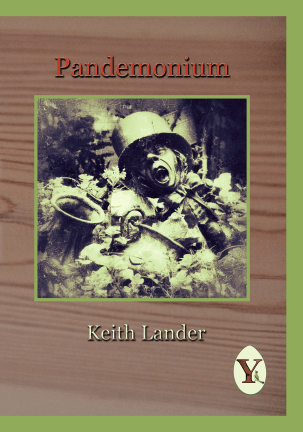
 

Pandemonium-cover (002)
Retirement

After a shit life horse-trading with wankers
down back streets of shady deals
he sought nirvana
in a kingdom of ticky-tack and sushi
finding it here, in this place,
with its parity of peace.
The psychedelic visions of his gullible youth
have paled into shades of white.
At last he’s immune to most earthly hazards,
but at night, in his boxroom,
he’s started to have visions
of a black shadow—
Milo in his cave lurking just out of sight.
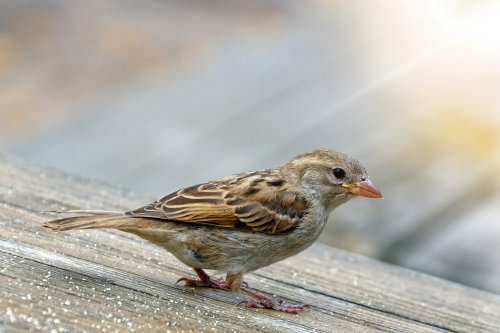
Birds on Paper (2)


sparrow-4334964_1920 (2)

Photo credit: Susanne Jutzeler, Suju Foto on Pixabay

More birds: here is the second half of the sequence Almost complete poems: encounters with twelve birds. The inspiration for these short poems came from different sources:

* The title comes from the Wallace Stevens poem Thirteen Ways of Looking at a Blackbird. I decided I needed at least one blackbird poem, but there are two.
* i – Almost complete poems is the title of a poetry collection by Stanley Moss. It is published by Carcanet who (used to) send postcards with pictures of their books with your order. The cover image of the book is Still Life of Grapes with a Grey Shrike, Antonio da Cavalcore. I keep dozens of art postcards in a box, in case there is no inspiration.
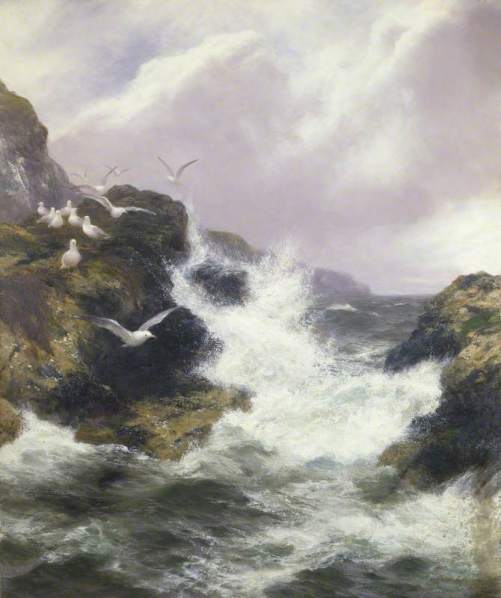
* ii – Painting The Sea-Birds’ Domain by Peter Graham in Manchester Art Gallery. The reproduction doesn’t show it clearly, but my dialogue is with the bird on the rock that is nearest to the viewer.


Graham, Peter, 1836-1921; The Seabirds' Domain

Graham, Peter; The Seabirds’ Domain; Manchester Art Gallery; http://www.artuk.org/artworks/the-seabirds-domain-205095

* v – inspired by reading Jaan Kaplinski, Estonian poet.
* vi – observation from my attic window.
* viii, x and xii – a short writing exercise from workshops with Ann Sansom, the Poetry Business. She often does these just before a break. Mostly six or seven lines with restrictions, for example line 1 must have a day of the week, line 2 a building, line 3 no rules. Written against the clock, some small jewels may appear.
* ix – observation from sun lounge window.
* xi – inspired by that phone call. The tanka was published in Blithe Spirit, the magazine of the British Haiku Society, some years ago.


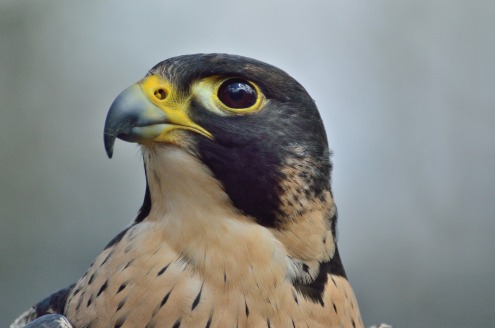
peregrine-falcon-371610_1920

Peregrine falcon, Photo credit: Ray Miller on Pixabay

vii
Pocked and pitted stone
visible only to the peregrines
that nest on this cathedral –
a grimace carved by the stonemason
who used to beat his apprentice.

viii
Sundays summer and winter
we went to church at least once –
If I was that tiny sparrow
I would slip out, circle the white
spray, marram grass, the endless shore.

ix
Blackbirds nest in the ivy hedge,
as one comes in with food
the other exits at the side –
I remember those empty rituals
well-meaning suitors spurned

x
All around fields are planted with dill,
among the fronds an anklebone.
Just one pale bone.
Scrawny canaries fly across
the aria Verdi never composed.

xi
My friend calls:
an orphan
at sixty, suddenly
I hear blackbirds sing
thin, feathery clouds.
xii
A lost parakeet, friendly face
against turquoise wings
paper notice on the mat –
small birds are a comfort stone
to be carried around in a sombrero.

Birds on Paper


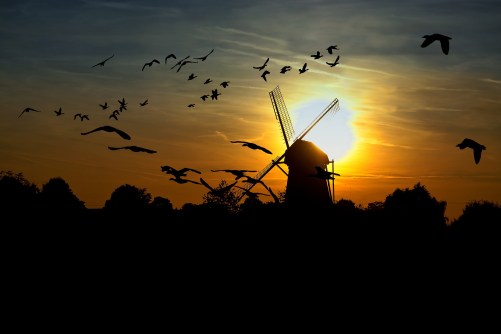
sunset-610097_1920

Photo credit: Foto Rabe on Pixabay


The last few months the poet John McCullough has posted many colourful images of amazing birds on Facebook. Other days he shared helpful advice about writing poems. It is fitting that his third poetry collection Reckless Paper Birds was recently awarded the Hawthornden Prize – the oldest of the major British literary awards (established 1919).

Reckless Paper Birds has been described as “dazzling” and a “celebration of abundance”. It was published by Penned in the Margins last year.


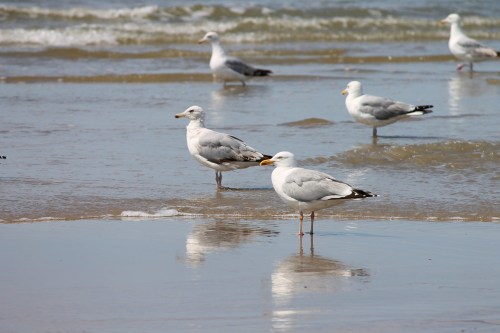
silver-gulls-4335397_1920

Photo credit: Manfred Richter on Pixabay

When I was putting the manuscript together for my second collection Nothing serious, nothing dangerous, I came across several short poems about different birds. So, these became a sequence: Almost complete poems: encounters with twelve birds. Here is the first half of the set.

Almost complete poems: encounters with twelve birds

i
If they’re honest
most poems are almost:
the nearly-there bird,
bowl of glowing grapes,
sun, this still life, silence.

ii
You don’t belong here
she seems to say.
Two small black eyes peer
straight at me.
There is a shadow over
the bowl of her belly,
a pale-blue shawl for wings,
feet firmly planted
on an outcrop of black rock.

Gannet, you are wrong, I say,
like you I’m mostly in the air,
white spray, white clouds,
lifting and landing.
The in-between domain
often cold and steep.

iii
In her dreams that night angry birds
came and pecked at the cherries,
small red stains on the grass –
it was a summer slowly
shrinking at the corners.

iv
On the shingle barnacled white
fishing boats lie on their side.
Standing above its reflection,
a gull stares straight ahead.
The gulls are tucked into their own lives.

v
The honking of homeward geese,
hush of flags half-mast on a building,
the crunch of fresh snow underfoot.
In Estonia planets were venerated,
I am Stella Maris, the planet’s interpreter.

vi
Squawking draws me from my emails.
I see two magpies closing in
turn on a young blackbird
peck      peck      peck
This bird gave its name to an opera.

Celebrating creativity …

marigolds

Too many gardening programmes can seriously damage your health! They said if you plant out your marigolds you will get a splendid display, but Nigella hasn’t had a single flower. Monty Donkey. What does he know?

During lockdown, the first thing I did after breakfast was to go to Facebook to see what my poet friend Helen Kay had come up with that day. As Helen explains:

“In 2016 I wrote some poems about chickens. I hit the road and read my poems to local groups, but something, or someone, was missing to bring a spark into my performance – and that was how a hen glove puppet came into my life – you could call it puppet love. I had no idea that my lively alter ego would become more popular than me, delighting all ages with her lively mix of bright-eyed innocence and femme fatale. She even has her own little book of poems called the Nigella Monologues- it’s all about me.

In 2020 lockdown came and Nigella and I left our home to live with my 99-year-old Aunty Phyllis. It was all very sudden; our packing was mostly food parcels, a laptop and a couple of books. Hidden away, we wanted to help others. Facebook seemed awash with anger and sadness, so Nigella and I decided to do a funny daily photo on the theme of keeping Sane & Safe. People liked it, so we ended up doing 103 posts. We made scenery using toilet rolls and old paint in the garage. Aunty Phyllis home schooled Nigella about the war and dug out bits of fabric. People added their own puns and quips and chatted to each other. The last week Nigella had her own art exhibition, then left us for the stars in her A Pollo 103 Spaceship. Out of the dark a star was born. Who knows what next?”

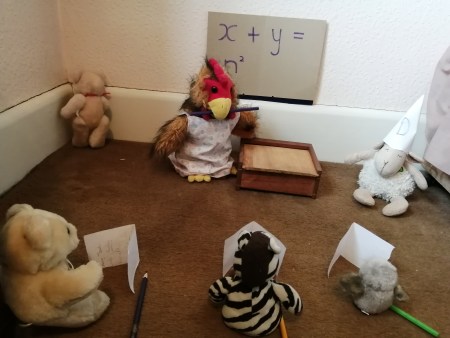
Nigella 2

Home School and the pecking order. Today maths: some things are more equal than others.

The posts brought me joy and gave me a cheerful start to the day. Some posts included references to very British phenomena: those Marigold gloves, Monty Don, a well-known TV gardener, Orwell’s Animal Farm. The wit was a bonus. The posts showed me how curiosity and creativity are a fundamental part of our survival kit. Let’s finish with a celebration!

NIgella 3

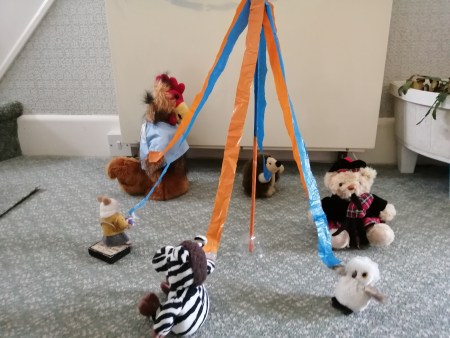
Celebrate May Day with a social distancing activity. Don’t get yourself in a tangle.

The Nettlebed – guest poet

Matthew Paul June 2020 (002)


I feel that I have known this month’s poet for many years. But, I don’t think we have ever met. Like me, Matthew Paul has been a participant on The Poetry Business Writing School. We both had work published in an excellent haiku journal. I very much enjoy his blog posts and am pleased that I can introduce you to his work: grounded in actual place and rich in vivid detail.

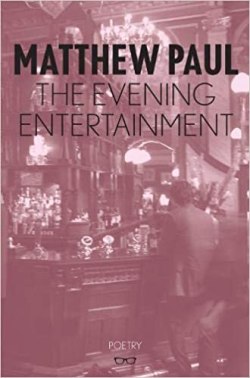
Matthew was born in New Malden, Surrey, in 1966, has worked for 30 years as an education officer for local authorities in south-west London, and lives in Thames Ditton. Matthew’s first collection, The Evening Entertainment, was published by Eyewear Publishing in 2017.

He is also the author of two collections of haiku – The Regulars (2006) and The Lammas Lands (2015) – and co-writer/editor (with John Barlow) of Wing Beats: British Birds in Haiku (2008), all published by Snapshot Press. He co-edited Presence haiku journal, and has contributed to the Guardian’s ‘Country Diary’ column.

 
THE TOXTON TORCHERS

Still their identities are secret. Let’s call them Gary and Glyn,
names which are popular then, at the Sixties’ fag-end.
This nit-locked pair of toe-rags, seeking alms box and plate,
enter St Joe’s via its sacristy, find nothing of value
and burn down the sanctuary like proper East End heavies.

They’re not discerning: any place of worship will do-
in the next few weeks, Our Lady Star of the Sea, St Anne’s,
the Kingdom Hall and the new St Margaret’s all go up in flames.
It’s when they smash collection boxes in All Souls that it ends:
old Reverend Carew and his nimble curate get straight on the blower
to the Law, who tip up in Black Marias at Z-Cars speed.

Gary blames it all on gormless Glyn. Brought before the Bench,
their eyes light up like matches as they detail every deed:
how in the new church they hadn’t the heart to torch the tapestries
as so much effort had been put into them, most by Gary’s nan.

 
THE KITCHEN GARDEN

On Capability Brown’s last visit
to this well-temperèd chalkland estate,
he plumped for action instead of advice:
training espaliers of local pears,

which would otherwise have become extinct,
against ev’ry venerable wall of brick—
‘for market opportunities’, he said,
and focused eyes on an artichoke head

whose outer bracts formed interlaced patterns
around the heart’s delirious embrace,
aubergine-veined chroma of grey–jade green.
He claimed it resembled ‘a scarecrow’s brain’.

Unaccountably, he bricked up the arch,
to dead-end our last remaining path;
so now unscalable walls enclose us,
in God’s own country’s Hortus conclusus.
(Both from The Evening Entertainment)


TEE (002)


THE NETTLEBED

One September afternoon in August, a water vole
beavers through reeds. I feel the slap
of rain on my father’s umbrella. Mercy
and I compare families: I can’t compete
with her memory of travelling,
as one of five kids, with her moody
half-sister in the boot of their dad’s Datsun Bluebird,
without a torch. The teasel-lined tributary disappears,
reappears. Moorhen chicks stumble off lily pads,
to spatter at pace upstream, their parents
flicking tail feathers and squeaking alarm.

We reach beyond toddler-high nettles and burdock—
seedheads packed like the yellowest sunflowers—
to pluck the last few blackberries, sugaring
from ruby to plum. Mercy says the wide outdoors
keeps her well; that nothing else,
neither booze nor love in any of its myriad forms,
quite does the job. We sit on a log to wait and watch.

The moorhens tiptoe over stepping stones fording
back-water channels, to vanish like mumbled
anecdotes. I shake the rain from the brolly
into the river. Day’s end brightens
as an afterthought muttered out loud; becomes
a crumbling hurrah of loneliness. Dusk
spotlights parakeets sidling, like circus budgies,
along the railing of a tower-block balcony.
We realise, then, our arms are stung to fuck.

(Previously published, in a different form, in Fire.)


PLOUGH POND

Tiptoeing through them to the Co-op
would be impossible, this ragtag army

of marsh frogs. They block the alley
from our cul-de-sac’s cul, pairing up

to belly down within the water’s grease:
tansy eyes, camouflage-trousered legs

and lime-striped backs, clamped
in the fumble of joyful amplexus.

(Published in Poetry Salzburg Review 34, summer 2019)

Father’s Day


40th Wedding Anniversary
The picture shows me and my parents at a dinner to celebrate their 40th wedding anniversary in 1984. At Christmas 1988 I became the scapegoat for the difficult circumstances around my sister leaving her husband. My father, my brother and that husband were all called Theo. My sister was living with someone else by then.

So, one Theo told me off for keeping in touch with that Theo and the third Theo collected me from my parents’ flat and took me to the airport. My father and I became estranged. Late September 1990 my father was taken to hospital after a suspected heart attack. He was doing okay, my brother told me, no need to rush and book a flight. Two days later my father died in hospital, instantly, after a large heart attack.


Almuerzo con mi padre

My father’s eyes behind the spectacles sparkle.
There’s wisdom in his moustache,
and dreams of fino sherry, chilled in a thin glass.

There would be time to wait and wander,
criss-cross a square, look at people,
the statue of a famous general on his horse.

The dead will be around us on the hills that hold the city.
My father claps his hands, decides where we will eat.

He’s learned his Spanish from reel-to-reel Linguaphone.
I’m online with Duolingo: Vino tinto, pan, conejo.

My father would have found it hard to choose
between the crema catalana and helada.
His moustache would have selected ice cream.

The Old Olive Press


rear view

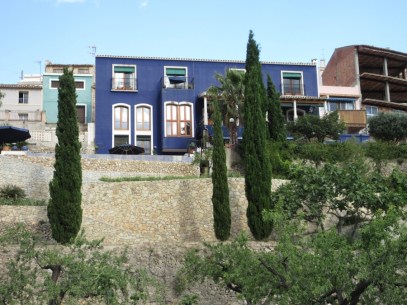
The Old Olive Press, view from the terraces at the rear

June was when I would visit the wonderful Almassera Vella (Old Olive Press) in Relleu, Spain. I have been on several one-week workshops with the incomparable Ann Sansom of the Poetry Business. Other poets from whom I learned a great deal were Mimi Khalvati and the late Matthew Sweeney.

Christopher North, himself a published poet, and his wife Marisa took two years to convert the old olive press into a stunning home. As you can see, they kept the actual press. Relleu is a one-hour drive from Alicante airport and about half an hour from Villajoyosa on the coast.


olive press 2

The olive press


Nowadays, Christopher and Marisa organise cookery workshops. You can also book B&B accommodation and the flat over the road is still available as retreat accommodation for writers.

The poem June rain is from my first collection Another life  published by Oversteps Books Ltd (2016).
June rain
for Cristopher and Marisa

It’s June and the rain is falling.
It is cooler and darker now.
It’s the rain we prayed for last night,
though we’d not meant to do such a thing.

The old women, eight or nine, spread
across benches outside the church.
Us along the tables, a line of snails,
sloping down towards the blue house.

It was speaking of Sundays now filled
with shopping and the silence
that binds Quakers together.

And it’s in silence we, snails,
all of us with our whorled shells
of stories, sit at the breakfast table.

The cheep-cheep-cheep of birds
after the rain is flowing into the room
and a fresh breeze that tells of new stories.

Strawberries – poem


strawberries-1452717_1280

Photo credit: congerdesign on Pixabay

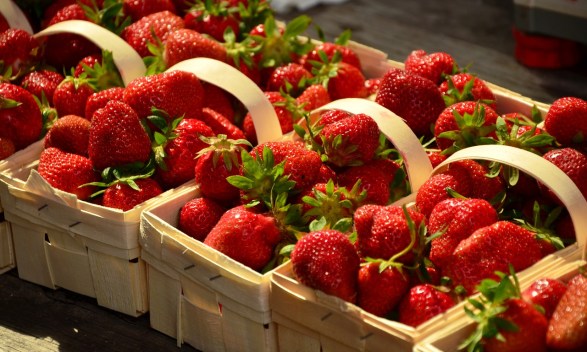
The first June weekend here in Holland is wet and windy: a perfect time to remember strawberries. My local supermarket has them on special offer this week, along with discounts on raspberries and watermelon.

During my childhood I lived in a small town further north, a couple of miles from the beach, and also close to the chimneys of the steelworks. Walking home from school my friend Nellie I and would take the long route, along the small harbour. We would pass the rear entrance to the covered market. I have a vivid image of a line of small horse-drawn carts, loaded with punnets, punnets full of strawberries …

The poem is from my second collection Nothing serious, nothing dangerous (Indigo Dreams Publishing Ltd, 2019).

 
Strawberries

The strawberries of my childhood
were like my favourite grandmother,
soft, a rosy smell, a taste that stayed
with you on the way to school.
Those strawberries were red,
not like the winter swedes
which are a red stone,
are purple with anger.

Strawberries entered our home
first in paper bags, then as June grew
in oblong wicker punnets. Then we ate
them for breakfast and for lunch, pressing
them with a fork on sliced white bread.
You could stroke the strawberries
of my childhood. They were company,
like cats, purring gently even when asleep.
Small green stalks their whiskers, and warm.

Missing Manchester …

Manchester_Art_Gallery_-_geograph.org.uk_-_1748756

I am settled in my caravan in Holland, enjoying the warm weather and making the most of the peaceful environment before the camp site opens 1 July when it will be the high season.

 
But I am missing Manchester and, in particular, the monthly writing workshops with Peter Sansom of the Poetry Business These have been held at Manchester Art Gallery. It consists of three connected buildings, two of which were designed by Sir Charles Barry. The main building is Grade 1 listed, while the Atheneum is Grade II. A modern extension was added in the beginning of this century.

 
During the writing workshops we have the opportunity to be inspired by the permanent collection – works of international significance and Victorian art. The painting Albert Square (1910) by the French impressionist painter Adolphe Valette hangs in a central foyer. Valette lived in Manchester for a period and really caught the damp and wet conditions. My poem is included in the pamphlet A Stolen Hour (Grey Hen Press, 2020,


Albert_Square_Manchester_1910,_Valette


Albert Square

I am not that cellar man pushing 

his barrow loaded with crates of wine.
I am not the horse with its head
stuck into a nose bag, nor
the coach driver resting his
right knee on the plate,
nor the men with bowler hats
conversing by the railings.

Up there is the Town Hall
covered in a velvet coat of soot.
I am the greyness of the oil paint,
the rippled rain reflecting
the cellar man’s rounded boots.
I am the smog and the smoke,
half shielding these statues:
politician, mayor, consort.

Palmistry in Karachi – guest poet


Elsa F

Imagine my surprise and delight when, in January this year, I received an email in Dutch from a fellow poet! Elsa Fisher had read and liked some of my poems. We started a correspondence and were going to meet at the end of May. It’s a great pleasure to introduce this month’s poet who has ‘a clear eye and an ironic ear’.

Elsa Fischer was born in The Hague, Holland. She has lived and worked on four continents and, later in life, studied Art History in Canada and at the Sorbonne. Always a lover of poetry, she joined a poetry workshop after her retirement.

She has two published pamphlets: Palmistry in Karachi (Templar Poetry, 2016) and
Hourglass – Poems from the retirement home (Grey Hen Press, 2018). Other poems have been included in a range of magazines and anthologies. She is currently preparing for a third publication.

Elsa lives in Bern, Switzerland, in a lovely retirement home (where some of her poems are set). She likes to point out that she does not belong to the Woopies (well-off older persons) but rather to the Yelpies (youthful energetic elderly persons)….

I hope you enjoy the range of these poems, with their sharp observation, humour, empathy and poignancy.

 
Palmistry in Karachi

“…the old days when we were still young,
naïve, hot-headed, silly, green. A little bit’s
still there…”              Wislawa Szymborska

 
At twenty I danced the tango
in Karachi at the saried begums’
Red Crescent Bazaar with a gay
attaché who had that rhythm in
his blood and where a sketch
of my profile by a local genius
fetched handfuls of rupees.
I shook hands with Ayub Khan
and Fatima Jinnah, ignorant
of who they were and that
he would have her killed.
There was my near-drowning
in the Arabian Sea and a wicked
camel race along its shore.
And I’ll tell you this: I lost
my innocence in Karachi.
To an Italian born without
toenails and his palms
with no lines so that you,
my friend of little faith, claim
he could not have existed
and that I’ve made it all up.


Seedpods

 
I love how your wisteria seedpods exploded in the night,

love to hear drops falling from where someone waters geraniums

early in the morning as I am writing at the wrought-iron table,

its rusty flakes cutting into skin and I remember how, in another life,

they caught my mother’s dress as she sat down to tea under

the glycine, my first French word, and for a startling moment

I hold this image called up by smells of soil and fleshy leaves,

by all this art nouveau abundance.


In the beginning are my hands
after Andy Goldsworthy

 
they are my skin-cut tools
cracked as dried earth.
I trust them, they lead me.

I listen to the passive witness
of stones, their dialogue with trees,
learn how they rely on each other.
I need the energy of peat – the melt of mud
and mineral feed and sheep’s piss on canvas.
Above all I love my icicles – reconstructed,
glued with my spit or draped like lobster
claws and oysters on a plate of river ice.

I square black-rooted bracken stalks
thorn-pin chestnut leaves into floating
snake ribbons until surfaces open up
and nature itself becomes the object found.

I go into its internal spaces, lie spread-eagled,
feeling the pull, feeling the rain.


Safe

Like ducks waiting for the cull
we line up at the doctor’s,
baring arms for the flu jab.

Once you stood like this, in an orderly row,
mouth wide open to receive the sugar lump
that the school nurse had carefully dosed
with the life-saving drops of Dr Salk’s vaccine.

To be protected from the fate of that boy,
fitted with braces, who sat for years reading
as we messed around with bats and balls in PE.

A nurse helps with the sleeves
and we return to our coops.
Safe for another season.


Trespassing

I’m digging out my winter things.
And watch from behind the slats
how he opens a wardrobe, takes out
the bridal gown for her to hold,
then gently crowns her with a garland.

On a small table lie the bric-a-brac
of a long marriage. Masai beadwork,
a glass paperweight from Venice,
the matryoshkas.

He gives her a moment,
then puts the gown carefully back
on the coat hanger, smiles as he lifts
the garland with its faded ribbons
from her hair. A whiff of Chanel.

He makes sure she’s comfortable
on the walker and wheels her away,
switching off the cellar lights.

I stand for a while, getting used
to the dark, arms heavy
with scarves and shoes.