Lat month I was in Manchester, walking down Portland Street on my way to Piccadilly Station. It reminded me of my brief time (seven months) when I worked for the Greater Manchester Council (GMC). With my boss I ran workshops helping to prepare staff for job applications, CVs, interview techniques and salary negotiation. The GMC was the top tier local government administrative body. Its 106 members came from 10 district councils with which it shared power from 1/4/1974 until 30/3/86. Most of those district councils were Labour: not to the liking of Margaret Thatcher. Her Conservative Government abolished the GMC as well as the GLC (Greater London Council). Hence all that preparation for new jobs.
Abolition Greater Manchester Council, March 1986
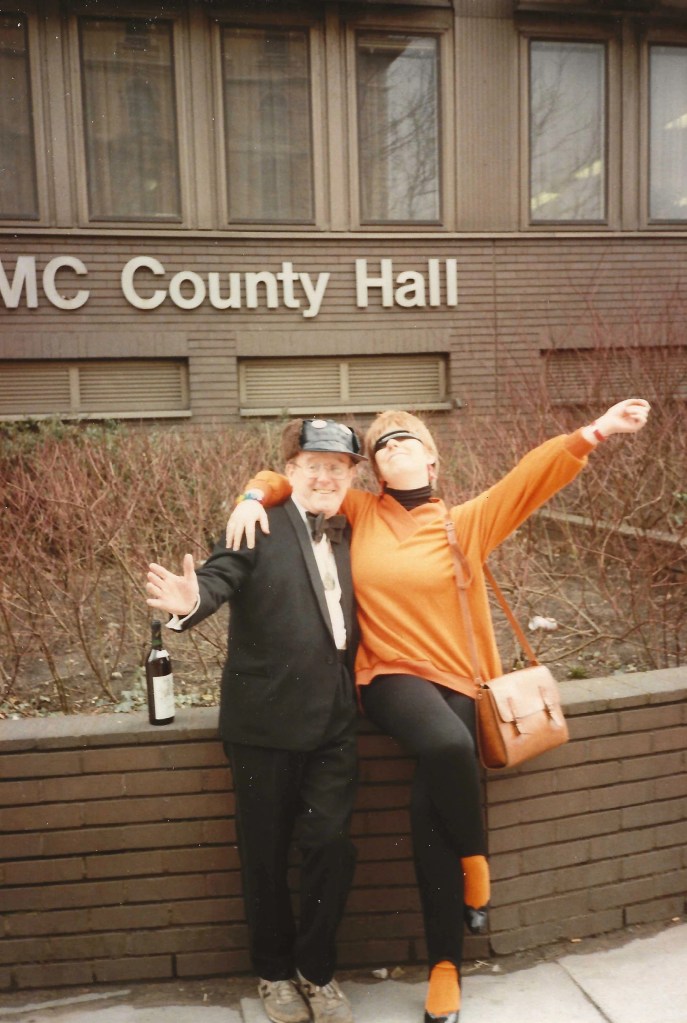
That was the time I went as a dominatrix. I wore my jodhpurs, riding boots, carried a whip. I had my Cleopatra eyes, and black bra under a side-less top.
Rebecca, my boss, had dyed her bob orange. Tony, always modest, in dinner jacket, bow tie, trainers, and baseball cap. Black lace gloves for the HR woman in the wheelchair.
The young clerks were versions of cowboys and Indians. We conga-ed across the zebra crossing onto Piccadilly Gardens. Later we carried on drinking in the empty offices, stroked and kissed the bricks of County Hall.
It is a great pleasure to introduce this month’s guest poet Rebecca (Becky) Cullen. Her poem February appeared last month. Becky and I met on a poetry workshop where I bought A Reader’s Guide To Time. This was the winner of the 2021 Live Canon Collection Competition.
Here is Becky’s biography: Rebecca Cullen has a PhD in Creative and Critical Writing. She was the second poet-in-residence at Newstead Abbey, ancestral home of George Gordon, Lord Byron. Director of the Writing, Reading and Pleasure (WRAP) extracurricular programme at Nottingham Trent University, Rebecca also curates and presents the Notts TV Book Club.
Photo credit: Fabrice Gagos
The collection is divided into eight sections, each representing a different kind of time. Becky ends her prologue with It’s time I love, winding as a cat wraps round an ankle. Here are four poems from Historical Time (n.b. timelines, clocks), Deep Time, Poetic Time (also ‘of Reading’) and Subjective Time (‘of our lives’), respectively.
Paris, Grands Passages
To enter requires trust: you can’t see the end from the beginning. You can’t see the next beginning.
Shop names are the contents page; each entrance is a diorama. Post yourself into the future.
At Hotel Chopin, climb the three red stairs. Would you like to buy a sink? A model of a carousel?
The tiles are monochrome and harlequin. The gates can keep you out, or keep you in.
In the window of the librarie, two wax children read a book, sitting in a rowing boat.
Claim a tall-backed chair at the café draped in vines, warm beneath the glass roofs pinched like fish spines.
The taxidermist stitches swans’ wings to a fox. Come, watch the past play, hear your heels knock.
Night Fragment
He wakes her with a ball of sorry. He wants her to hold it, keep it, as brash and bold as the coin in her lungs.
His sob comes, warms her gut, the flex of his young arm gone.
In the four o’clock light, her face is crumpled, dirty.
Garden at Newstead Abbey
Peacocks at Byron’s Pile
I had a dream of Newstead Abbey, that I was drifting through the garden and the blowsy flowers were heavy on the walls.
The words are just ahead of me this morning, the word for a large purple or white blowsy flower, a climber, and a tree’s branches so they grow
outstretched in two dimensions. Espalier. Both these things are in my head, somewhere, but the sparrows roost near the monk’s pond,
which also has its own name, and overlook the stump of oak on a lawn where a raven has been adopted by two geese;
they are always in correspondence, everywhere the remnants of a godforsaken kiss, the three of them, like this. Clematis.
My Father and I
Sometimes we didn’t get on. The songs I sang would please his ear. But I would over-act, embarrass him.
Now we go to appointments more often than we go for lunch. After the last tests he couldn’t be left alone. I spread across one sofa,
he slouched on his, and we watched a documentary on Howard Hughes; I didn’t know about the aviation or the Hollywood years.
So. We both kept turning up, not giving in. Lately, I’ve taken to calling him daddy.
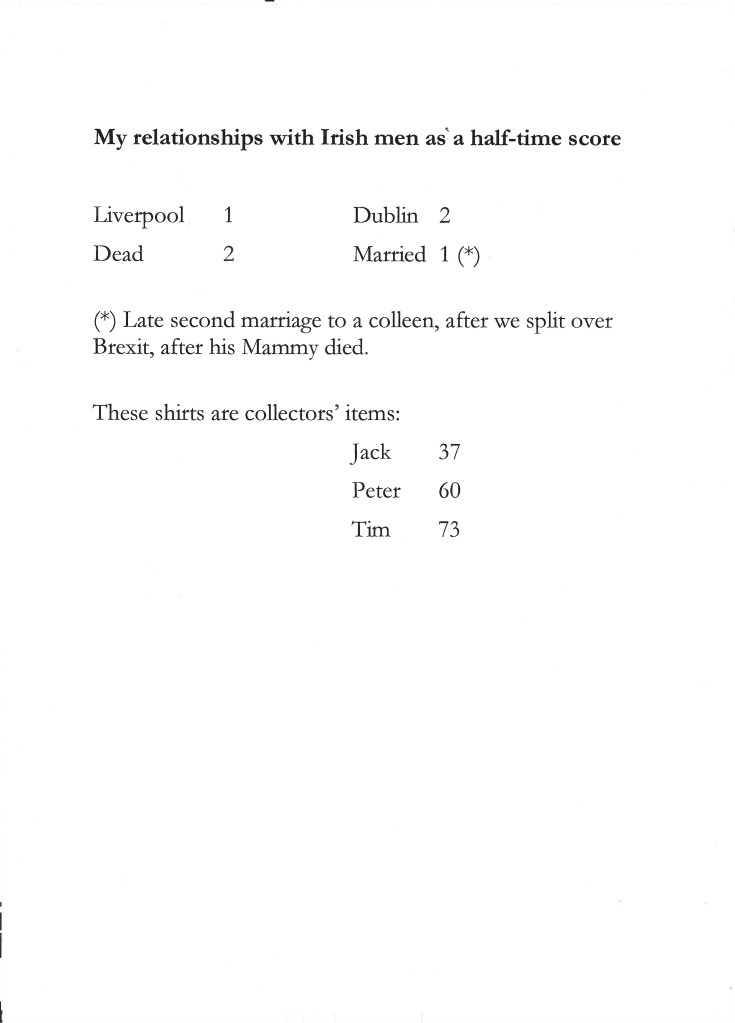
As I have an Irish surname and it’ll be St. Patrick’s Day this coming week, I am sharing this short poem. Many thanks to the editors of The Madrigal for accepting it for an Áitiúil: an anthology, jointly with the Martello Journal. It was published in September 2022.
World Book Day is on the 23rd of April. In the UK it takes place on the 2nd of March to avoid clashes with spring school holidays and St. Georges’ Day.
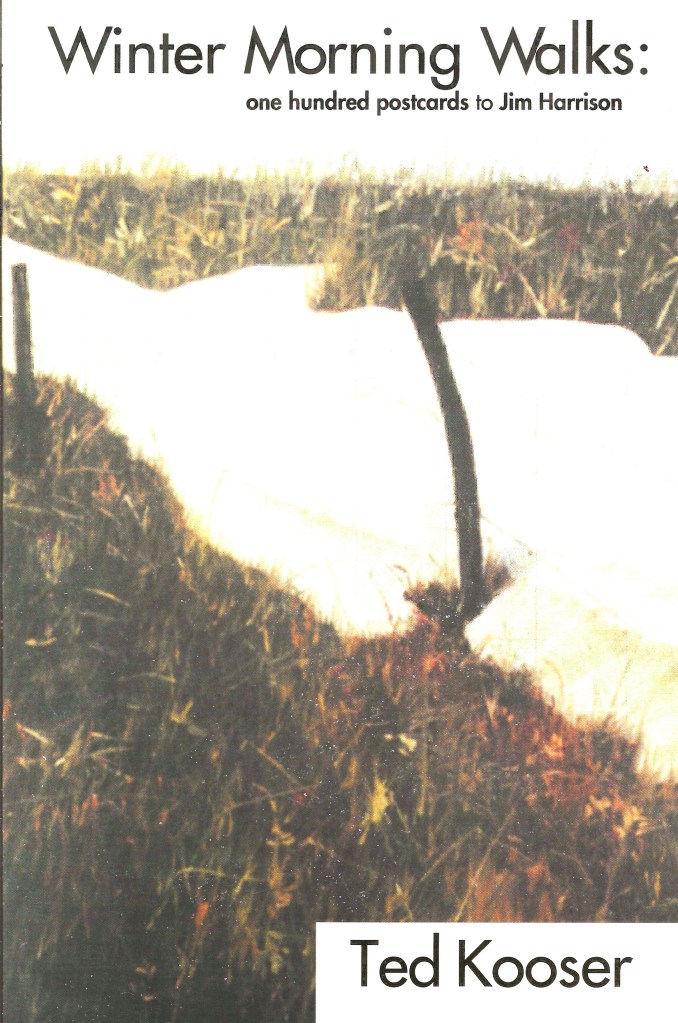
A fellow poet introduced me to the American poet Ted Kooser, now in his early 80s. His style is accomplished, yet extremely simple. My current bedtime reading is his poetry collection Winter Morning Walks: one hundred postcards to Jim Harrison (Carnegie Mellon University Press, 2001).
In the late 90s Kooser developed cancer. He gave up his insurance job and writing. When he began to write again, it was to paste daily poems on postcards he sent to his friend and fellow writer Jim Harrison. In the preface, Kooser tells us ‘I began to take a two-mile walk each morning. I’d been told by my radiation oncologist to stay out of the sun for a year because of skin sensitivity, so I exercised before dawn, hiking the isolated country roads near where I live.’ These country roads are in Nebraska.
The poems cover a period from 9 November until 20 March. In the poems Kooser doesn’t directly talk about the illness. He does so through metaphor. All the poems include a brief description of the weather. The clear and precise observation gives them a haiku quality.
Here is his postcard for march 5:
Very windy and cold.
A flock of robins bobs in the top of a wind-tossed tree, with every robin facing north and the sky flying into their faces. But this is not straightforwardness, nor is it courage, nor an example of purpose and direction against insurmountable odds. They perch like this to keep their feathers smooth.



 Acacia Publications