Tag Archives: poems

Discarding clothes

discarding clothes

It’s now just over a year since I closed my psychotherapy and supervision practice. I’ve gone through some wobbly spells. But, I feel more settled in this new way of being, especially after five glorious weeks in my caravan in Holland.

In my psychotherapy work, sitting closely with traumatised clients, I used to dress in sober colours: plain tops and trousers in grey, dark blue, black, dark green. No long, shiny ear rings, or clanging bangles… I wrote the poem Discarding clothes on a workshop last year, after a poem by Robert Vas Diaz.

Discarding clothes

Cheerio, black briefcase,
hand stitched in France,
with the deep smell of leather.

So long, three-piece suit,
pleated skirt, thin stripes;
a trio of ceremonial blue.

Farewell, flat shoes
you sensible goodie-goodies.
There’s pale skin underneath my watch.

I’m flip-flopping into retirement
with dangling silver ear rings,
Capri trousers, a selection of sleeveless tops.

I’ll need to fly back to Hawaii and Fiji.
Aloha! Colourful kaftans,
strapless pink and a cocktail or two.


The photo is of exhibits in the current exhibition Stage of Being at Voorlinden Museum, Wassenaar, the Netherlands: Please (neon) by Jeppe Hein from Denmark, with Dawn (polyester, hair, glass, oil) by John DeAndrea, USA.

Decluttering


Blue Horn 1

There will be many varied events across the country today on National Poetry Day.
Twenty poets have donated poems to York Explore Libraries.  These will be on display in the libraries in and around York and given out to visitors. Below is the poem I gave away.

Decluttering

I rarely used the cups and saucers:
good enough for the Red Cross.
Dark forest-green rim and each of the five

remaining dinner plates (Poole Pottery, Dorset)
chipped, thin brown cracks running
across the plain centre like a fault line.

You have turkey and trimmings in front of you.
You were wearing that 70s polo-neck jumper,
corduroy trousers, the lopsided smile.

Stacked securely in a cupboard,
suddenly taken away,
placed in a black plastic bag.


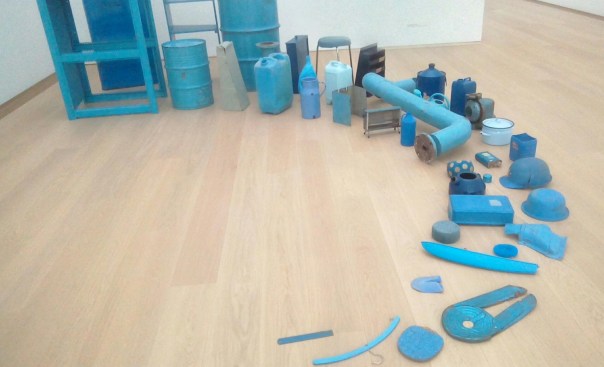
The accompanying picture is of Blue Horn by Tony Cragg. He collected 40 used objects in different shades of blue and then ordered them by size in the shape of a scythe, a reference to one of the oldest things used by men to work the land. The artist looks for ways to connect art with daily life.

I took the photo during a recent visit to Voorlinden, a new private museum in Wassenaar, the Netherlands.

Bee Journal

9 (2)

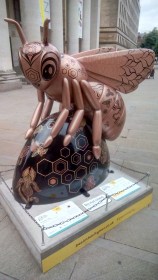
The Love Bee with Distiller-Bee on the right

6


In the 1800s the Manchester textile mills were called ‘hives of activity’ and the workers compared with bees. The Borough of Manchester was granted city status in 1842; on the city crest seven bees are flying over a globe, signifying Manchester’s industry being exported. Images of bees can be found on buildings and bins. After the Arena bombing last year many Mancunians got themselves bee tattoos.

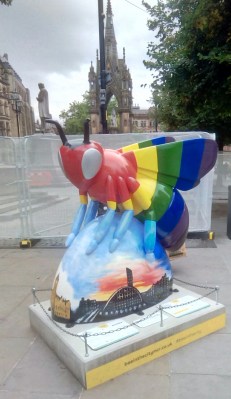
So, there is a lot of interest and excitement about bees currently dotted around town, in parks and public spaces. Over 100 large bees have been decorated by artists, while 130 little bees are part of the City Learning Programme. It’s how creative producers Wild in Art are celebrating their 10th anniversary, and there are some fabulous creatures to be found. The bee below shows some Manchester landmarks: the Town Hall, a Grade I listed building, the Manchester Central  Convention Complex (the original Central railway station) and the Beetham Tower with 47 floors, until recently, the tallest building in the UK outside London.

4 (2)

This is Manchester, C Elliott

On a recent trip to Leeds University to visit the Special Collection I was delighted to see a copy of the 1634 revised edition of the first English-language book devoted to beekeeping The Feminine Monarchie, the histori of bee’s. Charles Butler was also called The Father of Beekeeping. He was a priest and kept bees at his parsonage. Butler writes about bee gardens, hive making, enemies of bees, feeding, pollination and swarm catching. The book also includes a musical score: a four-part madrigal that mimics the sound of swarming bees!

Butler cover

One of the most original poetry collections I read in the last few years is Bee Journal by Sean Borodale. It was shortlisted for the 2012 Costa Poetry Prize. Borodale had previously published books based on walking and writing on location and Bee Journal was supposedly written at the hive, with the poet wearing a veil and gloves! The 90 pages chronicle the life of the hive, from the collection of a small nucleus on 24 May – extract below –

He just wears a veil, this farmer, no gloves
and lifts open a dribbly wax-clogged
blackwood box.
We in our whites mute with held breath.
Hello bees.
Drops four frames into our silence.

to the capture of a swarm two years later, with all the learning, joy and anxiety in between  The poem titles are all dates, some with additional notes, as below:

14th August: Bee Inspector
Today a DEFRA bee inspector clipped the wings of our queen.

Some days the poems are only a few lines, or a single word. 7th January starts:

Four inches of snow. The hive a hut
of silence and darkness.

A year later, there is the entry for 13th January: False Spring Week’s long hoax of mild weather/and bees wander like fools.  On the 15th January Sean makes herb tea for his bees, adding grains of salt and their own honey (10%) to boiling water.  Opposite is the devastating empty page, titled 24/25th January: Bees Die.

In between, there are many poems full of joy and marvel. Here’s a stanza from 2nd May:

A bee, a tine being struck was out:/sound like a rooting of thin flash/in liquid form poured from a bucket the size of an adult/tooth./Magnet of listening, I to hear it/turned the pole of my head.

Because of the regular small interventions the beekeeper has to make, his observations and devotion turn to a deep intimacy, with unusual imagery and dense, “clotted” language.  Reading it was an amazing experience.


Above a thousand feet of space – guest poet


D Wilson action


In the Balance

You pause beneath a boss of ice
above a thousand feet of space.
The picks of your axes barely bite:
it’s bullet hard, black with rock dust.
You’ve run out forty feet of rope,
placed only an ice-screw and screamer.
You’ve dreamed of this route for half your life.
Your calves ache. You can’t wait long.

Decision time. Weigh the following:-
an abseil retreat to blankets, pasta, beer;
the taste in your mouth if you bottle out;
November at work without a fix;
glimpses of where the pitch might ease;
a face at a window, Dad come home,
and you not knowing where you’ve been
or how to get back from it.

 
David Wilson turned to writing poetry a few years ago after being inspired by reading Derek Walcott’s poem ‘Midsummer, Tobago’ on the wall of a hospital waiting room in Leeds. He then discovered the Writing Days run by the Poetry Business in Sheffield and started writing poems of his own. His pamphlet Slope was published by Smith/Doorstop in 2016 and he has a collection coming out with them in 2019.

David was born and brought up in North London and studied at the London School of Economics, followed by a Master’s degree at Leeds University, which at the time had the only indoor climbing wall in the country and was close to excellent outcrop climbing. He has climbed extensively in the UK, Alps and further afield, at a standard best described as erratic.  In mid-life he got hooked on windsurfing, but writing about climbing has led him back into it.

After living in Leeds, David settled with his family in Harrogate. He has worked freelance for many years as an organisation development consultant. He now works part-time, exclusively in the area of academic leadership, helping people like Heads of Department to tackle the many challenges they face. He mainly works 1:1 with people and the diversity of their subject areas is a delight: from Medieval Welsh Poetry to Theoretical Physics to Cancer Research to Arabic, and that’s just in the past few weeks!  Favourite poets include Jane Kenyon, Les Murray, Jane McKie, Norman McCaig and Seamus Heaney.

Slope cover

David and I met on the 2012/13 Writing School and I’m delighted to share his work. Below are more poems from the pamphlet Slope. Everest was awarded 1st prize in the 2015 Poets & Players poetry competition, judged by Paul Muldoon. For a few technical terms: a cam is a device fitted into cracks to protect a lead climber. It has spring-loaded metal cams which grip the rock. A Micro-traxion gadget is a pulley that locks the rope, capturing what’s gained as a climber is hauled from a crevasse. A screamer is a sling which has stitches designed to rip and thereby absorb the energy of a fall. Typically used with doubtful ice-screws.

Stanage Edge

Summer’s returned for one day only,
blue sky, no wind, mist in the valleys,
bracken bronzing every hill,
the Edge’s gritstone silver in the sun.
Rock warm to touch. But holds won’t sweat.

I check my harness, knots and rack,
lay away, step high and up again to poise
off-balance, wriggle a cam into place,
then smear a slab, heels low, until
a crack grips my outstretched hand.

We linger on the edge. Smoke rises
straight up from the chimney at Hope.
It’s not a day to hurl ourselves against
but for dancing with, to feel alive
on Black Slab, Inverted V, Goliath’s Groove.

And it will light the long edge in our minds,
where name after name spells a life,
Flying Buttress and Left Unconquerable,
holds we could trust to be always there,
winds which threw every word away.


Everest

Once it was Chomolungma,
Mother Goddess of the Earth,
a face whose veil rarely lifted,
its whiteness the White Whale’s.

Now it’s like Elvis near the end,
a giant in a soiled jumpsuit,
blank, useful for percentages,
a sheet from which the music’s fled.


Alpine Partner

I was thinking of glaciers as metaphors,
you knew the car park’s exit code.
And you’d practised techniques
for rescue from a crevasse.

to dig a T slot, bury your ice-axe,
attach our micro-traxion gadget,
then fix the rope as a Z-haul
across the sweating surface, so that inch

by inch you heaved me up when I fell,
up from that cold place – its white walls
and longing, fins of green ice, pale blue caves,
darker blue depth beyond saying.

Giraffe

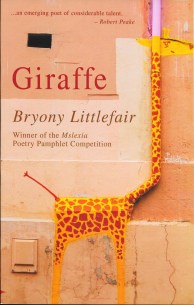
Seren Books had a brief 50% discount offer, so at the end of July I dashed to the website to make a purchase. In the library at Ty Newydd I’d seen a copy of In a different light, Translations into English of fourteen contemporary Dutch-language poets. Scrolling I suddenly spotted a picture of a giraffe!

giraffe-cover.jpeg

Bryony Littlefair was the Winner of the Mslexia Poetry Pamphlet Competition. Seren Books published her pamphlet last year. In her testimonial Myra Schneider says Her work, with its unexpected imagery and juxtapositions, is witty, ironic, frank, and poignant. Giraffe is a striking debut collection.

There are some intriguing titles: The year she asked for a scrubbing brush for Christmas; Poem in which not everything is lost; Visitations of a future self; The meaning of employable.

The tone of the poems is conversational, but Bryony has a clear eye for the detail. Dear Anne Monroe, Healthcare Assistant celebrates the “quiet beauty” of NHS nurses in Archway where the light is piss-yellow and everyone is angry. In The sadness of giftshops we see the owner’s thin, teal scarf, smattered with small white horses and the way she writes down everything she sells on a plain sheet of A4.

I enjoyed reading Bryony’s pamphlet, including the memorable poem Maybe this is why women get to live longer.  Here is a woman in a wrap dress/and brown hair tied loosely at the nape/of her neck, slack as an otter’s tail.  This woman is listening to a man with the thick/tufty eyebrows of a politics professor -/permanently raised, as if hung by them/to a washing line -.

The title poem is the last poem of the book, placed opposite Sertraline. It was previously published in Popshot Magazine, and I appreciate Bryony’s permission to share Giraffe with you.

Giraffe

When you feel better from this – and you will – it will be quiet and
unremarkable, like walking into the next room. It might sting a little, like
warmth leaking into cold-numbed hands. When you feel better, it will
be the slow clearing of static from the radio. It will be a film set when
the director yells cut! When you feel better, you will take: a plastic spoon
for your coffee foam, free chocolates from the gleaming oak reception
desk, the bus on sunny days, your own sweet time. When you feel better,
it will be like walking barefoot on cool, smooth planks of wood, still
damp from last night’s rain. It will be the holy silence when the tap stops
dripping. The moment a tap finally starts to make sense. When you feel
better, you will still suffer, but your sadness will be graspable, roadworthy,
have handlebars. When you feel better, you will not always be happy,
but when happiness does come, it will be long-legged, sun-dappled:
a giraffe.


Dublin: Day One

At airports my Dutch passport occasionally causes confusion, as it is in my maiden name Köhler, followed by w/v – widow of McDonnell.  On Tuesday the machine at Schiphol Airport struggled to match the name on the ticket with the passport.

Back in the late 90’s I self-published a pamphlet Boxing with the Lobster. The poem is based on my first visit, Christmas 1972, in a house with heating on the blink.  I believe that the area, Rathmines, has since gone up in the world.

Dublin: Day One

A hundred thousand welcomes
my arse.
I wasn’t a Catholic
I wasn’t a colleen
and when our hearts united
the money orders to your Mummy
ceased.
They put us in separate bedrooms
which I called hypocrisy.

Eamon de Valera
The Post Office
O’Connell Street
The Easter Rising.
My temples throbbed
and lunch was Guinness thick as stew.

You promised me a claddagh ring
but ended the day drinking
with Liam and Tommy and Joe.
I waited with them,
talked about cooking colcannon
while they kept the plates warm.

When you all came back
we sat in the parlour swaying
to the Rose of Tralee.
Asked for a Dutch song
I could only muster
a shepherd and his sweet girl.

Next your man Aidan sang
and his eyes glistened:
When they came down the stairs
they shot them in pairs
when they came through the doors
they shot them in fours.