
Poëzie Week ran last month in The Netherlands and Flanders, the Dutch-speaking part of Belgium. Events were arranged in libraries, bookshops, schools, etc.
If you spent at least 12,50 Euro on a poetry book, you’d receive a copy of the poetry pamphlet Metamorfosen, written by poet Ellen Deckwitz specially for Poëzieweek and published by het Poëziecentrum, Gent.
Op = Op. So, I dashed to the nearest bookshop and checked at the till copies were still available. You’re not surprised to learn the poetry section was small, but I found the new collection Tussen mij from the poet and artist Maria Barnas, just published .
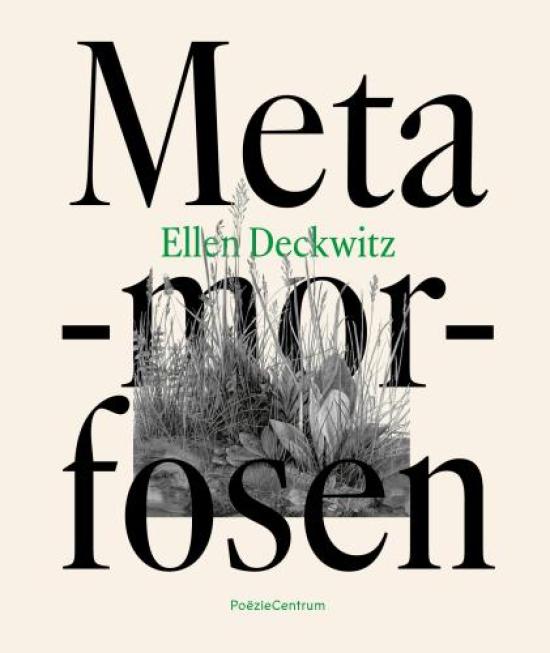
Ellen Deckwitz is a tireless ambassador for poetry: daily podcast for a radio station, columns, visits to schools and colleges. Her Eerste Hulp bij Poëzie (Poetry First Aid) is an accessible introduction to contemporary poetry. Her poetry has been translated into several languages, and she has received several Dutch awards and in Italy (Premio Campi).
I listened to a short interview she did with Hanna van Binsbergen (monthly podcast of het Poëziecentrum). Some of her poetic influences are Tomas Tranströmer, Sylvia Plath, Ted Hughes, Osip Mandelstam.
She talked about the unrealistic demands placed on romantic love and how friendships have increasingly become important. The nine metamorphoses in the pamphlet challenge the cliché of romantic love, our need for some significant other:
Ooit droomde je van een mens voor jezelf.
Iemand die je geliefde, je ouder, kameraad
of leider kon zijn.
Once you dreamt of a human for yourself. / Someone who could be your lover, your parent, comrade / or leader.
Transformation and metamorphosis as often seen as positive events: the pupa turning into a butterfly, catharsis leading to rebirth, renewal. Deckwitz reminds us that in Ovid’s Metamorphoses many of the metamorphoses do not turn out well – Icarus, Narcissus.
Romantic relationships can be violent: the facts are often also just pleasant machetes – en feiten zijn vaak ook gewoon / prettige machetes.
The person ending things with ‘Sorry, maar –’ changes into an earthworm, while the one left behind ‘jumped furiously up and down in his underpants’ – ‘sprong woedend op en neer in zijn onderbroek‘.
Writing Prompt:
How do you view metamorphosis?
Have you used any myths to inspire your writing? Or folk tales, fairy tales?
I drafted the poem Snow woman on a workshop. When I read through the notes, I realised it refers to the myth of Sisyphus. The poem first appeared on Atrium.
Snow woman
My father didn’t give up.
For many years, he kept going.
He carries the white with bare hands,
rolling the fresh snow uphill.
He shapes and sculpts roundness.
The snow woman stands in the shade,
so my mother has a greyish tinge
from the outset. Six small coals
give her a static smile. She does
not want to live in the shadows.
During the night, sometimes,
her silk scarf disappears. He buys
her new ones. Winter is their season,
spring follows. It’s warming up,
and a long, long time till summer.
My father never asked for help.
Mother starts shedding, and now
she is snowing words, words, words.
It’s soon a white-out.
 Acacia Publications