I’m chuffed to learn that my prose poem Broken biscuits has made it into an anthology of poems about Yorkshire, published by Valley Press. The proofs came through the other day. I am in good company with many well-known poets including the current Poet Laureate Carol Ann Duffy.
The launch is in Leeds on Saturday 18 March, a few days after I’m launching Another life in the International Anthony Burgess Foundation here in Manchester. A good many poems in the book were written there in the Engine Room.
I admire those poets who perform a piece from memory. I’ve decided to learn Broken biscuits well enough so I can perform it from memory: Is there poetry in broken biscuits? Discuss. The short answer is yes, provided it is articulated in the unashamedly Yorkshire, tongue-in-cheek, twinkle-in-the-voice tones of … (insert name of a very well-known poet living in Barnsley)…
During the Christmas holidays I went to see Paterson, the delightful film about a bus driver who writes poems. The poems in the film are by the New York poet Ron Padgett. Back home I found his work in the New York Poets II Anthology, including the Love Poem that Paterson writes in the film. The first line is: We have plenty of matches in our house.
Paterson is also the title of a long poem by William Carlos Williams, so I re-read him. Seeing Paterson sit in his bus scribbling away each morning before he drives off for the day reminded me of another American poet, William Stafford. He wrote a poem each day, starting with a brief description of the weather, then a short aphorism, then a poem. I believe his “hit rate” for acceptances was 1 : 7, or 1: 8. I’ll settle for that!
May you have a healthy, happy and creative year. If you’re short on inspiration, you can always write about the matches in your house. Over Christmas I used up a couple of boxes of good old “Svalan” from Sweden. Now I’ m on “Flix” from the Netherlands. The packaging is modern, but the tips are brown…
I’m planning to get the 10.41 to Liverpool Lime Street. I’m on the single-decker blue Magic bus, with the bright orange bars and handles inside. We’re crawling through the Curry Mile – with the newly completed cycle lanes and a few badly parked cars, the buses have to manoeuvre; even the walkers are catching up with us.
white petals float
towards the shisha bar
sleeveless cyclists
The Liver birds are shimmering, a salt tang, ice cream sellers and flocks of French pupils draped around the dock. The Tate opened late this morning. A friendly guide – grey curly hair, faded lilac shirt – directs me to the first floor.
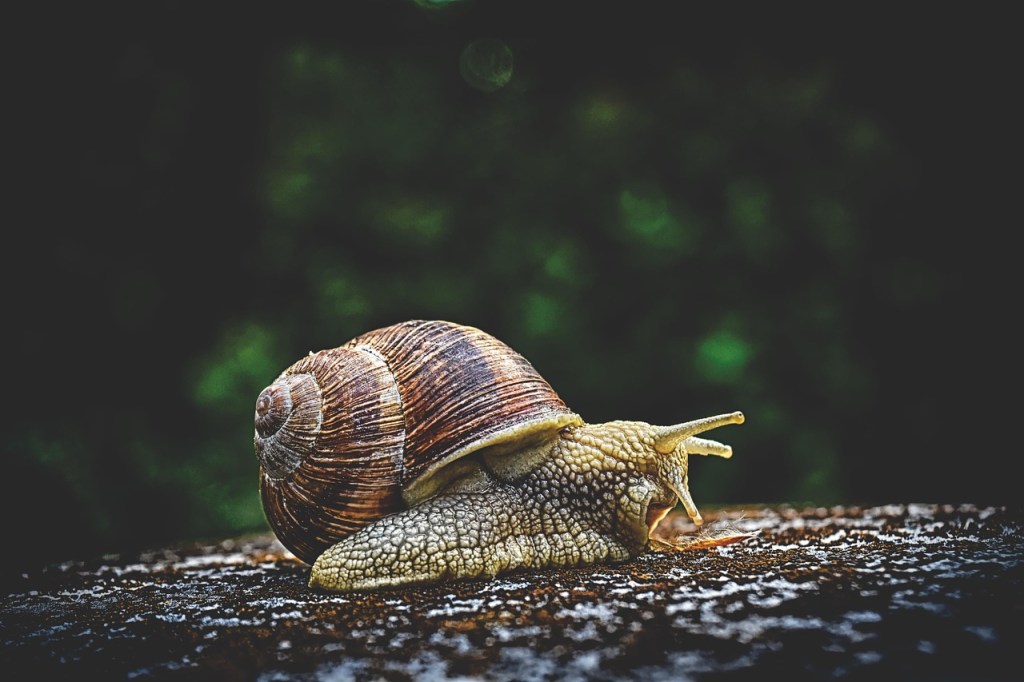
On one side of The Snail four bronzes: a backbone has become an “abstracted plait”. In fuzzy black-and-white film Matisse points with a walking stick to where the next piece of cut-out should be attached. The Snail’s alternative title is Chromatic Composition. Apparently it was planned as part of a triptych, this “purified sign for a shell”. The pin holes are visible in the brightly coloured paper.
Photo credit: Alexas_Fotos via Pixabay
In a traditional saijiki (list of kigo, or season words) the snail is linked to summer and that fits with these colours: orange, lilac, greens, blue. My own saijiki is Haiku World: an International Poetry Almanac compiled by the late William Higginson. It’s a unique anthology: over a thousand haiku, from more than six hundred poets, living in fifty countries, writing in twenty-five languages. At 400 yellowing pages it’s too heavy to carry around.
The snail is caracol in Spanish, slak in Dutch/Afrikaans and katatsumuri in Japanese. The Spanish word sounds like the shape of the protective shell and katatsumuri is, perhaps, the non-moving or slow moving, the snail stuck to the window. Many years ago I had a Korean manager lodge with me at Norwood Rd. He and his colleagues were learning English at the Business School. Smoking he paced through the rear garden, saw me sprinkle blue pellets…Miss Fokkina, you nourish the snails?

 Acacia Publications