More an ache than sorrow

Ian Storr

This month I’m featuring one of my fellow haiku poets: Ian Storr.  He is a history graduate and trained social worker whose last job before he retired was with Voice for the Child in Care, managing their advocacy service in the north of England. Ian  has been writing haiku and tanka since the mid-1970s and he has had over 200 published in British and oversees journals.

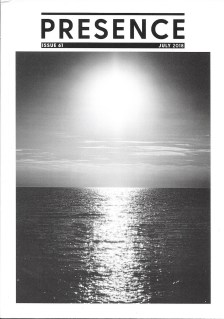
His poems have won prizes in Britain, Canada and Ireland and they have been included in British and international anthologies. Ian is the production and poetry editor of Presence magazine, described by the Founder and Chairperson of The Haiku Foundation as “the most important haiku journal in English outside the United States.”

I first met Ian more than 25 years ago and I’m delighted to share a selection of his writing with you.  His tanka, in particular,  I find deeply moving and masterful examples.


Haiku

Brightening
the house in winter
orange roses from the wreath

Cleft of the brook
wood sorrel bright
on a fallen birch

wind strengthening a skylark holds his place of song

The rhythm of
this baby’s sleep upon me
. . . days of rain

Valley head
white with cotton grass
the silence before the raven

Sweeping rain
deer on the ridge
climb into cloud

Gusts from the street
the store greeter’s
unreturned hellos

Darkening marsh
the swirl of golden plovers
settles again


Tanka

Night mist . . .
back where I was born
I walk this lane again
down to the flooded pit shaft
where tinkers used to camp

 
Snow falls tonight
as I drive slowly home
against the windscreen
a drift of stars
melting into water

 
Our son of seven weeks
struggles from sleep in my arms
tight in his hand
from the night’s feed
a long strand of your hair

 
Our balcony
over the settled sea . . .
you bring on two white plates
grapes the green of jade
the seeds within like shadows

 
More an ache than sorrow
this second anniversary . . .
falling on shrouded hills
and reservoir
the wet november snow

 
I put on my father’s boots
for a path I’ve never walked . . .
through reeds and cotton grass
comes the autumn wind
sounding like the sea


Year ending
frost covers the boards
of the empty pier
above a beach
strewn with razor shells


A stretcher-bearer
wounded twice and twice
returned to the front
Grandpa back on duckboards
over the sucking mud


Cover Presence

Comares, Spain

Comares Spain. Window & Steps

Comares Spain. Window & Steps, David Goad

While tidying and sorting folders on the laptop I came across this image. It was a reminder of the enjoyable project that the late Linda Chase organised jointly with Hot Bed Press in Salford. The photographers and print makers based there put work on a website and we, poets, chose something that inspired us. There were two exhibitions with readings of the poems, both very enjoyable events. One was at Hot Bed Press, the other at the Village Hall, Manchester.

I met the artist David Goad at the Lowry just before he moved to France and bought a copy of the work – a linocut/drypoint with hand colour dating from 2006. David was quite amazed that I’d got Triptych from his art.  Posting this is a reminder for me to make more time to go to art galleries and museums – that’s where I find inspiration when I feel stale…

Triptych

His song, like a veil,
laid out on the dry, cracked earth.
A farmer, soldier or goatherd
under the halo of this midday sun.

A future anchored in the past.
A past mirrored in the future.
And what are these offerings?

A man, his wife.
His life, her life.
The smallest token.
Words left unspoken.
Their family name.
The curved greyness of shame.

Only when shaken
or beaten with a stick
does the olive tree yield
its small, black fruit.

Against distant thunder
the cling-clang of their bells:
the counterpoint of loneliness.


Bee Journal

9 (2)

The Love Bee with Distiller-Bee on the right

6


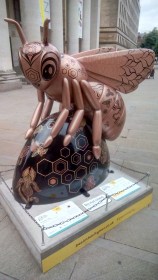
In the 1800s the Manchester textile mills were called ‘hives of activity’ and the workers compared with bees. The Borough of Manchester was granted city status in 1842; on the city crest seven bees are flying over a globe, signifying Manchester’s industry being exported. Images of bees can be found on buildings and bins. After the Arena bombing last year many Mancunians got themselves bee tattoos.

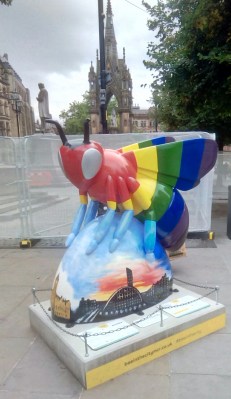
So, there is a lot of interest and excitement about bees currently dotted around town, in parks and public spaces. Over 100 large bees have been decorated by artists, while 130 little bees are part of the City Learning Programme. It’s how creative producers Wild in Art are celebrating their 10th anniversary, and there are some fabulous creatures to be found. The bee below shows some Manchester landmarks: the Town Hall, a Grade I listed building, the Manchester Central  Convention Complex (the original Central railway station) and the Beetham Tower with 47 floors, until recently, the tallest building in the UK outside London.

4 (2)

This is Manchester, C Elliott

On a recent trip to Leeds University to visit the Special Collection I was delighted to see a copy of the 1634 revised edition of the first English-language book devoted to beekeeping The Feminine Monarchie, the histori of bee’s. Charles Butler was also called The Father of Beekeeping. He was a priest and kept bees at his parsonage. Butler writes about bee gardens, hive making, enemies of bees, feeding, pollination and swarm catching. The book also includes a musical score: a four-part madrigal that mimics the sound of swarming bees!

Butler cover

One of the most original poetry collections I read in the last few years is Bee Journal by Sean Borodale. It was shortlisted for the 2012 Costa Poetry Prize. Borodale had previously published books based on walking and writing on location and Bee Journal was supposedly written at the hive, with the poet wearing a veil and gloves! The 90 pages chronicle the life of the hive, from the collection of a small nucleus on 24 May – extract below –

He just wears a veil, this farmer, no gloves
and lifts open a dribbly wax-clogged
blackwood box.
We in our whites mute with held breath.
Hello bees.
Drops four frames into our silence.

to the capture of a swarm two years later, with all the learning, joy and anxiety in between  The poem titles are all dates, some with additional notes, as below:

14th August: Bee Inspector
Today a DEFRA bee inspector clipped the wings of our queen.

Some days the poems are only a few lines, or a single word. 7th January starts:

Four inches of snow. The hive a hut
of silence and darkness.

A year later, there is the entry for 13th January: False Spring Week’s long hoax of mild weather/and bees wander like fools.  On the 15th January Sean makes herb tea for his bees, adding grains of salt and their own honey (10%) to boiling water.  Opposite is the devastating empty page, titled 24/25th January: Bees Die.

In between, there are many poems full of joy and marvel. Here’s a stanza from 2nd May:

A bee, a tine being struck was out:/sound like a rooting of thin flash/in liquid form poured from a bucket the size of an adult/tooth./Magnet of listening, I to hear it/turned the pole of my head.

Because of the regular small interventions the beekeeper has to make, his observations and devotion turn to a deep intimacy, with unusual imagery and dense, “clotted” language.  Reading it was an amazing experience.


Above a thousand feet of space


D Wilson action


In the Balance

You pause beneath a boss of ice
above a thousand feet of space.
The picks of your axes barely bite:
it’s bullet hard, black with rock dust.
You’ve run out forty feet of rope,
placed only an ice-screw and screamer.
You’ve dreamed of this route for half your life.
Your calves ache. You can’t wait long.

Decision time. Weigh the following:-
an abseil retreat to blankets, pasta, beer;
the taste in your mouth if you bottle out;
November at work without a fix;
glimpses of where the pitch might ease;
a face at a window, Dad come home,
and you not knowing where you’ve been
or how to get back from it.

 
David Wilson turned to writing poetry a few years ago after being inspired by reading Derek Walcott’s poem ‘Midsummer, Tobago’ on the wall of a hospital waiting room in Leeds. He then discovered the Writing Days run by the Poetry Business in Sheffield and started writing poems of his own. His pamphlet Slope was published by Smith/Doorstop in 2016 and he has a collection coming out with them in 2019.

David was born and brought up in North London and studied at the London School of Economics, followed by a Master’s degree at Leeds University, which at the time had the only indoor climbing wall in the country and was close to excellent outcrop climbing. He has climbed extensively in the UK, Alps and further afield, at a standard best described as erratic.  In mid-life he got hooked on windsurfing, but writing about climbing has led him back into it.

After living in Leeds, David settled with his family in Harrogate. He has worked freelance for many years as an organisation development consultant. He now works part-time, exclusively in the area of academic leadership, helping people like Heads of Department to tackle the many challenges they face. He mainly works 1:1 with people and the diversity of their subject areas is a delight: from Medieval Welsh Poetry to Theoretical Physics to Cancer Research to Arabic, and that’s just in the past few weeks!  Favourite poets include Jane Kenyon, Les Murray, Jane McKie, Norman McCaig and Seamus Heaney.

Slope cover

David and I met on the 2012/13 Writing School and I’m delighted to share his work. Below are more poems from the pamphlet Slope. Everest was awarded 1st prize in the 2015 Poets & Players poetry competition, judged by Paul Muldoon. For a few technical terms: a cam is a device fitted into cracks to protect a lead climber. It has spring-loaded metal cams which grip the rock. A Micro-traxion gadget is a pulley that locks the rope, capturing what’s gained as a climber is hauled from a crevasse. A screamer is a sling which has stitches designed to rip and thereby absorb the energy of a fall. Typically used with doubtful ice-screws.

Stanage Edge

Summer’s returned for one day only,
blue sky, no wind, mist in the valleys,
bracken bronzing every hill,
the Edge’s gritstone silver in the sun.
Rock warm to touch. But holds won’t sweat.

I check my harness, knots and rack,
lay away, step high and up again to poise
off-balance, wriggle a cam into place,
then smear a slab, heels low, until
a crack grips my outstretched hand.

We linger on the edge. Smoke rises
straight up from the chimney at Hope.
It’s not a day to hurl ourselves against
but for dancing with, to feel alive
on Black Slab, Inverted V, Goliath’s Groove.

And it will light the long edge in our minds,
where name after name spells a life,
Flying Buttress and Left Unconquerable,
holds we could trust to be always there,
winds which threw every word away.


Everest

Once it was Chomolungma,
Mother Goddess of the Earth,
a face whose veil rarely lifted,
its whiteness the White Whale’s.

Now it’s like Elvis near the end,
a giant in a soiled jumpsuit,
blank, useful for percentages,
a sheet from which the music’s fled.


Alpine Partner

I was thinking of glaciers as metaphors,
you knew the car park’s exit code.
And you’d practised techniques
for rescue from a crevasse.

to dig a T slot, bury your ice-axe,
attach our micro-traxion gadget,
then fix the rope as a Z-haul
across the sweating surface, so that inch

by inch you heaved me up when I fell,
up from that cold place – its white walls
and longing, fins of green ice, pale blue caves,
darker blue depth beyond saying.

Ink wasters

pen 2

The late poet Gerard Benson coined this term for the warm-up, stream-of-consciousness exercise at the start of a workshop: Start writing, don’t stop writing, don’t think, just keep the pen moving.

If you’re familiar with The Artist’s Way, then you have the Morning Pages in your toolkit. To me, the Morning Pages are still more of a “dumping” ground of grumpy stuff, Aargh – not a morning person and never will be….

At a workshop the tutor or facilitator gives a starting line and sets you off. But, how do you create that effect when you’re by yourself? How do you nudge your self on to the track? Here are some options I’ve used:

Liminal lines
The immediacy of being on a threshold of sorts, for example:
Standing on the flood line I noticed…
When I stepped into the room…
Waiting on the platform there was…

Lines that open onto the unexpected, the other side
I turned the corner and then…
As I opened the door…
At the back of the cupboard…
I thought I saw…., but….
I never even once…
It was that dream again…
Sometimes you’ll think of…
No telling what arrived here in the night…

Unlikely/Doomsday scenarios
It hadn’t stopped snowing for thirty years…
It rained for ninety days, then suddenly….
The morning after the storm…
Your body lies on the floor, with or without you…

Juxtapositions
I have an envelope with pieces of paper, some with names of rooms in a house, others with objects, others with abstract nouns. So, we might get hallway, stapler, vanity. Off we go just putting those together in some way or another.

List poems
We’re not expected to write a “proper” list poem with a story arc, a development, an argument. Just a list of anything will do. Six lines is a good starting point, six things I would never eat for breakfast. Then another day there could be a list of the opposite: breakfast favourites (scrambled eggs and my poet friend E told me to add mustard and some dill, homemade porridge with berries, and I’ve just found out that one berry is one calorie, so I’ll have a few more, and strong black coffee in the mug with lavender fields on it. That mug was given to me by a lodger who’d had wanted to become a nun, but then decided to train as a nurse instead….)

Borrowed lines
Using opening lines from poems often work. I have typed up a batch of these, cut them out and put them inside an envelope. Picking one out gives the surprise effect that just reading it in the book doesn’t give.

I’m signed up with the Academy of American Poets for poem-a-day. I really like getting a surprise poem in my inbox every day and sometimes use the title or the opening for my warm-up. Yesterday’s poem started Imagine your heart is just a ball. Go to poetry.org to sign up. Similarly, there may be good “triggers” from other websites – on-line magazines, poetry publishers. A recent newsletter from Carcanet showed Snow in C Sharp Minor which I found intriguing and could have used as a prompt. It is a poem from Errant by Gabriel Levin.

And there is always Carl Sandburg’s This morning I looked at the map of the day…

Sometimes ink wasters can be developed and turn into a poem. It’s rare for one to be a complete poem straight-away. That’s a bonus. Below is one of those. It was published in The North, No 48.

On the town

In the time it took to buy a birthday card, a special
80th birthday card, they had arrived in a long, black limousine,
jumped out, set fire to the hotel and released wicker
baskets. The flying baskets with wicker wings chopped
tops of trees, trees falling on traffic lights – chaos everywhere
and in the middle of it the small bronze statue.
A smiling woman holding doves covered in birdshit.
The wind howling, sirens crying like the end of the world had come.
And me and that card that had cost me £2.99 and nowhere
to buy stamps, no letter box to post it.

Giraffe

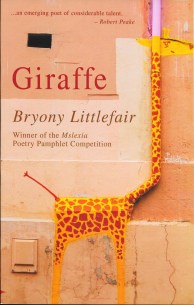
Seren Books had a brief 50% discount offer, so at the end of July I dashed to the website to make a purchase. In the library at Ty Newydd I’d seen a copy of In a different light, Translations into English of fourteen contemporary Dutch-language poets. Scrolling I suddenly spotted a picture of a giraffe!

giraffe-cover.jpeg

Bryony Littlefair was the Winner of the Mslexia Poetry Pamphlet Competition. Seren Books published her pamphlet last year. In her testimonial Myra Schneider says Her work, with its unexpected imagery and juxtapositions, is witty, ironic, frank, and poignant. Giraffe is a striking debut collection.

There are some intriguing titles: The year she asked for a scrubbing brush for Christmas; Poem in which not everything is lost; Visitations of a future self; The meaning of employable.

The tone of the poems is conversational, but Bryony has a clear eye for the detail. Dear Anne Monroe, Healthcare Assistant celebrates the “quiet beauty” of NHS nurses in Archway where the light is piss-yellow and everyone is angry. In The sadness of giftshops we see the owner’s thin, teal scarf, smattered with small white horses and the way she writes down everything she sells on a plain sheet of A4.

I enjoyed reading Bryony’s pamphlet, including the memorable poem Maybe this is why women get to live longer.  Here is a woman in a wrap dress/and brown hair tied loosely at the nape/of her neck, slack as an otter’s tail.  This woman is listening to a man with the thick/tufty eyebrows of a politics professor -/permanently raised, as if hung by them/to a washing line -.

The title poem is the last poem of the book, placed opposite Sertraline. It was previously published in Popshot Magazine, and I appreciate Bryony’s permission to share Giraffe with you.

Giraffe

When you feel better from this – and you will – it will be quiet and
unremarkable, like walking into the next room. It might sting a little, like
warmth leaking into cold-numbed hands. When you feel better, it will
be the slow clearing of static from the radio. It will be a film set when
the director yells cut! When you feel better, you will take: a plastic spoon
for your coffee foam, free chocolates from the gleaming oak reception
desk, the bus on sunny days, your own sweet time. When you feel better,
it will be like walking barefoot on cool, smooth planks of wood, still
damp from last night’s rain. It will be the holy silence when the tap stops
dripping. The moment a tap finally starts to make sense. When you feel
better, you will still suffer, but your sadness will be graspable, roadworthy,
have handlebars. When you feel better, you will not always be happy,
but when happiness does come, it will be long-legged, sun-dappled:
a giraffe.


Mirror poems

mirror

A poet friend gave me the collection The World’s Two Smallest Humans by Julia Copus as a birthday present. Copus is said to have invented the specular (mirror) poem form. However, the word palindrome comes from the Greek, meaning “running back again” and palindrome or mirror poems have been found in Sanskrit language and way back in antiquity. But, it was Copus who gave the form the new title and she has written several of such poems, where the second stanza repeats the first, but in reverse order.

The title of the poem is Raymond, at 60. It starts The 185 from Catford, the 68 from Euston -/those same buses climbing the hill long into the evening. The last line of the first stanza is: that first time she’d taken him down to watch the buses. The first stanza of 20 lines is a journey through time with Raymond in a hospital ward. He kisses his mother who has just died, and this takes him suddenly

back on Broadway, crushed to her breast, in a gesture
that meant, he knew now, You are loved. There he was, with her

The second stanza, perfectly mirroring, is therefore also a journey: this time in chronological order, with Raymond setting out, aged eleven, or twelve.

By the time we have read the first stanza, we have the story, the information. So, the second stanza will not be a complete surprise. Small changes in punctuation are permitted in the second stanza, but it far from easy to ensure that the second half of the poem is alive, has emotional impact. This poem works because of the death, the mother-son relationship, rich and telling detail.

In the recent Ver Poets Competition one of the shortlisted poems clinging on in the badlands by Steve Pottinger is another example of a specular poem:

The beer is good when you’re sitting in the sun.
I can only tell you that
the work has gone to China or Taiwan.
We’re a precariat now, bolting up memories.

The poem is an effective and moving account of changes, the end of manufacturing. All this were factories, once, making locks by the million: Yale, Union, Parkes’s. Steve has dealt with the challenge of making the second stanza “fresh” by keeping the poem relatively short – 22 lines.

The poem by Victoria Gatehouse Weathering the Tent (from her book Light After Light) has the same length as Raymond, at 60. Perhaps there is an optimum length for this type of poem? Anyway, it’s still summer, we’re not packing up that tent yet!

Weathering the Tent

Tonight, we pack up the tent –
a corner at a time, our familiar routine, folding
the canvas we weathered twenty years ago,
cocooned in green dimness, listening, listening
until finally, that drip drip drip on our faces
as we lay on the groundsheet, numb-backed
from the cold, every one of your roll-ups
lighting me up, a catch in my throat;
over our heads that slow expansion,
fibres growing into one another,
meshing until watertight.
Tonight, kneeling side by side,
we press forward to quash the billow,
releasing breaths of earth, smoke, gabardine.
All creaking resistance, this fabric,
you and I cursing, our guy-roped hands
holding out for old creases.
All these years of practice and still
so many attempts
to force another summer in the bag.

To force another summer in the bag –
so many attempts,
all these years of practice and still
holding out for old creases;
you and I cursing, our guy-roped hands
all creaking resistance, this fabric
releasing breaths of earth, smoke, gabardine.
We press forward to quash the billow
tonight, kneeling side by side
meshing until watertight,
fibres growing into one another;
over our heads that slow expansion
lighting me up, a catch in my throat
from the cold, every one of your roll-ups,
as we lay on the groundsheet, numb-backed,
until finally, that drip, drip, drip on our faces.
Cocooned in green dimness, listening, listening –
the canvas we weathered twenty years ago,
a corner at a time, our familiar routine, folding.
Tonight, we pack up the tent.


Yorkshire Day

A suitable day for checking up on the Northern Poetry Library project: a series of poems in the new 821 form. I posted about the competition a few weeks ago. The picture is of Fountains Abbey, near Ripon, North Yorkshire.

img_20171126_1349339_rewind-003.jpg

The first canto of poems is up: poems about Liverpool, drystone walling, the journey North, a poem titled Notes made on Hadrian’s Wall by Catherine Ayes, and Ghost Crossing by Harry Man which has been Commended in the competition, and starts:

Making an enemy of the wind, a crow
backtracks on its own trajectory against

Two poems have just been added to the second canto and you can follow the growing sequence on https://poemsofthenorth.co.uk

The Artist’s Way

At Ty Newydd on the Writing Retreat the other week I talked with one of the people about books that might be helpful for dealing with “blocks”. I mentioned Julia Cameron’s bestseller The Artist’s Way. They hadn’t heard of it.

The book was recommended to me by a good friend who was a musician/painter. It had helped him work through blocks about being an artist and he thought I might benefit too. The Artist’s Way was first published in 1992 and it is A Course in Discovering and Recovering your Creative Self.

The book is based on the creativity workshops Julia Cameron had been running. In the book she briefly introduces Spiritual Electricity: the Basic Principles, then outlines the Basic Tools. Each of the 12 chapters addresses a major block. You’re expected to work through a chapter each week, by completing various exercises. Most pages have one or two short quotes about creativity in the margins. I found many of these very uplifting and supportive.

the-artists-way.jpg

I have just found the Contract which I signed on 30 June 1997. I had also highlighted a quote by Oscar Wilde: The true mystery of the world is the visible, not the invisible.

In sequence the chapters are Recovering a Sense of: Safety, Identity, Power, Integrity, Possibility, Abundance, Connection, Strength, Compassion, Self-Protection, Autonomy, Faith.

I found several of the exercises, tasks, questions extremely challenging and even very painful at times. Julia Cameron had warned me about the process in her initial chapter, that working through the course would be peaks-and-valleys, that I would experience anger, grief, defiance, want to give up the whole thing before I came to the creative U-turn from which there would be choppy growth.
She was correct! But I stuck with it and I have kept up with the Basic Tools since then:

1) Morning Pages – the main purpose is “to get to the other side” – of the critic, it’s a “brain drain”, just stream-of-consciousness dumping, angry, whiny stuff. Cameron suggests three pages in long-hand and she says “you shouldn’t even read them yourself for the first eight weeks”. After that period, it’s okay to read and see if there are things that could be used in your creative work.
2) The Artist Date – a block of time, perhaps two hours a week, set aside to nurture our inner artist. It doesn’t need to be expensive; it could be a solo walk on the beach, a visit to an art gallery, seeing an old movie. It’s the time commitment that is sacred. This is all about “Filling the Well, Stocking the Pond”.

If I was compiling that list of books that changed my life, The Artist’s Way would be on it.

Illness poems

Emma Press have recently put out a call for submissions of poems on Illness. The closing date for your submission (maximum of three poems and up to 65 lines each) is 31 August. To be able to submit you must have bought one printed book or e-book in this calendar year. Emma Press is an active small publisher with a range of anthologies, individual pamphlets and collections. So that one book could pay for several submissions. I will be submitting and have ordered Postcard stories, mini-stories about Belfast.

The editors are looking to “express the experience of illness right across the spectrum” and are “keen to uncover invisible symptoms, as well as unravel the stigma of mental illness”.

Signs and humours cover0001

I have Signs and humours: the poetry of medicine on the shelf. This anthology holds 100 poems written over the last 2,000 years and it includes subjects such as autism, infertility, pancreatitis. It was edited by Lavinia Greenlaw who commissioned 20 poets to write on a topic of their choice. The poets were then introduced to medical specialists on that subject (for example, PTSD, glaucoma, malaria, psoriasis). Since 1982 I have had tinnitus in my right ear, so David Harsent’s poem Tinnitus spoke to me; a short extract:

A single note drawn out
beyond imagining,
pitched for a dog or a rat
by a man with a single string
on a busted violin.

There are also poems about how we respond  when faced with a diagnosis. The first few lines from Raymond Carver’s What the Doctor Said:

He said it doesn’t’ look good
he said it looks bad in fact real bad
he said I counted thirty-two of them on one lung before
I quit counting them

There is Sharon Olds who accompanies her father to a meeting with the doctor who says that nothing more can be done: My father said /‘Thank you.’ And he sat motionless, alone,/with the dignity of a foreign leader.

Around AD 842, when he was paralysed, Po Chü-I wrote a short poem that ends:

All that matters is an active mind, what is the use of feet?
By land one can ride in a carrying chair, by water be rowed in a boat.

The anthology Signs and humours was published in 2007. It will be interesting to see the similarities and differences between this and the Emma Press Anthology. Will there be poems about eating disorders, body dysmorphia, internet addiction?