Category Archives: News

Refusal of a visit visa (2)

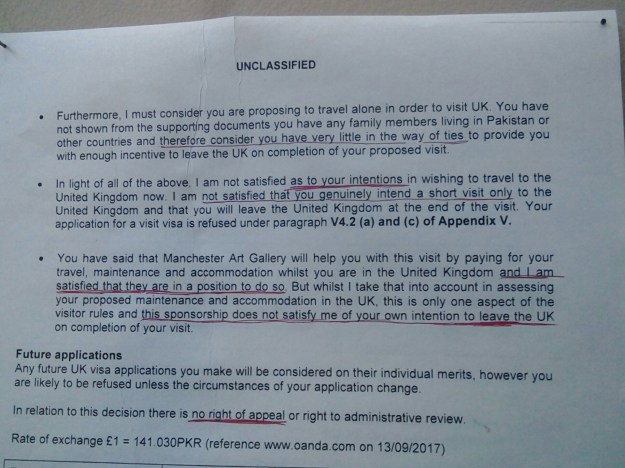
Recent Poetry School workshops have been held in the Manchester Art Gallery. So, we have been inspired by sample poems as well as the works on display. On the second floor there have been several interesting exhibitions of modern art. Dashing back downstairs I missed the display on the foyer wall – an enlarged copy of Home Office form OV51 Visit (NRA). On the first page the staff have given another reason for the refusal. They doubt that the artist has control over her bank account (the application was accompanied by bank statements, as required).

visa 2

Some personal details have been blacked out prior to posting, but the applicant is born in Pakistan and the work in the gallery is by Adeela Suleman, a sculptor and artist and Associate Professor and Head of the Fine Art Department of the Indus Valley School of Art and Architecture in Karachi.

My short “found” poem:

Refusal of a visit visa

Date of refusal decision: 13 September 2017

Furthermore, you have stated that you are single
with no dependents.

I am not satisfied that you have demonstrated ties
to Pakistan that would give you reason to return
there.

a simple pattern that silently repeats itself
               silence haunts you
                                       silence is disturbing


Text in italics by Adeela Suleman.


Refusal of a visit visa (1)

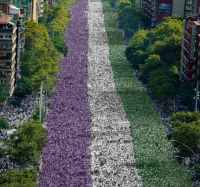
I’m flying out on Saturday, so can’t take part in one of the women’s processions that are being held in the four political capitals: London, Cardiff, Belfast and Edinburgh on Sunday. Those taking part will be given a sash in one of the suffragette’s colours – white (purity), green (hope) and violet/purple (loyalty and dignity). Manchester is the birthplace of the suffragette movement. The Pankhurst Centre is just a few miles from where I live.

processions-2018_-courtesy-of-artichoke

Suffragette Procession, courtesy of Artichoke

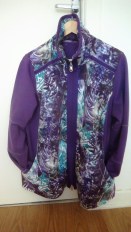
Yesterday I realised that this top, bought in Holland, is in the suffragette colours! Okay, the green is turquoise.

Pankhurst jacket

The Pankhurst Centre published a booklet – essays, memories – to celebrate its tenth anniversary in 1997. The one poem included was mine: a sonnet of sorts.

A line to Mrs Pankhurst

Leaving space for dreams between
the cooking and the dressing of the tree
Purple White and Green

Counting wrinkles on baubles I flee
to caress the turkey and knock
about the choice: dead or free.

Skimming fat off steaming stock
to start afresh, to say seems equal folly
Purple White and Green I fill my sock.

With another drink I might feel jolly.
Outside fairy lights among a flurry of snow.
I shudder when he pulls me under the holly

and Purple White and Green I know
that maybe next year I will go.


New poetic form: 821 – a competition

The 821 is an 11-line, 3-stanza poem created in 2018 to celebrate the 50th anniversary of the Northern Poetry Library. This is based in Morpeth, Northumberland and has the largest collection of post-WWII poetry in England outside London: over 15,000 volumes.

Why 821? It is the number allocated to English poetry in the Dewey Decimal Classification (DDC) System. The form also uses the “volta”, the turn, a concept traditionally associated with sonnets, and this is used to create a subtly interconnected series of stanzas that turn, or riff of one another.

The poem consists of an opening octet (8 lines), line break, a couplet (2 lines), line break, followed by a single line. There is no set meter. It could use a rhyme scheme or be free verse.

The Northern Poetry Library is sponsoring a competition for 821 poems. International entries are welcome. The poem needs to have a connection to the “North”; how you interpret this is up to you. The judges will select a total of 50 poems: during a five-month’ period 10 poems will be picked each month to form a canto which will be published on-line.

Include with the submission a statement (max 100 words) about your connection to the North. The closing date is 17 June 2018. Some sample poems are on https://poemsofthenorth.co.uk

I am grateful to poet Pam Thompson for introducing me to the form. I am definitely going to submit: I have been in the North West for almost 40 years so I have the connection, but I don’t yet have the poem – I’m not finding it easy to get a balance between the opening octet and those final three lines…


Optimism

Any writer is an optimist. Why? Number one: they think they’ll finish their book. Number two: they think somebody will publish it. Number three: they think somebody will read it. That’s a lot of optimism.       (Margaret Attwood in a recent interview.)

I was about to give up on Animate and inanimate objects relating to J Abraham. It has been sent to at least a dozen magazines and competitions in the last few years. I know one or two editors who don’t like prose poems and don’t publish them. But I like the piece, it’s quirky and I have grown attached to it, so I sent it along with three poems to Carole Baldock, editor of Orbis – a quality UK poetry magazine. I had two poems accepted in 2014, but not submitted since. Just had an email acceptance!

The piece consists of short monologues by, respectively, the favourite mug, the handkerchief, the ashtray, the moustache, and the newspaper cutting. It came out my decluttering before I downsized a few years ago.

There are echoes of Elizabeth Bishop’s poem 12 O’ Clock News. This prose poem is in the form of a report of an alien territory: the gooseneck lamp becomes the full moon, the typewriter is an escarpment, a pile of manuscripts is a landslide, and so on. I fancy that Bishop wrote the poem when she was having a bout of writer’s block. It is a witty, humorous piece that must have been hiding in my subconscious for a long time. Here is part of Bishop’s report:

From our superior vantage point, we can clearly see into a sort of dugout, possibly a shell crater, a “nest” of soldiers. They lie heaped together, wearing the camouflage “battle dress” intended for “winter warfare”. They are in hideously contorted positions, all dead. We can make out at least eight bodies.

That’s the ashtray again…


Tulips

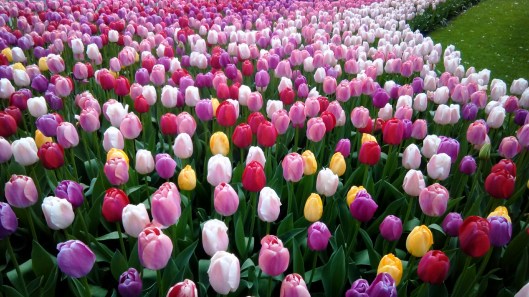
During my recent trip to the Netherlands I joined my sister and brother-in-law for a visit to the Keukenhof. It was a clear dry day, with a slight breeze and a some sun in the afternoon.

The Keukenhof is one of the world’s largest flower gardens incorporating different gardens and styles on a 79-acre site. It’s situated on 15th century hunting grounds and there are beech trees which are centuries old. The original park was designed in the 1830s and the Keukenhof (Kitchen garden) first opened in 1949. Each year some seven million bulbs are planted up.

17 purple tulips

I vaguely recalled the Sylvia Plath poem about tulips, so I looked it up. It was written in 1961 and consists of nine 7-line stanzas. It starts: The tulips are too excitable, it is winter here. The poem is based on Plath’s experience of recovering in hospital from an operation: I am learning peacefulness, I am lying by myself quietly/ In the following stanzas the tulips are not experienced as benign: The tulips are too red in the first place, they hurt me. The vivid tulips eat my oxygen. The tulips should be behind bars like dangerous animals;

I have one poem about tulips (in the Building Bridges anthology published by Ek Zuban last year). It has a very different feel from the fabulous Keukenhof tulips and is more at the Sylvia Plath end of the continuum. The title of the poem is the title of a watercolour painting donated by the (anonymous) artist to Manchester Art Gallery.

Extraordinary Popular Delusions and the Madness of Crowds

They’ve not yet reached one of the tulips,
the central one of this display.
You can imagine a window, if you like.
Five parrot tulips lean towards the light.
Degrees of purpling. The ants appear
half-way up the bulb-shaped vase.
I’ve left the thin pencil lines
indicating a flat surface.
Look closely and you’ll see this vase
should tumble, fall or slip.
Three fingers’ width, water level
in the glass. Greying water extracted.
The tulips were a present.
You can count the ants, if you like.


Greenpeace

Last night I did an open mic slot at a fundraising event for Greenpeace. There were two fabulous readings by the poets Kim Moore and Clare Shaw, as well as music. The open mic slots were four minutes each which meant three poems per person.  This gave a good flavour of each poet’s “voice” and offered plenty of variety. I’d come back from Holland 36 hours earlier, so only just got my tongue round the English…

In the afternoon Clare Shaw ran a short workshop. One of the sample poems was The Low Road by Marge Piercy. The poem starts: What can they do/to you? Whatever they want. The first stanza is then a list of things that can be done, e.g. “bust you, break your fingers, blur you with drugs, burn your brain with electricity.” After a short second stanza starting But two people fighting/back to back can cut through/a mob, there is this third stanza. The recent news in the UK (the ongoing Brexit saga, the “Windrush generation” scandal, the NHS failure with 450,000 women missing out on mammograms and treatment) has been deeply depressing. So, this was a timely reminder of people-power and I found it immensely encouraging and heartening to read.

Two people can keep each other
sane, can give support, conviction,
love, massage, hope, sex.
Three people are a delegation,
a committee, a wedge. With four
you can play bridge and start
an organisation. With six
you can rent a whole house,
eat pie for dinner with no
seconds, and hold a fundraising party.
A dozen make a demonstration.
A hundred fill a hall.
A thousand have solidarity and your own newsletter’
ten thousand, power and your own paper;
a hundred thousand, your own media;
ten million, your own country.


Light After Light

In Halifax last night my friend Victoria Gatehouse read at the Corner Bookshop to launch her debut pamphlet published by Valley Press. Their representative made us all welcome. It was a packed house. Vicky read alongside Wendy Pratt and Jo Brandon.

Vicky is a clinical researcher by day and in this “beautifully balanced and sure-footed debut” there are poems about science, such as Recording the Phlebotomist, Burning Mouth Syndrome, Phosphorescence, as well as poems set firmly in their locale (The Geese of Sowerby Bridge, In Praise of Pylons) and some which are, like folk tales “on the threshold of mystery”. I particularly enjoyed these and the poems which are inspired by art work made by Susie MacMurray: Pillion, Velvet Shells, Widow.

The bookshop is based in the Piece Hall, which recently has been renovated to a very high standard. I walked across this large open space to the sound of trickling water, marvelling at the lights against the last light of the day.

Vicky’s book is now on the shelves, between Rosie Garland and Kahlil Gibran. She keeps very good company, that’s for sure!


Don’t talk to me of snow

Don’t talk to me of snow

Just give me her body laid in Longmire’s
and I’ll show you stillness, silence, chill.

I’ll show you every thread cut through
to heart, limb, brain.

I’ll show you in-and-out stopped up
to speech, song, sigh.

I’ll show you stone no touch or kiss
will every warm again.

Don’t talk to me of snow, of landscape whited out
and all ways lost. Give me mother.

This poem is by Gina Wilson, from her new pamphlet IT WAS AND IT WASN’T, published by Mariscat Press in Edinburgh. Gina’s adult poetry started to appear in 1996 and has been widely published in anthologies and a range of magazines. Happenstance Press published her first poetry pamphlet Scissors Paper Stone in 2010. She was first published as a writer for children and young adults – novels (Faber), poetry (Cape) and picture books (Walker Books). Gina has been shortlisted for the Carnegie Medal, Kurt Maschler Award and the Smarties Prize. She is a psychotherapist in Oxford.

Gina and I met in 2012 on the Writing School in Sheffield. She wrote a testimonial for my debut collection. I see our work as similar in some ways: her poems are complex, but they seem deceptively simple. Tough and compelling, no verbiage – no sentimentality Kate Clanchy wrote of her first pamphlet. Below is the poem that gives the new pamphlet its title:

Treasure

Squirrels spend a lot of time
digging up and reburying their store,
checking it’s still there, taking a bite.
My mother used to be the same
with dates and nuts at Christmas.
Never an unopened box of anything
by the Day itself. Funny how people
can’t quite bury a treasure. My brother
dug up our dead rabbit by torchlight
to see if it was safe. It was and it wasn’t.


Snow, snow, snow…

Under all that snow is a silver lining: last night I made it through snow to our small local writing group where we worked with a poem by Phil James The Eskimos’ Hundred Words for Snow.  It includes some wonderful words and definitions, such as priyakli – snow that looks like it’s falling upwards, and dinliltla – little balls of snow that cling to Husky fur.  There may be some genuine Inuit words here, but the whole poem is a take-off.  So we have tlalam – snow sold to American tourists, and Mac Tla – snow burgers.

This afternoon, while fresh snow swirled outside, I looked up the details.  In his 1911 Handbook of American Indian Languages, the anthropologist Franz Boas published on his research undertaken in the 1880s.  Later the story of the 100 words for snow was deemed to be just a myth.

But the Inuit language has at least 50 words for snow and sea ice, and the Yupik about 40.  We have matsaaruti – wet snow that can be used to ice a sleigh’s runners, and pukak – crystalline powder snow that looks like salt.  That would be the snow then just outside my living room window…

My funny Valentine…

This is not a poem

the editor wrote, this is a list.
and I thought, he must be right,
he is an editor. But then I
thought there are list poems…

from afar, in love with his car,
or his wife, depressed about life,
attached to his money,
or his mother,
or some other pre-occupation,
watches trains from a station,
alcoholic, workaholic,
football high on his list,
never been kissed,
recently converted to church,
leaves you there in a lurch,
Elvis look-alike,
any man called Mike.

But I just had some great news: my poem Quantum has been Commended in the 2017 Barnet Open Poetry Competition and will be published in their anthology.