Category Archives: Inspirations

Hyacinths and biscuits

In Good Morning, America (1928) Carl Sandburg wrote thirty-eight definitions of poetry. My two-day one-fruit detox (apples) has left me a little obsessed with food and drink, so this one stands out:

Poetry is the synthesis of hyacinths and biscuits.

I wrote a poem once about hyacinths (inspired by one of the Louise Glück flower poems), but it’s in a huge pile of So-so poems that I’m going through this week and it may not survive the cull.  As for biscuits, I can only offer broken ones. It’s a long prose poem that was published by Valley Press in their Anthology of Yorkshire Poetry last year. I rarely do politic poems and I rarely do rants…

Broken biscuits

Is there poetry in broken biscuits? Discuss. The short answer is yes, provided it is articulated in the unashamedly Yorkshire, tongue-in-cheek, twinkle-in-the-voice tones of Ian McMillan of The Verb. You need a risk assessment now before being allowed to step onto a soapbox: its size, the maximum weight of poet it may carry. There is the marshal in a fluorescent jacket, carrying a walkie-talkie, clipboard and stopwatch, holding at bay some members of the Society for the Prevention of Cruelty to Biscuits. Biscuits are indexed and cross-referenced, generic categories and brand names listed: Bourbon, broken, chocolate, chocolate (milk), chocolate chips, chocolate digestive (Milk Chocolate & Orange Digestive), digestive, dunking….. Specifications are laid out, spelled out and laid down for the packaging of biscuits. Here the blue and orange house colours of McVitie’s nestle up with the listing of the ingredients: wheat flour, dried whey, cocoa mass, along with emulsifiers (soya lecithin, E476, natural vanilla flavouring), raising agents (sodium bicarbonate, ammonium bicarbonate, tartaric acid, malic acid). A touch then of the barbarous, barbaric, acidic and malicious. Raising agents might be the euphemistic title for these officials. Some Government-funded scheme would have lifted people off the scrapheap in a cold and distant Northern town; the group photo – five of them smiling in their smart uniform – appeared in the Echo, and now they do their daily rounds: moving beggars along, breaking up groups of young men loitering, or giving the impression that they are, or might be soon. The faded For Sale signs creak in the windy cave of a shopping mall, windows are boarded up and people – young girls in anoraks, smoking, pushing their friends; pensioners with stick and Zimmer frames – queue up in Penny and Pound shops for bags of broken biscuits.


Refrigerator, 1957

To help me get back into writing, I got out 52. Write a poem a week. Start now. Keep going. The book originated in the 52 Project by Jo Bell and guest poets. I opened it at random and got to Prompt No. 15 titled Bell, Book and Candle. This is a prompt on writing about the unnoticed object.

The second sample poem Refrigerator, 1957 is by the American poet Thomas Lux. As synchronicity would have it, today is the first anniversary of his death. He was born in 1946 on the dairy farm his father owned. On poets.org, the website of the Academy of American Poets, I watched a short video In Memoriam 2017 which had a picture and a short quote by each of the US poets who died last year.

Adding that date to an ordinary object already makes it less ordinary. It tells us the perspective is that of an eleven-year old boy. More like a vaultyou pull the handle out it starts. There is humour: not a place to go in hope or hunger. Then the poem zooms in, heart red, sexual red, neon red, on that jar of Maraschino cherries. The same jar there through a childhood of dull dinners… Then we go down the timeline to grandparents, pig farm in Bohemia. The poem ends and because you do not eat/ that which rips your heart with joy.


Love and a dry February

Paper Swans Press are going to publish my poem Cromer, August in their Love anthology.  I had a poem selected for Great Britain anthology, so I know Sarah, the Editor, will produce a lovely book.  It’s going to be pocket-sized…

While I was on Lanzarote I didn’t write much, but I read 11 books.  Brought back The Iceberg, in which Marion Coutts writes about the two years leading up to the death of her partner, the art critic Tom Lubbock.  The quote on the cover says “mesmerising, harrowing and radiant” and I understand why the book was awarded the Wellcome Book Prize in 2015.

As I’m giving up alcohol, I’ve been reading and thinking a lot about other drinks and am well stocked up with herbal teas:-

Moroccan Mint – with a twist of cardamon

Three cinnamon – a sweet embrace of organic Indian, Indonesian & Vietnamese cinnamon

Lemon, ginger  & manuka honey – a welcoming cup of spicy-sweet organic bliss

Linden flower –  Carmencita Tila (Sp) bought in Playa Blanca

Pure Fennel – the bright yellow flowers of the fennel plant fan out like water from a sprinkler…

When is a list not a poem?


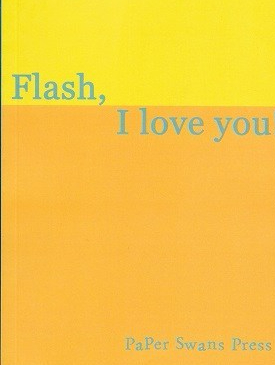
Flash, I love you!

Here are 34 extremely short stories in an anthology of flash fiction published by Paper Swans Press. My submissions didn’t cut the mustard: they were prose poems in disguise and didn’t have that important story arc.

cover flash fiction

I’ve made a handful of resolutions.  One of these is to write more short stories and get into writing flash fiction. Many years ago I had some success with short stories: published in anthologies and broadcast.  I got a cheque from the BBC for £5, that’s £1 per minute broadcast for Diving at Calypso Bay.  I’m a total novice at flash fiction and will study the form closely.  That’s after I’ve submitted some poems to issue 3 of Strix…

The Haiku Calendar

I’m not that superstitious, but I never open a new calendar before January.  I came back from a wonderful traditional Dutch family New Year’s Eve yesterday.  The small desk calendar sits on my dining table.  I gave several as Christmas presents.  I’m keen to support small publishers: John Barlow has published the haiku calendar since the start of the century, along beautifully produced anthologies and single-author collections of haiku and tanka.

Each month has one haiku with that month’s dates and on the back are three or four more seasonal haiku.  Billie Wilson from the USA has the January slot with a haiku that mentions “winter stars”.

John has an annual competition to select the haiku for the calendar and submitting some is on my Writing To Do list…

Very best wishes to you all and happy blogging…

Poetry Carousel

I celebrated Solstice by scribbling possible titles for a new poem in a beautiful suede notebook which was a retirement present from one of my supervisees.  Then I decided to hop on the bus into Manchester City Centre to buy a special 30th Birthday present for my niece in Holland. Wow!  There were two men dressed up as Father Christmas singing karaoke Christmas favourites.  They said it was their ninth day and all to collect money for the local children’s hospital.  It was cheerful, people smiled and donated money into their bucket.

That new poem was written 10 days ago on the Poetry Carousel, up in Grange-over-Sands, Cumbria.  I think it’s a great format: four two-hour workshops (Friday afternoon up to and including Monday morning) where you stay in your small group of eight and move along the carousel.  It was organised by Kim Moore who also ran one of the workshops on “veiled” narrative.  The other poets were Steve Ely (workshop on speaking with the dead), Hilda Sheehan (workshop on surreal/absurdist poetry), and David Morley who presented on the links between nature and poetry.  Afternoons were free and the tutors and four guest poets read in the evenings.  Mealtimes were an chance to catch up with people in other groups.  I met some old poet friends and made new ones.  It’s no surprise that the next event (Cornwall spring 2018) is already sold out.

Season’s Greetings to you all.  I’m signing off with a seasonal haiku, written during the Carousel:

old snow     behind the bench     rustling birds

Finding the Words

I enjoyed my final reading of the year, at York Explore last week.  For almost ten years I used to come to York often, to facilitate on the accredited EMDR trainings, running at either the Bar Convent (a “live” convent with nuns still living there) or Kings Manor.  So, it felt a little strange to travel to York in a different capacity.  Also reading were Nairn Kennedy, an expat Scot who’s lived in Yorkshire for many years, and Laura Potts.  She is twenty-one years old, has twice been named a London Foyle Young Poet of the Year and Young Writer.  This year she received a Shadow Award in the US, and became a BBC New Voice.  Her first BBC radio drama Sweet the Mourning Dew will air shortly.  She is definitely someone to look and listen out for!

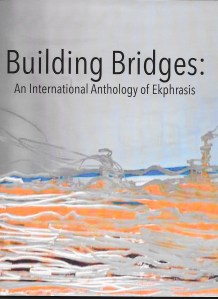
Building Bridges: an International Anthology of Ekphrasis

Building Bridges cover

The cover of Building Bridges, published by Ek Zuban, 2017.

Yesterday was the Manchester launch of this anthology, edited by Bob Beagrie and Andy Willoughby of Ek Zuban.  It’s truly an international anthology: work by poets from the UK, Finland and elsewhere – several poems have been contributed by asylum seekers.  Many of the poems have been inspired by well-known art work, but the book also contains pictures of contemporary art.

Before the reading some of the contributors took part in a short workshop where I learned a new form – triadic gnome.  There are some examples in the anthology.  Apparently, it’s usually in four lines, where the first line gives the explanation and the following three lines extend on this.  Kieren King’s Three Things I Never Said To You was a clear example.

I took one of the illustrations (Waiting Nightmare) and came up with the following:-

Three ways of keeping the nightmare waiting
Keep walking, skipping over the bulldog, the mastiff, the dead pigeon.
Do not, under any circumstance, take a body-builder to bed.
Keep your crop circles small.

It was good fun practising with this and I’m almost sorry that I’m going to miss the next launch.  That will be Helsinki in January 2018.


Armistice Day

Ceasefire

Bodybags, white gown.
Many soldiers drown.
Delay.

Parade on the down,
fireworks, parties thrown
in May.

She catches your frown.
A mindfield of brown
decay.

Now your life’s your own
you wish you’d been blown
away.

This poem is in the form of a lai (virelai), a medieval French lyric form which was revived in the 17th century.  It’s in units of three lines: a rhymed couplet in lines of five syllables, and a third line, containing only two syllables, which rhymes not with the preceding couplet but with the other short tail lines in the stanza.

I wrote it some years ago as an exercise to practise the form.  I think there’s an interesting contrast, some kind of friction, between the short lyric form which here gives a snapshot of the contrast between public display of glory and the personal life of the ex-soldiers struggling with their mental health issues.

Vahni Capildeo

Vahni Capildeo is one of the guest poets at the next reading organised by Peter Barlow’s Cigarette.  She’ll be reading here in Manchester, UK, on Saturday 25 November.  Her collection Measures of Expatriation was a Poetry Book Society Choice last year.  Leafing through the book, I found it rather daunting at first: all these huge chunks of text and long prose poems.  Once I got reading I was totally taken with it, and have written several poems inspired by it.  To me it is experimental but still approachable.  And I like the way she uses other languages and plays around with the shape of the poem on the page.  Such a treat to hear her read just down the road….