

Earlier this year, a group of artists in The Netherlands set up the Ongelezen Boeken Club (Unread Books Club). It is a sad fact that many library books are never borrowed. Currently, there is an exhibition in a public library in Amsterdam featuring some of their unread books.
Upstairs, around 200.000 books are on loan. If a book is not taken out during a period of two to three years, it moves onto the ‘null list’ and disappears downstairs. Here a good 400.000 books are stored along 24 km of shelving. At the exhibition, there is an old-fashioned telephone on which visitors can ring and reserve one of the unread books on the ‘nul lijst’.
The artists have declared Thursday 19 September as the first Nationale Ongelezen Boekendag (National Unread Books Day).
There is the concept of the anti-library: a collection of unread books as a research tool, as an ode to everything one wants to explore. Related to that is Tsundoku, acquiring reading materials and letting them pile up. Many poets I know feel somewhat guilty about new poetry books piling up.
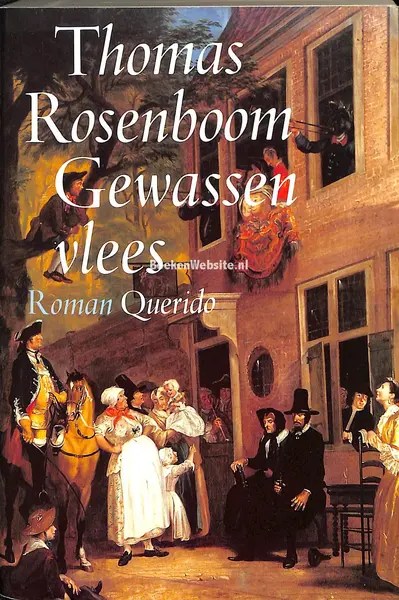
This is the cover of a historical novel, Gewassen Vlees, by Thomas Rosenboom. It won the dutch Libris prize (worth 50,000 Euros) in 1995. It’s over 700 pages long. I am never going to read it. A friend gave it to me. He died in 2000 and that’s the reason it’s still taking up shelf space.
 Acacia Publications