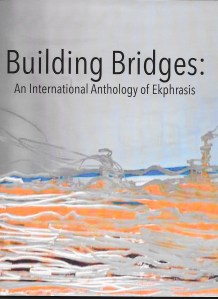
Building Bridges: an International Anthology of Ekphrasis

Building Bridges cover

The cover of Building Bridges, published by Ek Zuban, 2017.

Yesterday was the Manchester launch of this anthology, edited by Bob Beagrie and Andy Willoughby of Ek Zuban.  It’s truly an international anthology: work by poets from the UK, Finland and elsewhere – several poems have been contributed by asylum seekers.  Many of the poems have been inspired by well-known art work, but the book also contains pictures of contemporary art.

Before the reading some of the contributors took part in a short workshop where I learned a new form – triadic gnome.  There are some examples in the anthology.  Apparently, it’s usually in four lines, where the first line gives the explanation and the following three lines extend on this.  Kieren King’s Three Things I Never Said To You was a clear example.

I took one of the illustrations (Waiting Nightmare) and came up with the following:-

Three ways of keeping the nightmare waiting
Keep walking, skipping over the bulldog, the mastiff, the dead pigeon.
Do not, under any circumstance, take a body-builder to bed.
Keep your crop circles small.

It was good fun practising with this and I’m almost sorry that I’m going to miss the next launch.  That will be Helsinki in January 2018.


Armistice Day

Ceasefire

Bodybags, white gown.
Many soldiers drown.
Delay.

Parade on the down,
fireworks, parties thrown
in May.

She catches your frown.
A mindfield of brown
decay.

Now your life’s your own
you wish you’d been blown
away.

This poem is in the form of a lai (virelai), a medieval French lyric form which was revived in the 17th century.  It’s in units of three lines: a rhymed couplet in lines of five syllables, and a third line, containing only two syllables, which rhymes not with the preceding couplet but with the other short tail lines in the stanza.

I wrote it some years ago as an exercise to practise the form.  I think there’s an interesting contrast, some kind of friction, between the short lyric form which here gives a snapshot of the contrast between public display of glory and the personal life of the ex-soldiers struggling with their mental health issues.

Vahni Capildeo

Vahni Capildeo is one of the guest poets at the next reading organised by Peter Barlow’s Cigarette.  She’ll be reading here in Manchester, UK, on Saturday 25 November.  Her collection Measures of Expatriation was a Poetry Book Society Choice last year.  Leafing through the book, I found it rather daunting at first: all these huge chunks of text and long prose poems.  Once I got reading I was totally taken with it, and have written several poems inspired by it.  To me it is experimental but still approachable.  And I like the way she uses other languages and plays around with the shape of the poem on the page.  Such a treat to hear her read just down the road….

Sundays

Sundays have been difficult days since childhood.  My father was one of the organists at the church in the small town where I was born.  He often had to play at both the morning and the afternoon service.  When I was still at Primary school we moved into a terraced house in the same street as that church.  Other church goers would walk past, look in to check we were going to attend.  These looks could be angry if they didn’t like the way my father had played at the previous service….

Just after 11.00 we would come home to coffee and cake, then sit around until lunch, then sit around again. My brother and I were sometimes excused from the afternoon service. In later years I could escape upstairs to hours of home work for the Gymnasium. Later still the Dutch Reformed branch relaxed its Sunday rules, so families could go for a walk, cycle, or even make trips by car.

I have quite a few half-hearted poems about Sundays in a purple box file, waiting to be tackled.  But I won’t be able to do that on a Sunday.  Motivational speeches are needed to just get myself to the Sainsbury’s down the road.  It’s that “fly-trapped-in-amber” feeling.

The following story…

I am back in the Wassenaar library and have paid my 40 cents for returning two books late.  Yesterday it rained heavily non-stop – it could have been Manchester, so I sorted through my books here in the caravan, and put a dozen or so in a bag for the recycling (Kringloop) shop.

Het volgende verhaal by Cees Nooteboom has been translated into many languages.  I’ve read this novella several times over the years.  This edition comes with a glowing introduction by David Mitchell.  I savoured it this week one evening, finishing just before 1am.

When I was an adolescent in Holland I wanted to be Cees Nooteboom.  It seemed marvellous to get paid to travel and write about it… Back at home in Manchester I’m sure to have written a poem on not being Cees Nooteboom…

Body and Soul

I’m blogging in the Wassenaar Library while the The Dutch Dixieland All Stars are playing in the corner!  Just after I arrived last week I dashed to the Museum Beelden aan Zee in Scheveningen – my annual museum card was going to run out the next day and the replacement hadn’t arrived.  Body and Soul is the first retrospective in Europe of Zhang Dali: the Chinese sculptor, graffiti and performance artist.  Visitors enjoying coffee and cake on the terrace faced the 18 marble nudes of ordinary Chinese people sitting, kneeling, some of them in contorted poses.  Inside were the white sculptures of the so-called urban peasants, all of them with white doves attached to them.  I found them deeply moving – their bent backs, little rugsacks, small caps, socks, plimsolls.

For Zhang Dali they represent the 300 million or so people who worked in the construction industry in the run-up to the 2008 Summer Olympic Games and who were sleeping in sheds or containers.  I visited Beijing in late 1990 when the demolition of the old urban districts and historic housing had just started; people being cleared, often at short notice.  Zhang Dali has given each of these sculptures a number.

My new card arrived this morning, so I’ll be going back to Beelden aan Zee soon and (if the weather is good) will go for a walk on the beach afterwards.

Crawling into Caernarfon

Yesterday I crawled into Caernarfon, along with holidaymakers in cars and caravans, travelling back to Manchester from a fabulous poetry writing course Working the Body with Helen Mort and Andrew McMillan.  It was my first visit to Ty Newydd, the writing centre in Wales and we were blessed with wonderful weather, so tutorials could be in the large garden that gives a view of the sea.

Helen and Andrew gave us generously of their time, knowledge, experience and shared an interesting range of sample poems: most of these were new to me.  We were a mixed group –  varied in age, background, different levels of experience – and supportive of each other.   Helen and Andrew did great readings and on Friday evening we got to hear each other’s poems. I gained in technical skills – a better sense of creating the “spine” of the poem, the notion of the “bespoke form” for each poem, different ways of mining a piece of stream-of-consciousness writing for material and – most importantly: I’ve calmed down.  Just keep writing is the motto…

Ways with Words

I had a wonderful time in Devon, celebrating my birthday with a poet friend, en route to the Ways with Words Literary Festival at Dartington.  I read in the morning with the other ‘new’ Oversteps poets (David Broadbridge, Christine Whittemore and Richard Skinner). We all bought a copy of the other poets’ books.  The weather was glorious and I enjoyed a healthy salad lunch with a few women poets where we compared notes and exchanged experiences and gave one another tips and suggestions about new outlets.  In the afternoon a number of Oversteps Books poets read their poems on historical figures.  I read four poems, including Joan and On reaching his 102nd birthday which imagines a long life for a writer who died young.

I came back to some good news: my poem Leaving Czechoslovakia, 1964 that didn’t do anything in an annual competition had caught the eye of the editor administrating this competition, so it’s now included in the anthology Songs for the Unsung, which Grey Hen Press expects to publish this autumn.  It’s just a good reminder to send work out into the world…

Strix – new magazine

The launch of the new printed magazine Strix is at the Hyde Park Book Club in Leeds tomorrow, Wednesday 5 July, from 7:00pm.  Editors Ian Harker and Andrew Lambeth are looking for poems and short fiction for the next issue.  My poem Whitby Scenes made the first issue and I’m sorry to miss the launch: I’m heading down to Devon where I’ll be reading later this week at the “Ways with Words” literary festival at Dartington and meeting up with a poet friend en route.

Almassera Vella

I have just returned from the Old Olive Press, the Almassera Vella, in Relleu, a poetry writing week with the excellent Ann Sansom from the Poetry Business.  This was my sixth visit and it was a perfect time: writing new work in the morning, time to type up poems or have a swim, leisurely lunch with the other poets and with Christopher North.  A published and prize-winning poet himself, he has run the Almassera Vella with his wife Marisa since 2002.  The olive press has been retained, there is an infinity pool with views of the terraces and a small white hermitage on the hill outside the village.  Inside there is a library with over 3,000 books.  There are a few bars in the village and it’s only just an hour’s drive from Alicante airport.  As well as attending poetry courses, you can book self-catering accommodation next to the Old Olive Press for writing retreats.

broken blue chess piece

the morning after the storm –

our words, free as swifts